Brits at their Best Sharing the Inheritance

Faith in Freedom

Abolishing Slavery

5

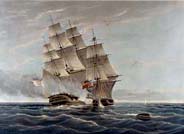
HMS Black Joke firing on a slaver

HMS Black Joke firing on El Almirante after a 31-hour chase. Originally a slaver captured by the Navy, Black Joke was one of the swiftest and most successful ships in the Royal Navy's African squadron which patrolled the seas of West Africa for 59 years. The Royal Navy liberated 150,000 enslaved Africans, and suppressed the international slave trade.

Image: Royal Naval Museum

The Fellowship at Sea

Two brilliant strokes

In 1807, the great fellowship that had come to include almost all of the British people succeeded in ending the slave trade by law. Great Britain then ordered the Royal Navy to abolish the trade in fact. The Navy that Charles Middleton had reformed and rebuilt prepared to sail.

The Navy ended the slave trade operating under the British flag in three years, but other countries moved in to take up the vile trade. The public demanded action, and the British government began a worldwide campaign. With a thousand year history, Britain was untroubled by the idea that the trade would take longer than five or six years to bring to a successful conclusion. Younger nations might throw up their hands after a few years, and withdraw support from their brave soldiers and sailors, but not Britain, not in the 19th century.

The government did two brilliant and surprising things. The Royal Navy had no legal right in peacetime to intercept the ships of any other nation (just as Iran has no right to intercept ships in the 21st century), but piracy put a ship outside the protection of the law. Britain began a full court press to persuade other nations to equate slave trading with piracy. This would allow the ships of any nation to stop and search suspected slave traders. Overcoming considerable resistance, British diplomats negotiated individual treaties with European powers and local African rulers.

The second brilliant stroke was this: In a war, a captain and sailors who captured a privateer would divide the profits. In the case of the sailors and commanders of Africa's 'Preventive Squadron', the British government provided the prize money, rewarding crews for every slave freed and giving a larger tonnage bounty for captured slave ships. In addition, Britain paid heavy ‘subsidies’ to other European countries to induce them to give up or curtail their trade in slaves; paid numerous chiefs on the African coast, and paid for the costs of maintaining a squadron. This was a heavy financial burden that was borne year after year by the British people.

Dangerous work

Royal Navy ships sailed the globe to suppress the slave trade, but their most intense activity centered on a thousand miles of West African coast. There the slavers were sometimes heavily armed, and fast, but the speed and accuracy of British fire, and the practised fighting ability and determination of its crews made steady inroads. Traders waiting for a slave ship to make it through the tightening British gauntlet kept hundreds of slaves shackled in thatched-roof barracoons. The Brits responded by taking the action inland, going up river in pursuit of slavers, burning down barracoons and freeing slaves. This was the

Pinnace on African waters at sunset

A pinnace on the river Niger in Mali, Western Africa.
In the 19th century, embarkation canoes carrying 200 slaves packed in their bottoms and 20 or 30 rowers carried Africans to slave ships waiting offshore.

Image: Elfenpfote@istockphoto

most dangerous work because inland Africa was rife with malaria and yellow fever. In 1829, 204 men died on board HMS Eden from yellow fever. It is not contagious, but it must have seemed to the men that it was. The Royal Naval Museum reports that the surgeon on HMS Sybille, Robert McKinnal, had to take drastic action to convince them that a fellow sailor's yellow fever was not contagious. One of the symptoms of yellow fever is black vomit, and McKinnal, on deck and in sight of the crew, drank off a glassful.

Desperate straits made worse by an attorney

The slaves were usually in desperate straits when they were rescued. Exhausted, starving, suffering from fever, dysentery, diarrhoea or malaria, they had to be cleaned and fed and nursed. The British officers were also negotiating the local treaties with the African chiefs. The Royal Navy Museum says they had "little success with the inland kingdoms such as Dahomey, from which so many of the slaves came, but much more on the coast where the impressive sight of warships had due effect."

In a curious prefiguration of events today, Captain Joseph Denman, a passionate abolitionist, burned down a number of barracoons. The British Attorney General subsequently advised the Foreign Secretary that this might be illegal, and the Spanish slaver immediately sued Denman for unlawful seizure of property. "The impression given in Africa was that Denman had been disowned by his government; and the slave trade at the Gallinas, which had been suspended, revived at once."

Denman fought the case, and drafted Admiralty "Instructions for the Suppression of the Slave Trade" for every officer, including specimen treaty forms for local chiefs, and texts of all the relevant conventions. It was a large book "with useful additions such as a Swahili phrase book for use on the east coast." The case was resolved in Denman's favour, and he is credited with doing more to improve efficiency and end the trade than any other officer.

Blaming those who do good

The slave traders were retreating, but there were still ships engaged in the trade that could not be touched because they flew the flags of nations which had no anti-slavery treaty with Britain. Because these ships could not get through the effective British blockade to pick up the slaves, the Africans were often left to die of starvation on shore.

The reaction in Parliament in the 1840s uncannily prefigured 21st century efforts to make the liberators who free a people from oppression guilty of their suffering. In the 19th century some people felt that those trying to stop the trade were creating the slaves' suffering and that the Royal Navy should withdraw. Significantly, the men who endured the depressing, dangerous work and saw the sufferings of the slaves first-hand did not feel that way. The officers of the African Squadron argued strongly against withdrawal. African suffering only made them more determined to stamp out the trade.

And success, though it could not yet be seen, was very close.

What price success?

By the end of the 1840s success was becoming evident. The squadron had become even more effective, and a network of anti-slavery treaties had been put in place. Britain's greatest diplomatic triumph was the closing of the Brazilian slave markets. An Act that allowed the Royal Navy to seize suspected Brazilian slave ships received unexpected support from the people of Brazil, and the trade "collapsed with astonishing swiftness." It remained to end slavery in America.

In 1860 US President Abraham Lincoln started action against slave ships "built or fitted out in the northern States". In 1862, a treaty between America and Britain gave the British squadron freedom of action for both countries. By 1866 the Royal Navy had hunted the last transatlantic slave ships from the sea.

Tragically, "another slave trade was flourishing." The Royal Navy would continue to fight Arab and African slave traders on the east coast of Africa into the next century. And this, for those interested in such things, is our last modern parallel. It is fine to hope that the justice and compassion we cherish will be realised without force of arms, but what if only force of arms can end centuries of gross abuse?

21st century shambles

Following the Battle of Trafalgar in 1805, Britain was the only nation with the political will, the economic strength, and a Navy strong enough to end the slave trade. Today, the Navy is responsible for rescuing the victims of disaster, deterring piracy, intercepting illegal narcotics, preventing people trafficking, and protecting Britain. Senselessly and tragically the Labour government has slashed the Royal Navy's funding with the expectation that next year the Navy will be reduced to the size of the Belgian Navy. As recent events suggest, the Royal Navy can no longer protect even its own sailors.

Man reading

THE FELLOWSHIP, Part 6
Ending Slavery at Last


When you contribute to this website,
you support Brits at their Best.

Join the Circle of Friends

English bulldog puppy


Copyright 2006, 2007, 2008 David Abbott & Catherine Glass