Brits at their Best Sharing the Inheritance

Faith in Freedom

Abolishing Slavery

3

Woman in nightdress holding her head and a cup of coffee

When the abolition movement faltered in Parliament,
British women and children came to its rescue. They launched
a boycott, refusing to buy or consume sugar.

The Fellowship
Powerful Methods

This section sketches the hopes, tragedies, and achievements of the fellowship in the 1790s, and examines some of their powerful and interesting methods. We think you may be struck by how they differed from the public and non-governmental organizations (NGOs) working today.

In May 1789 Wilberforce had stood up in the House of Commons and to the fury of the plantation owners and their adherents moved twelve resolutions condemning the slave trade. He gave a spellbinding speech based on the research and testimony of Thomas Clarkson and James Ramsay. William Grenville rose to support him, but the anger of the planters and slave traders was scalding. They claimed the British economy would be destroyed if the trade were ended, and attacked Ramsay viciously. Charles Middleton defended him. The slave interests demanded a delay to hear from more witnesses.

Two months later, Ramsay died. He had led the fellowship to base camp, but the strain had been too great, and he did not survive.

That same year, Olaudah Equiano, a former slave who had managed to free himself, made his way to Britain after voyages to the Arctic and Turkey, and wrote his autobiography. This was a marvellous achievement. Equiano's odyssey, available online, bore witness to the cruel injustice of slavery and to the irreducible nobility and astonishing perseverance of the human spirit. Thomas Clarkson met Equiano, and introduced him to the fellowship, who helped him publish his book. His book tour made a deep impression on the public.

Clarkson meanwhile was on horseback again, searching for every last witness willing to testify to Parliament. They were brave sailors and captains and surgeons, often risking their jobs and their personal safety to testify. They remind us of those ‘ordinary’ men and women today, such as Gina Khan, who testify to modern oppression despite threats to their lives.

Meanwhile Wilberforce was meeting with Granville Sharp and the Quakers for strategy sessions, consulting with Pitt and Grenville and Middleton, and questioning the witnesses brought before Parliament. As the evidence grew, he compressed thousands of pages of evidence into a précis. In 1791, he rose to present the evidence to the House, and to call for the end of the slave trade. Opposing him was three-fingered “Bloody” Tarleton.

Team play

The fellowship strikes us as quite different from the NGOs, UN committees, and lobbyists we hear about today for several reasons which you may consider important. First, the fellowship did not consist of inner and outer circles filled with competitors jostling for perks or power or position or money. There were no perks, power, position or money to be obtained. No one was paid. For another, the fellowship had no leader leading the fellowship. They worked as a team.

Rather than becoming an exclusive society, the fellowship kept expanding to include new members who spanned age, sex, race and class. In the 1790s the Middletons were entering their fifties and early sixties, and their daughter was filling Barham Court with grandchildren (there would be eighteen all told). Another member of the fellowship, Beilby Porteus, Bishop of London, who had been born on a plantation in Virginia and educated in Britain, was also an older man. Wilberforce, Pitt, and Pitt’s cousin William Grenville were in their late twenties, just turning thirty. Thomas Clarkson was a year younger.

Equiano and the writer Hannah More were in their mid-forties. We haven't mentioned Hannah before now. She was a friend of David Garrick, Joshua Reynolds, Samuel Johnson, and Edmund Burke, stars of theatre, painting, literature, and political philosophy. After mounting successful plays in London in the 1780s, she withdrew to the country, was a friend to all the members of the fellowship, and wrote poems and pamphlets condemning the slave trade. Original and spirited, she was, like her contemporary John Adams, a lover of the British Constitution. (Like him and unlike so many politicians today, she knew what the British Constitution was and why it was worth defending. If you're interested in reading a little more about the Constitution, you could look at Network of Freedom.)

The fellowship quietly challenged many of the preconceptions of the day. They welcomed a former slave, did not revere the rich, did not give precedence to priests or bishops, and listened seriously to women and younger members. The Middletons were a powerful unseen force contributing to morale. There was another force we’ll speak about later.

Creating and acting on a free consensus

Creating a free consensus (not a consensus obtained by threats, force or money) was at the core of the fellowship’s decision-making. Achieving this kind of consensus requires respecting other people, listening, speaking without attempting to dominate, and finding shared agreement. Consensus was possible and proved effective because the members of the fellowship shared a common understanding of what was right.

The Quakers who were so important to the fellowship were successful in business due to their habit of taking ideas from a variety of sources, building consensus, moving swiftly and efficiently into action, and insisting on accountability. They were also smart enough never to make the process more important than the goal. Pitt, Wilberforce, and Grenville knew how to achieve consensus, and, when necessary, how to go it alone.

Through this process the members of the fellowship “forged virtually every important tool used by citizens’ movements in democratic countries today” – investigative journalism, newsletters, posters, campaign buttons, books, boycotts, petitions, and “report cards” on how representatives voted (Adam Hochschild, Bury the Chains).

They could be described as idealists, but their common sense was never in short supply. They were not ideologues. They were interested in ideas that worked.

Self-interest or lack of it

Charles Middleton’s ruthlessly energetic reform of the Royal Navy had rebuilt ships, improved the chain of command, and taken better care of sailors. Middleton always placed Britain ahead of his own personal interests. However this did not mean he lacked personal interests.

When faced with a new and demanding Navy responsibility, Middleton astringently told his Treasury colleagues that “a sense of duty would not sufficiently compensate him and his colleagues for the burdens they were about to assume; they would require more pay”. At the same time, Middleton was willing to offend anyone and risk any pain and trouble to equip the Navy to defend Britain.

In 1789 Middleton was a Member of Parliament, and supported abolition. He knew very well that most members of Parliament were indifferent or actively hostile to ending the slave trade. (Historians point out that in the 18th century there were few people on earth who did not accept slavery.) That made no difference to Middleton. He did not subject the idea of abolition to a poll or test the waters. Ramsay’s testimony, Lady Middleton’s concern, and his Christian beliefs had decided him, along with the undeniable fact that the slave trade had horrific effects on British sailors as well as on African slaves. Thomas Clarkson’s evidence had made that abundantly clear.

Middleton had faith in Thomas Clarkson’s evidence about the trade for several reasons. For one, Clarkson believed in objective truth. It would never have occurred to him to alter or invent the facts in order to support a “good cause”. He would have rejected “post-normal science,” a popular notion with some environmentalists who assert that their values, not scientific facts, should hold sway.  Once, searching for a sailor whose evidence was considered of the greatest importance but whose name was unknown, “Clarkson boarded all the ships belonging to the navy at Deptford, Woolwich, Chatham, Sheerness, and Portsmouth. He at length discovered the man on board the fifty-seventh vessel which he had searched, in Plymouth harbour” (Oxford DNB).

Clarkson could also be believed because he had no vested interest in opposing slavery. Unlike 21st century NGOs, Clarkson did not receive a salary to work for a cause. He worked night and day gathering evidence while living off his own funds. He impoverished himself. None of the members of the fellowship made money from their work, except possibly Equiano, whose autobiography sold well.

Unlike some charitable patrons, the members of the fellowship did not support abolition because it would make them money or earn them thanks or give them prestige. They gave of their time, energy, and money to end something they understood was horribly wrong.

In sharp contrast with many MPs today, William Wilberforce was indifferent to party pressure, was not angling for a ministerial position, and would not face a loss of livelihood if he were voted out of office. MPs in the 18th century were not paid salaries. There were, however, ways of making money in Parliament. The Crown could give you an office with a handsome salary, usually for favours in return. Wilberforce never attempted to make money at the expense of his nation in this or any other way.

More surprisingly, neither did William Pitt, who had very little money of his own. Pitt had helped to carry his father out of the chamber of the House of Commons when he collapsed after speaking for the last time on April 7, 1778. Like Clarkson, Pitt was trained in Greek and Latin. Classical knowledge was an important component in the education of many remarkable Brits. Pitt also studied history, political philosophy, English literature, chemistry, and mathematics. He took his seat in the House of Commons in 1781 at the age of 21. His first speech was unprepared, but deeply impressed the House due to its logic, maturity, and power.

He was immediately offered lucrative offices in the new government, but poor as he was, he refused them. Instead he advocated reforming Parliament, sweeping out the corrupt constituencies and increasing representation for London and the shires.

Pitt’s principled independence won him a surprising return. After the Prime Minister died, a new government was formed, and in 1782, at the age of 23, he was asked to become Chancellor. The situation in the House was volatile, but he refused to make a deal with those whose principles he opposed in order to acquire power. This is so refreshing a concept we pause to appreciate it.

He maintained his independent stance, and despite the parlous state of his finances continued to decline the rich offices on offer. (Later, when he fell in love, he had made so little while prime minister he was unable to support a wife and marry.) After another political crisis, it seemed obvious to Pitt's friends that his political career had ended. Pitt shrugged, and made plans to resume his impecunious legal career. Less than a year later, a new political crisis caused another reversal. In December 1783, when he was just 24, the King asked him to be prime minister. Aside from Wilberforce, Grenville, and Middleton, Pitt had hardly an ally in the House. Its members thought of him as a talented schoolboy, and greeted him with derisive laughter. But he was a cool strategist, and he toughed them out. When he called a general election he was returned with a large majority. 

Pitt and Parliament faced a host of issues. Despite the modern idea that trade with Europe has only occurred since the establishment of the Common Market in the mid 20th century, Pitt negotiated three thousand trade resolutions. (One lowered the duty on French wines with a resulting copious increase in the French wines drunk in Britain.) Pitt also developed a formula to reduce the national debt; reframed the administration of India in the India Bill; responded to Spain’s attack on Vancouver Island; reduced some taxes and increased others on the principle that all classes should contribute to revenue without pressing unfairly on any; and created a government for Canada. Meanwhile he was under constant fire by the opposition, and was blindsided whenever the King descended into madness. He made time for abolition, however. His support for the cause came from his heart (DNB).

Bills and boycotts

In February 1791 Clarkson and Wilberforce began presenting new witnesses and evidence to the select parliamentary committee, which had resumed its deliberations. That same month, old John Wesley lay dying. From the time he was rescued from a burning rectory when he was six, Wesley had felt close to God. He believed that prayer, communion, and meditation on scriptures brought men and women closer to the love of God so they could become God’s hands and do good. He wrote his last letter to Wilberforce. He begged him to stay true to the cause of abolition no matter how long it took him.

On April 18, Wilberforce spoke to the House for four hours, and moved for leave to bring an Abolition Bill. He was eloquent, and a complete master of all the evidence. The debate was fierce. When the house divided at 3.30 am on the morning of 20 April the motion was defeated by 163 votes to 88.

The members of the fellowship were so disappointed they found it difficult to speak. But their fierce determination to see abolition through prevailed.

And now a strange and wonderful thing happened. The newspaper accounts of parliamentary debates had inspired the country. “At a time when only a small fraction of the population could vote, citizens took upon themselves the power to act when Parliament had not” (Bury the Chains) They began to boycott sugar. They refused to buy it, to put it in tea or coffee or hot chocolate, pies or desserts. Women, mainly responsible for buying and cooking food, put the boycott into effect. Sales of sugar dropped by a third and then by half.

Women working in sugar cane fields in the West Indies

The boycott against sugar struck not only at the slave trade but at
slavery itself. Brits connected the sugar in their coffee and tea
with the misery of slaves.

Clarkson back on the road

Clarkson went back on the road. The Quakers on his London committee had urged him to create an Abstract of the evidence delivered before the select committee of the House of Commons. He condensed more than 600 pages to a less than 150 and travelled 6,000 miles delivering the Abstract, “moving upwards and downwards in parallel lines” through all of England and Wales. The Abstract was filled with horrific details about slavery written with almost unbearable clarity. It became a potent force in the abolition campaign.

John Kimber, a slave-ship captain named in the Commons as having flogged a slave girl to death had been arrested and tried for murder, but was acquitted due to poorly presented prosecution evidence. Kimber began menacing Wilberforce with physical violence. Wilberforce was not a big man, but he had courage. Despite his charm, he had no interest in pleasing everyone. He stood up to Kimber, and all the supporters of slavery, and on April 2, 1792, moved for abolition of the slave trade in the House.

"Bloody" Tarleton, who had lost part of his hand in battle, and used to wave it for effect, defended the slave interests with some of the brutal insolence he had displayed against civilian populations in America. The ensuing all-night debate was fierce, and drew Pitt’s fiery support. He cried, “I hope we shall hear no more of the moral impossibility of civilising the Africans”, but rather make “an atonement for our long and cruel injustices”.

When the bill seemed lost, Henry Dundas, the Home Secretary, decisively intervened by proposing the compromise of gradual abolition. His proposal passed by 230 votes to 85. There are different interpretations of the word gradual, but in the event no translation was needed because the House of Lords rejected the bill.

Four days later, on April 7, Equiano and Susanna Cullen, an Englishwoman who lived in Soham, Cambridgeshire, were married. They began a happy marriage, and had two daughters together. That same year, 1792, Margaret, Lady Middleton, died. Clarkson, still travelling the country, was approaching collapse.

Entering the hurricane

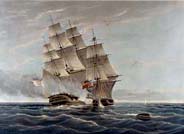
Meanwhile Britain was sailing into a political hurricane. France’s revolution had become a Reign of Terror, and in 1793 France declared war on Britain. At the age of 67, Charles Middleton, left semi-retirement to defend his country.

African family

Abolishing Slavery
THE FELLOWSHIP, Part 4
Creating a new world


When you contribute to this website,
you support Brits at their Best.

Join the Circle of Friends

English bulldog puppy


Copyright 2006, 2007, 2008 David Abbott & Catherine Glass