Blog Home | All Posts | Liberty Timeline | Faith in Freedom | Heroes | Science Timeline | Artists | Life | Sports | Calendar | Brits Worldwide | Imagine
|
|
Blog Home | All Posts | Liberty Timeline | Faith in Freedom | Heroes | Science Timeline | Artists | Life | Sports | Calendar | Brits Worldwide | Imagine |
 CAROLINE COX
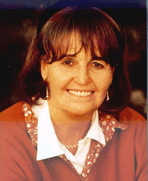
Baroness Cox ("please call me Caroline") has been NEVER ALONE Baroness Cox of Queensbury, has often done what was not expected. Her father, Robert John McNeill Love, a London surgeon and the coauthor of the classical medical reference, A Short Practice of Surgery, expected Caroline would take a place in university. Instead she chose to go to nursing school. After qualifying, Caroline began her professional life as a nurse. Working the midnight shift in a London hospital in the summer, she met Murray, a young intern, and slipped away with him during their breaks to meet outside in a rhubarb patch, and talk. Caroline and Murray Cox married, and had two sons and a daughter. Her life was busy and full. Then she was diagnosed with tuberculosis, and forced to rest in bed. Meditating on her life, she began to have fresh ideas. Caroline decided to get a sociology degree. Studying at night so she can take care of her children by day, she graduated with First class honours in sociology from London University, and with a Masters Degree in Economics from the University of Newcastle-upon-Tyne. She went into academia to teach, and hit a ghostly brick wall. Hitting a ghostly brick wall The powers that be expected her to adopt the latest politically fashionable thought – to become one of the intellectual elites who trashed democracy while talking up Marxist-Leninism at public expense. The walls were all around her, though sometimes evident only in a gesture, a laugh, a rejected funding grant. Appalled at the economic theories being forced on her students, Caroline attacked the citadel, battling for freedom of speech and inquiry. 'Examine all things. Hold fast to what is good' was her motto. The hatred and anger from Marxists was immediate and palpable. The rape of reason She experienced almost nine years of relentless intimidation by tyrannical university academics and administrators. But she surprised her tormentors. She co-authored The Rape of Reason, describing their tactics in brilliant detail. Her book had the unexpected effect of light in darkness, in so far as political thinking in Britain was concerned. In the late 1970s Caroline became Director of the Nursing Education Research Unit at Chelsea College of the University of London, and an Honorary Fellow of the Royal College of Surgeons. In 1982, Prime Minister Margaret Thatcher recalled The Rape of Reason, recognized a woman of indomitable spirit, saw the fine teaching work which Caroline had done, and recommended that she be made a working peer. Baroness Cox of Queensbury To her surprise, Caroline was made Baroness Cox of Queensbury, and entered the House of Lords. Here it was expected that she would sit on the red leather pews under the high arched windows in the panelled and gilded chamber, listening respectfully to her colleagues and asking an intelligent question or two. Instead, almost immediately she set off in a 32-ton truck for Communist Poland, Romania, and the Soviet Union, to bring medical supplies behind the Iron Curtain. Behind the Iron Curtain with dissidents and children She had also packed blank computer paper, infuriating her driver when he discovered it. He asked her if she realized they could be imprisoned if the paper were found. “In a totalitarian state, blank paper is dangerous,” he shouted. “You can write ideas on it.” Caroline saw his point, and looked for another way to spread freedom. Risking imprisonment, she met with members of the Polish Solidarity movement, and carried their ideas and hopes with her, in her head. Then she used her newly gained fame as a member of the House of Lords to speak publicly about the Polish people's struggle for liberty. With her husband's unqualified support, Caroline defied fashionable pieties about communism, and called openly for Soviet regime change from the House of Lords at the height of the Cold War. Her daring work would eventually earn her Poland's highest award for a foreigner, the Commander Cross of the Order of Merit. Visiting the Soviet Union, Caroline met small, intelligent children who were being warehoused as mentally handicapped because they were orphans. Returning to Britain she wrote and published the report, "Trajectories of Despair". As the Soviet Union crumbled, Russian medical and social service officials, at last able to speak freely, welcomed her ideas, and began acting on them. With her help, they reformed the system of child care, and established family-style foster care and adoption. Walking into darkness In retrospect these trips behind the Iron Curtain into Eastern Europe will seem comparatively easy compared to her subsequent missions. Caroline believed that she must use the gift of freedom on behalf of those who had been deprived of liberty. She aimed to learn the truth, to speak it, and to help the most vulnerable men, women, and children on earth. But to do this she had to walk into darkness. In an interview she remarked that she did not feel the darkness of fear in the unhappy countries she visited, where she was in danger of being blown to bits. Rather, it was in the relative serenity of Britain, before she left on her next trip, that she entered the darkness of her fears. As she admits to Benedict Rogers of CRISIS, “Home is very comfortable, with clean water, electric light, warmth, clean clothes. To wrench yourself away and go voluntarily into a conflict zone, you recoil against it." She was afraid she would be violently killed. It was during those dark moments of fear that she recalled words she had learned as a child, and was encouraged:Have I not commanded thee? Be strong and of a good courage; be not afraid, neither be thou dismayed: for the Lord thy God is with thee whithersoever thou goest (Joshua 1:9). Her husband Murray had became a senior psychiatrist at the hospital for the criminally insane, Broadmoor. He was developing theatre and music therapy for his patients. (One of his many books is Shakespeare Comes to Broadmoor.) Murray was concerned about her safety, but supported her all the way: "Only where there is great danger can there flourish that which saves," he promised her. There was plenty of danger. She travelled to Armenia, an ancient land of mountains, forests, and fertile valleys, ancient churches and monasteries whose people welcomed Christ's apostles, Thaddaeus and Bartholomew, in the 1st century AD. Despite assaults by the Persian, Byzantine, and Ottoman Empires, Turkey, and the Soviet Union, Armenians maintained their integrity as one people over two thousand years. Bounded on the east by Azerbaijan and on the west by Turkey and Iran, they survived the implosion of the Soviet empire to become an independent, pro-democratic, free-market nation, which extended traditional hospitality to their visitors. Nagorno Karabakh is a part of Armenia that was cruelly and malevolently cut off from the Armenian homeland by the mass murderer Stalin when he controlled the Soviet Union. The Armenians in the enclave of Nagorno Karabakh were surrounded. They were being relentlessly attacked in their villages by violent Islamists from Azerbaijan, and no one in the world seemed to care. Little girls were cut in half, and left hanging on trees. Young men were beheaded. Homes were burned down. Caroline flew into Nagorno Karabakh at the height of the conflict. Her helicopter was shot, and crippled. She had a desperate, "sacramental moment", suspended between life and death as the pilot fought to bring his crew, passenger, and supplies down safely. He managed to make a soft landing in snow. Caroline went on to complete her mission. She made fifty-eight journeys to Armenia to bring medical supplies, to learn the truth, and to alert the world. Meeting the Armenians who had experienced unspeakable acts of violence, she was inspired by their "dignity, courage, and faith" and by their willingness to forgive. By her 60th trip, the violence had ended. Much work remained to be done, but there was hope that reconciliation was underway. Ruthless persecutions Along with the rise of violent Islamists, the most under-reported story of the 1990s and the 21st century was the ruthless persecutions of Christians around the world. Christians in China, many of them advocates for freedom and democracy, were being killed, imprisoned, and tortured; in Saudi Arabia, where it is illegal to be Christian, thousands of Christians have been jailed; Christians have been discriminated against, kidnapped, and killed in Egypt, Morocco, Iran, Uzbekistan, Pakistan, North Korea, Cuba, Laos, Vietnam and Nigeria. In the Sudan, the Islamic government has murdered hundreds of thousands of Christians. Ducking bullets, Caroline subsisted on military rations (she liked the inexpensive, vacuum-packed MREs from the States with their miniature bottles of Tabasco sauce), and slept in tents as she travelled through jungles, over unbridged rivers, across mountains, and into the desert. She was serving as a nurse and witness - a voice for embattled peoples in Burma, Indonesia, Nigeria, and the Sudan who had no voice, and who were being raped, enslaved and murdered. Finding the truth in Darfur What she tried to learn was the truth on the ground: to take no man's word for it but to find the facts herself. She travelled secretly to a country off-limits to foreigners and aid organisations. The racist Islamist Sudanese government had given China unfettered access to their oil in exchange for money and weapons. The government bought bombers, assault helicopters, and armoured vehicles. They funded the brutal Janjaweed militia to kill civilians who were not Arab, to rape women, and steal land, goods, and herds of livestock. Caroline reached Bahr-el-Gazal with a cameraman, and found that just days before the National Islamic Front had swept through, slaughtering unarmed men and enslaving women and children. “Bodies were piled high, rotting. We went to an area of sheer carnage – human bodies, cattle corpses, burned homes, scorched-earth policy.” They found a Christian catechist wandering in the desolation. He had seen his church attacked, his brother and brother-in-law killed and his sister captured as a slave. Standing in the dust of his destroyed farm, he described the men paid by the Sudanese Government to kill his people. Then he hesitated, trying to explain the worst thing: “We feel completely on our own. You are the only Christians who have even visited us for years." Then he asked, “Doesn't the Church want us anymore?” Caroline and the seasoned television journalist with her were devastated. “He sat by the river and wept, and I sat under a tree and wept." They brought news of the carnage to the West. The world called this the Darfur genocide. Over 2 million civilians have been displaced. The death toll is estimated at 400,000 killed. For illegally entering Sudan, Caroline was sentenced in absentia by the National Islamic Front. Despite her efforts and the condemnation of the world, the Islamic government of Sudan continued to murder defenceless civilians, and the UN was seemingly incapable of stopping them. Caroline carried the shining courage of Sudanese Christians before her as she made repeated, dangerous trips back to the Sudan. She was criticized for purchasing the freedom of some Dinka and Nuer people who had been enslaved. Apparently it is easier to lambaste the person who tries desperately to help free a slave, rather than to condemn the slavers. It is worth recalling that when Muslim pirates enslaved an estimated 1.5 million European Christians between the 16th and 18th centuries, Cervantes was one of those ransomed after being enslaved for five years. Caroline also was attacked for her straight talk about violent Islamists, who have brought suffering to many parts of the world. In 2003, with physicist and educator Dr. John Marks, she wrote a book called The ‘West’, Islam and Islamism. Is ideological Islam compatible with liberal democracy? Caroline and Marks challenged the free world, including moderate Muslims, to take the threats from violent Islamists seriously, and respond. Her concern that Britain would experience the horror she had seen elsewhere proved prophetic in July 2005 when violent Islamists bombed London transport, injured hundreds of Londoners and killed seventy. Recreating a vision Caroline created another sensation when she helped to publicize a book by a Nigerian missionary who wrote that Britain's moral strength was disintegrating. Caroline agreed. She said, "There is an urgent need to recreate a vision, which will preserve all that is best in our spiritual heritage." With the rise of Islamic extremism, Caroline saw not only Christians but moderate Muslims under attack. In Indonesia, Muslim leaders who signed peace agreements with Christians have had their homes bombed. Saying "we must offer a real hand of friendship to the moderate Muslims who wish to promote reconciliation and reconstruction,” Caroline helped to found the International Islamic Christian Organization for Reconciliation and Reconstruction (IICORR) with former Indonesian President Wahid as its honorary president. Caroline mobilized resources to help reconciliation and reconstruction, pointing out that "the two have to go hand in hand. You can’t have reconstruction before reconciliation because everything that has been invested may be destroyed again. But reconciliation without reconstruction could be empty words to people who have lost homes, schools, jobs, so you need to bring hope back to shattered communities.” It is doubtful that anyone except possibly Margaret Thatcher expected Caroline to work as hard as she has. Baroness Cox has served as founder Chancellor of Bournemouth University; trustee of the Andrei Sakharov Foundation, the Siberian Medical University, and MERLIN (Medical Emergency Relief International); founder and Chief Executive of HART (Humanitarian Aid Relief Trust), which helps oppressed peoples ignored by the international media; Council member of the Freedom Association; deputy speaker of the House of Lords; an active member of the World Committee on Disability; a judge for the Franklin Delano Roosevelt International Disability Award; and president of Christian Solidarity, United Kingdom. In tribute to her service, Caroline has received the Wilberforce Award, which recognizes “an individual who has made a difference in the face of formidable societal problems and injustices”. She has received honorary doctorates from universities in the United Kingdom, America, the Russian Federation, and Armenia. These honours and recognitions are almost beside the point. Now a grandmother, Caroline says simply, “I always come back having received more than I have ever been able to give.”
Biographical details on Baroness Cox provided by, among others: Crisis Magazine, "The Unconventional Baroness", Benedict Rogers
When you contribute to this website,
|
Abolishing Slavery
Love of freedom inspires
Andrew Boyd describes For UK orders:
For US orders:
“Christian theology is not my specialization. I only know all prisoners for freedom are intertwined in their chains.”
For British orders
For American orders
Muslim fundamentalists present a challenge to the values of Western democracies. It is the intention of the authors that through this book non-Muslims may develop better relationships with moderate, peaceable Muslims. For British orders
For American orders
NO WONDER THEY'RE GREAT IF THEIR WOMEN ARE LIKE THAT |
This wonderful book describes Britain's gifts to the world. Adults will refresh their understanding of profound events in British history, and young people will find inspiration. Warning: This book defies aggressive secularism and unthinking multiculturalism. Written by the co-editors of this website, Share the Inheritance is beautifully illustrated with 125 colour images and a timeline. Available at Amazon UK and at Amazon USA.
|
 |
||