BRITISH HISTORY

THE STORY of
FREEDOM

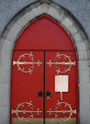
Magna Carta posted on red church doorsGirl rejoicing on beach

LIBERTY! THE TIMELINE


Black and white hands clasped

Four great themes emerge as the Brits fight for freedom.
THE FREEDOM NETWORK


Boy holding out arms on beach

BRITS WHO LOVE
FREEDOM

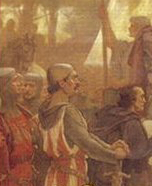
Knights and monk

THE KNIGHTS

Never a dull moment on the road to Runnymede

Parts 5 - 6

Part 7

Part 8


Part 1, With a Horse

Part 2, Tournaments, Chivalry, Assassinations

Part 3, Fighting to Hold the Centre

Part 4, The Anti-Knight


The Servant King promised in his Coronation Oath to defend his people’s liberty and give them mercy and justice. John plundered his people.

Coronation Throne

THE SERVANT KING AND WHY HE (OR SHE) MATTERS TODAY


Images:

The Knight, from A Short History of the English People by John Richard Green, MS. Roy 2 A. xxii
Late Thirteenth Century

Patrick Agin of Rhode Island, dressed in chainmail. Agin, who enjoys medieval reenactments, was told by his high school that he could not use this photo in the school yearbook. His family is suing for loss of freedom of speech.

Tapestry (portion) of the Holy Grail by Edward Brune-Jones

Two knights in combat, illustration by Howard Pyle

The Coronation Chair in Westminster Abbey


Heroes

Three knights on horseback

THE KNIGHTS

Never a dull moment on the road to Runnymede

The story of The Knights provides intriguing modern insights to those who want to keep the torch of liberty burning.
With enormous physical energy and pragmatism, chivalric and mystical Christian ideals and English traditions, the knights of Britain established and implemented one of the great breakthroughs for freedom on earth.
We follow England's knight, William Marshal, the Lord's Knight, Stephen Langton, and the anti-knight, King John, on the road to Magna Carta, and we start on horseback.

With a Horse
Part 1

One cool, misty morning, I rode through a forest. I had borrowed a horse, and we jiggled over the roots of trees on the narrow forest path. In the saddle I had a higher view than usual, and different sensations. I felt the ground through my horse's body and the warmth and strength of his body with my legs. I was attentive to the forest and to him. He spent most of his life outdoors in the fields, so he did not have the nervousness of horses who stand all day confined to a stall. He seemed happy to be with me. His name was Lancelot.

Sunlight began to stream through the mist and the trees. The country seemed more alive when seen with a horse. We left the woods and started up a steep hill, cantering. When we reached a meadow high above the river, where the grass was green and long, we began galloping toward a low rail fence. Lancelot took the fence with an easy exhilarating jump, and we sailed over. As we entered the woods on the other side, I laughed out loud with joy.

Swinging off him two hours later, pulling up the stirrups and loosening his girth, I walked with him back to the yard. I was tired. The muscles of my thighs ached. Once seated so high, I now stood with my head below his. While he drank and ate, I brushed him down and picked his feet clean, a servant to him who had been my servant. In 13th century England these would have been the tasks of a squire, not a knight; but almost every knight began as a squire and it is worth remembering that in Old English the word knight originally meant servant.

I give you my impressions of riding, which many of you will know far better than I, because I think that the experience of riding gave Brits a feeling of mobility and freedom that spurred their love of liberty. Why this should be we are not exactly sure. Britain had good country for raising and riding horses, and most Brits treated their horses the way they treated their dogs, as beloved companions. King John affirmed Magna Carta, the foundation of freedom in Britain and America, in the presence of a host of knights and bishops on horseback in a meadow. When, just a few months later, he threw off his mask of compliance, the knight-barons would be on horseback again, fighting to defend it.

In Magna Carta, King John addresses his most important bishops and barons by name, and the very first baron he names is William Marshal. Like all the barons and the king himself, William Marshal was also a knight. His turbulent career illuminates King John and Magna Carta, but it also sheds light on many things we care about, such as how a boy becomes a man; the importance of spiritual quest; physical fitness; entrepreneurship; and the balance between self-interest and the risks necessary to establish and defend liberty and justice.

William Marshal first met a king of England when he was a small boy of five or six and the king's hostage.

Boy in chainmail with sword

Tournaments, chivalry and assassinations Part 2

His father, John Marshal, had sent him to Stephen, King of England, as a hostage in 1152 because the king was besieging his castle, and Marshal needed a truce. Reckless of his little son, he used the truce to re-arm. The king warned him that his son would die, but the elder Marshal’s notorious answer was that he didn’t care about his son since he “still had the anvils and hammers to produce finer ones”. Unfortunately John Marshal never learned that he would never have a finer son than William.

What the child felt we do not know. He survived partly because Stephen could not bear to kill him, partly because it would not have been politic to do so. After he was freed, when he was about nine, William's mother sent him to be fostered with her cousin, the chamberlain of Normandy.

Becoming a squire

There William learned to wrestle and ride and to fight with a spear and a sword on foot and on horseback. It is uncertain whether he learned to read. He was a big teenager so he ate when he wasn't sleeping and slept when he wasn't eating. Some squires might have learned about law or managing an estate since knights were landowners and frequently held local courts. It is not evident that William did.

At the age of fifteen or sixteen, he became a squire in service to a knight. His duties included dressing the knight in the morning, serving all of the knight’s meals; cleaning his armour and weapons; caring for his horse; and and accompanying his knight into the field of battle.

At this time armour included a helmet and a coat of chainmail with a slit in back and front for riding and a hood that could be pushed back onto the shoulders. Chainmail was created with an exacting, fiery skill that produced links that rarely varied by more than twelve-thousandths of one inch. The outer rings were rough, but the inner rings, which rested against a leather undercoat, were "smooth as cloth". A chainmail coat was something of a luxury, and this was a problem for William, who was poor.

Becoming a knight

His father died in 1166, when William was twenty. Soon after he was made a knight in a public ceremony. He had fasted and prayed the night before in a chapel, and his sword lay on the altar all night as he prayed. The symbolism was deliberate. In the morning he bathed and dressed and confessed, and after his night meditation and his bath, he came before his lord dressed in only a tunic with his sword strung from a loop around his neck.

William told his lord why he wished to be a knight and he promised to follow the Code of Chivalry, which had evolved out of Christ's teachings.

Having sworn to be a chivalrous knight, William knelt. His lord tapped him on each shoulder with a sword, or, as often happened at that time, hit him with a sword, knocking him over in a reminder to be humble. Then everyone enjoyed a huge feast with music and dancing.

Code of Chivalry and Geneva Conventions

Knights and foot-soldiers died in battles and castle sieges, and disease took a toll, but the ideals of chivalry remained vivid and current. Chivalric ideals prefigured the Geneva Conventions.

The Code of Chivalry called on the knight to

Defend the weak and to be courteous to all women, as Christ had been.

Give mercy to a vanquished enemy. If he captured a knight he would treat him with respect as a guest until his ransom was paid; if the captive knight was wounded, he was expected to care for his injuries.

Serve Christ.

Keep your word.

The parallels with the Geneva Conventions are striking. The Geneva Conventions call for "the Amelioration of the Condition of the Wounded and Sick in Armed Forces in the Field”; the humane "Treatment of Prisoners of War”; and "the Protection of Civilian Persons in Time of War". These are a fair translation of the knights' code, which also included loyalty to one's lord and serving God at all times.

The code prohibited “unchivalrous” assassinations and “uncourtly” treatment of prisoners because if such events became common, society would descend into chaos. Everyone would abuse everyone else in a desperate effort to protect or advance their own interests, and in the confusion and unpredictable violence, no one would be safe and no one would prosper. You can have little doubt that this unhappy syndrome remains common in the world today.

Chivalry was not only an ideal. It was the practical philosophy of the knights who asserted the right to justice in Magna Carta. Trust is a hallmark of a successful society, and there was a general feeling that those who abused the code of chivalry deserved punishment in order that everyone else would have the confidence to trust each other and cooperate. Though it has been largely forgotten by historians, lack of chivalry would be one of the more severe charges against King John.

Lancelot bending over the Lady of Shallott

Lancelot by Dante Gabriel Rossetti

The Code of Chivalry, which incorporated the Christian principle that we should treat others as we wish to be treated, was a rare and remarkable code of conduct for any century, including the 21st. That it was not always followed does not diminish it. This supremely idealistic and practical rule became something beautiful and inspiring when honoured during the difficulties and dangers of 12th and 13th century life.

Penniless

Unlike his elder brothers, William Marshal received no land or money when his father died. He had nothing to support himself with except his body and his skill with a sword, but as a brief frontier war flared (between France and Normandy), he “found himself in the rare position. . .of commencing his career in a pitched battle” (Oxford DNB).

“Get back, William, don't be such a hothead, let the knights through!” his master shouted, as he proceeded to distinguish himself in the skirmish. Unfortunately he lost his horse in the cut and thrust of a street fight in the suburbs of Neufchâtel, and failed to take advantage of the opportunity to seize the ransoms that would have retrieved the situation. This was ironically pointed out to him by the earl of Essex, who, at the victory banquet, asked him loudly for various items of saddlery and harness, which he could not produce — but of which he could have had his pick, had he fought professionally, rather than boyishly, in the manner of a knight of the romance” (DNB).

The tournament circuit

William was now in the unfortunate situation of having to sell his clothes in order to buy a horse. However, he rode off with his lance to a jousting tournament, determined to make some money, very much as a golf professional today might head off with his clubs to play a tournament in hopes of winning a purse.

As you know, tournaments were mock battles, fought before an audience of knights and ladies. The knight fought both as a single champion and on a team, and was expected to follow the rules and to act chivalrously. To make sure knights did so, umpires watched for dishonest play. It was rather like a modern sporting event, but with the participants weighed down by 40 to 60 pounds of chainmail, a large oblong shield, a lance and a heavy sword.

The tournament began with individual jousting followed by the charge of two lines of knights who at the sound of a bugle would gallop toward each other with levelled lances. Those who were not unhorsed would fight each other and take ransoms over a field of several square miles. William was terrific, and “threw himself into the tournament circuit for over a year”.

With the money he made unhorsing knights he took service with his mother’s brother, Earl Patrick of Salisbury, but this assignment ended dramatically and unexpectedly. In 1168 the Earl was assassinated near Poitou. William, who was with him, was trapped against a hedge, wounded in the thigh by a slash from behind, and captured. His "uncourtly captors” had no interest in chivalry. They neglected his wound, and half-starved him.

Tutor-in-arms

Eleanor of Aquitaine, Henry II’s Queen, ransomed William from captivity, and took him into her retinue. She was a fascinating woman. The mother of ten children, two by the French king and eight by Henry, she was also politically astute, powerful, and the patron of poets and troubadors. Their songs of courtly (and unrequited) love seem to have made little impression on William, but Eleanor's next move did.

Recognizing William's skill with the sword, she sent him to England in 1170, when he was twenty-four, to serve her eldest son, young Henry, as tutor-in-arms. It is possible she already had treacherous plans in mind, but possibly not. She was an enigmatic woman, and not easy to read.

That same year Henry II crowned young Henry a king. The older Henry apparently wanted to make sure that his son would succeed to the crown after he died, but it was a 'paper crown', since no real power or land went with it, a fact which frustrated the Young King.

Several years later, Henry II gave lands that the Young King considered to be his to his younger brother John since Henry II wanted his young son to have something he could call his own. Henry II's contributions to justice in English courts were significant, but he was an unjust and exasperating father.

In 1174, when he was 19, the Young King raised a rebellion. His mother Eleanor supported him, perhaps because she loved her son more than her husband. When the revolt fizzled, young Henry fled his father's court. William Marshal, his faithful companion-at-arms, went with him.

In the whirlwind years that followed, the tall, blond, extravagantly generous and inconsistent young Henry reconciled with his father, only to subsequently quarrel with him and his brother Richard and attack them. By then he had fallen out with William Marshal, too, and had dismissed him. In 1183, young Henry fell ill with dysentery. He begged his father to forgive him, and pleaded with him to visit, but Henry II, suspecting a trap, did not come.

At the bedside of the dying Young King

William Marshal did, however. He was called by messenger to the dying Henry, and he went. He arrived just in time. Young Henry asked him to take his cloak on pilgrimage to Jerusalem, and Marshal said he would.

After extricating himself from the Young King's mercenaries, who had seized him as security for their unpaid wages, William Marshal set out on pilgrimage with Henry's cloak. He was gone for two years. In the kingdom of Jerusalem he met the Knights Templar and fought with them to defend Jerusalem from Muslim attacks.

In 1186 he returned to Normandy, and entered Henry II’s household. Marshal by name, he became the King's Marshal by title.

William Marshal with shield and sword in chainmail

Drawing of William Marshal

Right-hand man

It was a demanding and dangerous position. In 1189 Henry II was attacked by Philip of France and his own sons, Richard and John. On 12 June, William Marshal commanded the party that acted as Henry's rearguard, protecting the king's flight from Le Mans. “In the course of the action Marshal encountered Richard. . .who was leading the pursuit. Richard was alone and unsupported, having ridden lightly armed ahead of his troops. He is said to have begged the Marshal to spare him, as to kill him would be dishonourable. The Marshal shouted, ‘Indeed I won't, let the Devil kill you, I shall not be the one to do it’, and shifted his lance to kill Richard's horse beneath him” (DNB).

This is an unpleasant episode for those who love horses, but it was the right decision. Marshal rode off to defend his king, leaving Richard stranded. Within the month Henry II was dead, and Richard, recognising the precious quality of loyalty when he saw it, asked William to be his right-hand man.

William Marshal was now 42. In 1189 he finally married. His wife Isabel was the eighteen-year old daughter of Richard de Clare (Strongbow) and his wife, Eva, daughter of Diarmait Mac Murchadha, king of Leinster. William became the loving father of five sons and five daughters, and, in a fairytale-like twist, inherited his father's title and all his lands when his elder brother died.

King Richard departed England in July, 1190, to win Jerusalem back from Muslims who had refused to allow Christian pilgrims to enter the holy city. He left William Marshal to guard his throne and his mother Eleanor and justiciars to run his country. His faith in their abilities was amply rewarded. In a story much loved by Robin Hood fans, Richard's younger brother, Count John, tried to seize Richard's throne. William Marshal and Queen Eleanor fought successfully to defeat John's rebellion.

13th century map of England, Scotland, Ireland, and France

The English Angevin kings (the Plantagenets) held land in France, and were constantly dashing back and forth across the Channel to defend their possessionss. Their territories are coloured orange.

Map: A Short History of the English People by John Richard Green

Fighting to hold the centre
Part 3

Richard the Lionheart ruled a kingdom that included rebellious duchies in France and hostile neighbours. Before he left England on Crusade in December, 1189, he restored estates to men whom his father Henry II had disinherited; appointed new justiciars who would serve him under the watchful eyes of William Marshal; named new sheriffs; confirmed old grants and made new ones. Those who kept their lands or received new offices paid "fines" (fees) for them. This was standard practice for a new king, but Richard's pace in reorganizing his government was breathtaking.

The usefulness of a powerful executive

Richard intuitively recognized that without the central force of a king, lesser powers would battle for primacy and destroy the kingdom. William Marshal, who was bound by his oath to support the King, understood this too. Not everyone did.

The idea of a strong executive will prove crucial in the development of the British and American constitutions. In Britain power will be divided between the sovereign who was executive, Parliament which was legislative, and the courts. The king will be accountable for protecting his people from attack and making sure they received justice in the courts. Running with this idea, Americans will create a strong executive to curb the legislative and judicial branches of government, which, in turn, will be powerful enough to curb the power of the executive.

In addition to grasping the concept of a stable, accountable executive power, King Richard was well aware of his image. The Oxford DNB reports that he consciously associated himself with the world of romance, carrying a sword that was supposedly King Arthur’s Excalibur. But Richard was also businesslike. When he required additional transport on his way to the Holy Land, he didn’t hesitate to trade Arthur's mythical sword for nineteen ships.

On crusade

It is sometimes forgotten that almost a hundred years earlier, in July 1099, Jerusalem had been attacked and stormed, and the entire population murdered over three days. The attackers were Muslims. Seventy thousand Christians and Jews died at their hands. Since that time it had been difficult for Christians to visit the Holy Land. Richard aimed to change that.

Richard conducted a brilliant military campaign in the Holy Land, and defeated the forces of Saladin, the Sultan of Egypt. But he could not persuade the European nobles leading troops with him that the key to freeing Jerusalem was Egypt, the source of Saladin's power.

As we observed, the code of chivalry called for the humane treatment of women and knightly prisoners. The principle worked when captured knights acted according to the code and abided by their word of honour not to return to the fray and resume fighting. (If they did, the law of tit for tat would rapidly operate and they would learn what it meant to break their word.) It did not work if it was impossible to depend on a man's word.

At the siege of Acre, Crusaders captured 3,000 Muslims in battle, but Saladin reneged on his promise to ransom them. The Crusaders were aware that Saladin had beheaded more than a thousand captured Crusaders in previous encounters. They faced the fact that if they released the foreign soldiers, it was likely they would have to fight them over again. A more immediate problem was that their food supplies were low, and they were facing starvation. As a result, the Crusaders killed the prisoners. It was not an act that reflected well on chivalry.

However, “Considered as an administrative, political, and military exercise,” writes the DNB, Richard’s crusade was “an astonishing success”. He retook the coast from Tyre to Jaffa so it was once again in Christian hands, and Christian pilgrims were allowed access to Jerusalem. Richard was successful because he never asked more of his men than he asked of himself. In a striking modern parallel to the soldiers in British and American armies, he refused to leave men behind on the battlefield. When, against advice, he went to the rescue of a foraging party in difficulties, he said, “I sent those men there. If they die without me, may I never again be called a king” (DNB).

Murder and manslaughter

Today many people abhor Richard’s feeling that he was called by religious obligation to rescue the Holy Land. They consider any fighting or killing done by any Christian to be wrong and to directly contradict Christ’s injunction to “love your enemies”.

Christians are called to try to love even those who hate them. If necessary most Christians would kill a person to stop him from killing a child. “Turning one’s cheek” to receive a second smack is different from not defending another person or dying without defending ourselves. The Commandment that Christ quoted does not say, “Do not kill”. It says, “Do not murder”.

The sanctity of self-defence is firmly embedded in the Anglosphere's justice system. British and American law recognize we have the right to defend ourselves, and until very recently both societies understood that the possibility of self-defence helps to check evil which, if it finds no opposition, attempts to overmaster us all.

Whether the Crusaders should have tried to protect Christians trying to visit Jerusalem, we leave to you to decide.

Spirit Quest

The knights did not always act in self-defence, but they avoided killing when they could since it was neither chivalrous nor practical. They saw life as precious and infinitely important, and as part of eternity. They understood there was a difference between saving their lives and losing their souls. This may strike some as absurd, but it was also imaginative, and gives to life a richness that more materialistic ideas lack.

Knight in search of Holy Grail

Holy Grail Tapestry (portion) by Edward Burne-Jones
Collection of the Birmingham Museum & Art Gallery

Literature reflects the interests of people, and in the 1190s, the decade of Richard’s reign, Robert de Boron’s legend of the Holy Grail appeared, and caught the imagination of knights. Shining, mysterious, and absent, the Holy Grail was the Chalice that Christ had used at the Last Supper. It symbolized the radiant and divine presence that seems to lie just beyond reach.

The quest for the Grail gave knights what we ourselves desire – a sense of spiritual adventure, purpose and grace in the midst of the mundane and the dangerous. Success on the quest required that a knight take responsibility for his actions, and live up to the ideal of justice and chivalry. The ideal of the knightly quest shines like a star in contemporary accounts of Magna Carta, but it has been lost to view.

Entrepreneur

However, a glance at William Marshal’s life in the 1190s suggests less the knight on a quest and more the entrepreneur, albeit one with a sword. Like entrepreneurs today, Marshal recognized opportunities and organized resources to take advantage of them. His source of income was land, and he chose skilled and honest men to manage it.

He managed those men, built castles to protect his holdings, negotiated treaties, defended his property and his king, all while travelling hundreds of miles by horseback. He continued to play an active part in battles. In 1198, at the siege of Milly-sur-Thérain, he “climbed a scaling-ladder and defended a section of wall: at that time he was over fifty years of age." His age did not stop him from flattening the constable of Milly as he met him on the wall walk, "but he did need to sit down on the man's unconscious body, to catch his breath” (DNB). Abiding by the Code of Chivalry, Marshal did not kill the constable.

In 1199 Richard the Lionhearted was shot in the shoulder with an arrow while reconnoitering a castle. His wound turned gangrenous, and he sent a message to William Marshal, who was acting as a ducal justice in Rouen. The message told Marshal that Richard was in danger, and to secure the city.

Before he died, Richard forgave the archer who had shot him, and named John as his heir. William Marshal held Rouen. Hearing of the king's death three days later while on the point of going to bed, "he crossed the city in the night to discuss the succession with. . .Hubert Walter”, who was the Archbishop of Canterbury (DNB). Walter had come to France to try to negotiate a peace with the French king.

A new, dangerous reign begins

Marshal told Walter that he supported John for the succession, rather than the king's young 12-year-old nephew, Arthur of Brittany. Marshal wanted a candidate strong enough to keep the powerful barons in check and maintain the rule of law. Richard had named John heir, and equally important, John had grown up in England, while Arthur was a stranger, and despite his blood ties, almost a foreigner. Marshal may have believed he could influence John. Some accounts say that Hubert Walter advised Marshal against supporting John, and warned him that “you will never come to regret anything you did as much as what you're doing now” (DNB).

Soldiers learn to judge men by answering the toughest question. They ask, Can I trust this man with my life? William Marshal exhibited this standard of trustworthiness to other men, but he misjudged John. Taking ship back to England in 1199 to help gain the barons’ support for John, returning to France, and travelling by horseback and ship back to England for John's coronation, Marshal could not imagine how weak, greedy and unjust John's rule would prove to be. He did not guess that his life and the lives of his much-loved sons would be threatened. Nor could he foresee that out of the darkness of John's reign would be born Magna Carta, a light to Western civilization.

Two knights in combat

The Anti-Knight
Part 4

John was the youngest son of Eleanor and Henry II, and charmed his father, who spoiled him. Henry is said to have given John the nickname ‘Lackland’, a name that any boy would have despised. Henry tried to make it up to him by giving him cities and duchies that belonged to his older brother Henry and revenues that belonged to other men, and women.

Many women inherited fiefs in England, though usually their husbands controlled it. “After the death of Reginald, earl of Cornwall, Henry II reserved the earl's estates to John's use; this disinherited the earl's daughters and their husbands, including the vicomte of Limoges, who then rebelled. . .In 1176, after the death of William, earl of Gloucester, John was betrothed to Isabella of Gloucester on terms that disinherited her sisters and their husbands” (DNB). These were surprising injustices by Henry II, one of England’s most brilliant, judicially active kings. They would haunt John's reign, and teach him a lesson that would not stand him in good stead, namely that whatever he wanted was his to take.

An arrogant young man's lust for power

Gerald of Wales, an early British historian who knew both Henry and John, “left vivid portraits of these unpredictable, energetic, and self-willed rulers”. Gerald bravely detailed John's arrogance and mismanagement in Ireland in 1185 when John was 18. His version was confirmed by Roger of Howden, who laconically observed that John's avarice and reluctance to pay his troops led to their deserting to the Irish.

Described as superstitious, deceitful and lecherous, John attracted men with his money and power. As he grew more powerful, his sense of entitlement grew, and so did his uncontrollable rages.

With the death of his brother Geoffrey, John moved up the ladder of dynastic advancement. The widespread belief that Henry loved his youngest son best led to rumours that Henry planned to disinherit Richard. In 1189 Richard revolted (and as we mentioned was confronted by William Marshal, defending Henry II). John betrayed his father, and sided with his brother. According to contemporaries, his treachery precipitated Henry’s death.

Although the Archbishop of Canterbury forbade it on the grounds of consanguinity, in 1189 John married Isabella of Gloucester. (The Church’s insistence that cousins not marry one another has contributed to the success of Western civilisation. It nullified family and tribal allegiances which so often lead to nepotism, clannishness in the worst sense of the word, and corruption.) John was untroubled by the Church’s position as it allowed him to view his marriage as voidable when it suited him. This, to put it mildly, was not a chivalrous attitude.

In December 1189, Richard, who was now king, gave John four more counties, partly to increase his revenues and partly to appease him, since he had named his young nephew Arthur as his heir. Just before he left on crusade, Richard made John swear to stay out of England for three years, but John was back within 12 months, seizing castles, organizing a coalition against Richard’s justiciar and presenting himself as the champion of English law and liberties. On October 7, 1191, a torchlight procession welcomed Count John into London, and the next day he granted the citizens limited self-government.

John’s lust for power and land may not strike us as much different from the greed of other men. However, in his deviousness, and his underhanded efforts to cloak himself in the ideals of freedom, we cannot help but see some modern parallels.

Richard had been shipwrecked on his way back from Jerusalem, and was making his way home overland when he was captured and held for ransom in Austria by a prince who hated him. John joined in a conspiracy against Richard with Philip Augustus, the French king. He agreed to marry Philip’s half-sister, even though he was already married, and helped Philip make plans to invade England. William Marshal and the barons crushed John's rebellion.

The next five years can be swiftly described. John received a message from Philip: ‘The Devil is loosed’ and fled to France on the reasonable assumption that Richard, now free from captivity, would be wroth with him. Richard was not yet free, however, and in France, John tried to bribe Richard’s captor to hold him longer or sell Richard to him. In England, in disgust, the archbishop and the council of barons excommunicated and formally disseised John, and reinstated the sieges of his castles. All of his lands were declared forfeit.

Richard arrived in Normandy, and John fell at his feet, begging his forgiveness. Richard had faults, but lack of generosity and an unwillingness to forgive were not among them. He forgave John.

John was a disgrace to chivalry, but it was not until Richard died and he succeeded to the throne that he truly became the "anti-knight". It was as if power fed a madness in him. He abandoned his wife; murdered his nephew in a drunken rage; mistreated captive knights until other knights were sickened and rebelled; unjustly seized the land and homes of men and women; and starved a boy and his mother to death.

How the knights face him and establish Magna Carta is the theme of Riding into the Rough, The Lord's Knight, Never a Dull Moment on the Road to Runnymede, and Defending Magna Carta.

When you contribute to this website,
you support the Best of the Brits.

Join the Circle of Friends »

English bulldog puppy