BRITISH HISTORY

THE STORY of
FREEDOM

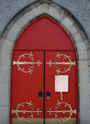
Magna Carta posted on red church doorsGirl rejoicing on beach

LIBERTY! THE TIMELINE


Black and white hands clasped

Four great themes emerge as the Brits fight for freedom.
THE FREEDOM NETWORK


Boy holding out arms on beach

BRITS WHO LOVE
FREEDOM


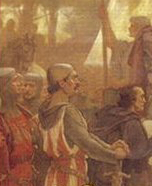
Knights and monk

THE KNIGHTS

Never a dull moment on the road to Runnymede

Parts 1 - 4

Part 7

Part 8


The description "fiction of tenure" was William Blackstone's, in his Commentaries on the Laws of England (1760).


In its first chapter the Old Testament establishes that each person has inherent dignity and freedom by declaring that man and woman were created in the image of God (Genesis 1:27). The inherent dignity and freedom of every man and woman is the essential heart of western liberal democracy.


Heroes

stream, stone bridge, autumn woods

Wycoller, Lancashire, looks much as it did in 1214 when the
northern knights rode out to win justice from King John.

Image: On This Day

THE KNIGHTS

Never a dull moment on the road to Runnymede

Riding into the Rough
Part 5

It took John three years to create a coalition of French nobles who loathed and distrusted him; to arrange a peace with Philip, the King of France, at a price his English contemporaries thought too high; to dispose of his wife Isabella and marry a 12-year-old, also called Isabella, thereby infuriating the powerful man who had been betrothed to her; to capture and hold 200 barons and knights in such vile conditions that he drove powerful Angevin nobles into rebellion; and to lose Normandy to the French.

In England, John was standing on a fault line. His great-grandfather William the Conqueror had introduced the "fiction of tenure" - that all land tenure depended on the king whose subjects held their lands only because he allowed them to. The Common Law and the law of Edward suggested otherwise, but no one seemed aware this was so, not the knight-barons and not John. In the 13th century we see the same curious intersection between common, false ideas which have not been corrected and political realities that we see today.

In 1202 John mounted a rescue of his mother when she was beseiged at Mirebeau by her grandson, Arthur. John captured Arthur, and rumours began to circulate that he had murdered him. The rumour could not be proved at first; the awful story trickled out. Hubert de Burgh apparently defied John's command to blind and castrate Arthur, but a drunken, enraged John had murdered his young nephew with a stone. William de Briouze was a witness to the murder, and the subsequent disposal of the boy's body in the Seine, and he and his family would pay dearly for it.

William Marshal loved Normandy. In 1202 he was trying to defend Upper Normandy from the French, but John’s knack for turning allies into enemies and his lack of support made his job impossible.

Chateau-Gaillard, ominous against stormy sky

Château-Gaillard from the east
Richard the Lionheart built Château-Gaillard to hold Normandy.
In 1203, Château-Gaillard was lost after river-borne and land forces failed to link up, and Marshal's outnumbered forces were defeated.

Homage and hostages

Marshal returned to England where he and his young wife had five young sons. To protect them he remained affable to the king, while building up his castles in southwest England and confirming his wife’s claim to Leinster as the daughter of the earl of Clare and the granddaughter of the king of Leinster. In 1205 to retain his Norman lands, Marshal did liege homage for them to Philip, the French king. This obliged him to give Philip military service when he was in France. It was a necessary and practical step, but it made John angry.

John's fury exploded while organising the campaign to recover his possessions in Normandy and Poitou in 1205. Marshal refused point-blank to go with him. John accused him of treason and told the knight-barons to make an example of him. They refused, impressed by Marshal's warning, delivered with his customary force of character, “Be on alert against the king: what he thinks to do with me, he will do to each and every one of you, or even more, if he gets the upper hand over you” (The History of William Marshal, ll. 13171–4).

William Marshal

William Marshal

John furiously ordered his household knights to challenge Marshal, who was nearly sixty, to combat. None dared. Taking heart from him, the knight-barons refused to accompany John to France, and forced the cancellation of his expedition.

Marshal had managed to hold the king at bay, but the king’s power was great. John demanded that Marshal give his eldest son, William, who was fifteen, as a hostage for his loyalty.

It was a cruel demand because William Marshal and his son “were devoted to each other” (DNB), but if he refused, the King would wage war against him and take all he possessed. His only reasonable chance of keeping his son and his family alive was to agree.

Pembroke Castle with gateway and turrets

Pembroke Castle
William Marshal, earl of Pembroke, saw King John only once during his six-year exile from England. They met at Pembroke Castle.

Marshal goes into exile

Forced to leave his sons William and Richard as hostages for his good behaviour, Marshal entered the political wilderness. His great ally, Hubert Walter, Archbishop of Canterbury, who had helped him to keep John in check, died in July 1205. In 1206 Marshal decided to move to Ireland with his wife, the countess. They settled in Leinster with men loyal to them, but it was not long before John demanded that he return to England.

Expecting the worst, Marshal travelled with a small band of knights, leaving his remaining knights to hold his castles in Ireland. John demanded that all his men return, but in Ireland Marshal's men refused. They defeated the forces which the king sent to to attack them, and placed the countess in control of Leinster. John came to terms, and William Marshal and his countess settled down to life in Ireland.

John as oppressor

In England, John showered William Briouze with gifts of vast lands and manors to to buy his silence about Arthur’s murder. He also named Briouze's second son, Giles, bishop of Hereford.

Like many knight-barons Briouze was living a high-stakes life, fighting in field and court to secure his lands, and hustling round the country on horseback to collect his profits and check on his managers. The barons were often on the road, since their properties lay in different parts of England. They were often at John's court or in law court, which was sometimes the same thing. Like everyone else Briouze had to pay John for his fiefs and his court rulings. He offered John £100 to have a case heard in his court; a gift of 300 cows, 30 bulls, and 10 horses for expediting the plea; and 700 marks ‘if it indeed should be won’. . . (DNB).

John was in the business of selling justice. Those who could not pay did not receive a fair hearing or, indeed, any hearing at all. He charged heavy fees for inheritances, marriages, and deaths, levied a punitive tax, and used brutal measures to collect the fees and taxes he said were owed to his exchequer. He used the money for himself and stashed it for another campaign in France. Like certain 21st century governments, his exactions, which changed year by year, eroded a taxpayer’s ability to plan ahead and decimated the economy because the types and rates of taxes were constantly increasing. John taxed so heavily that England ran short of coins.

William Briouze had accumulated large debts to the king for fees, and these debts made him vulnerable. In 1208 his wife Matilda dropped an indiscreet remark about John's murder of young Arthur. John demanded she hand over her eldest son as a hostage. Matilda refused, fearing for his life, so John demanded the family pay the large fees they owed. They surrendered all their money and castles as payment, but John claimed they had resisted violently, and ordered them killed.

The Briouzes fled, and were given refuge in Ireland by William Marshal. John pursued them. He captured Matilda and the eldest Briouze son, William. Mother and son were held prisoner, probably in Corfe Castle, and starved to death. The father escaped to France, reaching his son, Giles, the bishop in exile, and died.

John quarrels with the Pope

In 1206, Pope Innocent III had persuaded the Canterbury monks to elect Stephen Langton the Archbishop of Canterbury. John had wanted another candidate. Furious, he seized the Canterbury estates, and exiled the monks. He refused to allow Langton, who was on the continent, to return to England.

In turn the Pope slapped an interdict on all England, which meant no church services. Marriages and funerals could not be held. Uninterested in church services and obsessed with regaining his lost French dominions, John used the interdict to seize the Church’s income and enlarge his war treasury. By then he had angered the Pope and every bishop in the English Church with the exception of one bishop who was French. In 1209 the Pope excommunicated John. The English bishops and abbots joined Stephen Langton in exile.

John on the attack in England, Ireland, Wales and Scotland

John inflicted a humiliating submission on the Scottish king, and launched an army of men in 700 ships against Ireland in 1209. William Marshal could not resist such a force, and if he had, his sons who were John’s hostages, would have been killed. Marshal crossed the Irish Sea to Pembroke, submitted to John, and gave more hostages.

John had a huge and negative effect on Ireland as he took lands from the Irish and gave them to his men. In 1211 he invaded Wales. Soon it appeared there was “no one in Ireland, Scotland and Wales who did not obey his nod” (the Barnwell chronicler). Capricious and cruel, energetic but corrupt, John appeared all-powerful.

His knight-barons increasingly distrusted and feared him. They were chilled by John’s equation of English law and the harsh law of the exchequer, which offered no rights of appeal, and which masked the king’s increasingly arbitrary and exhausting demands for money. They were weary of his heavy fines, and angered by his seizure of their castles, his demand for hostages and his sale of justice to the highest bidder. They had every reason to rebel, but each reason was personal, and they hesitated. Each man was afraid to put his head ‘above the parapet’.

John's enemies

Quietly men began to number themselves enemies of John. Each man had his reasons.

John de Lacy. Forced to offer a massive fine of 7000 marks when he inherited his father’s lands, de Lacy had to surrender his chief castles to John, while garrisoning them at his own expense, on pain of confiscation should he rebel. In return for the king restoring a castle to him, he had to offer hostages, among them his younger brother.

Henry de Bohun, earl of Hereford. Engaged in a long dispute to reclaim lands he believed his, he lost them when John gave them to the earl of Salisbury.

William d'Aubigné. He had been forced to give up a son as hostage in order to retain Belvoir Castle. In 1213 he was one of the barons sent to hear the complaints of the men of Lincolnshire and Yorkshire against the abuses of John's administration.

Robert de Vere, third earl of Oxford. He had to pay a huge fine to release a widow from John’s clutches when he married her, and another large fine to receive his rights when he succeeded his brother. In spite, John withheld his earldom.

William of Huntingfield. He had to surrender his son and daughter to the king as hostages.

Roger Bigod. Earl of Norfolk, Roger Bigod was an older man who had helped to free Richard the Lionheart from captivity and had served as his justiciar. John burdened him with heavy fees. When a case was brought against him and the earl objected to the chosen jurors on the grounds of their likely bias, his arguments were ignored by John, who ordered that the case proceed. The earl's son Hugh would join the rebellion against John.

Robert Fitzwalter. One of the most hot-tempered and powerful men in England, Fitzwalter quarreled with John over his inheritance. He claimed John had raped his daughter.

Geoffrey de Mandeville. His first wife was Maud, Fitzwalter's daughter, whom John allegedly had raped. John later forced him to pay 20,000 marks to marry Isabella, countess of Gloucester, John's first wife, then deprived him of the most valuable manor in the earldom. When Mandeville was unable to pay the huge debt in one year, John confiscated Mandeville's Gloucester estates.

Saer de Quincy. Earl of Winchester and Fitzwalter's brother-in-arms, Quincy quarreled bitterly with the king when John deprived him of Mountsorrel Castle.

Eustace de Vescy. He believed that John had tried to seduce his wife. John outlawed Eustace, and seized his lands.

William de Mowbray, lord of Axholme Castle. Small as a dwarf, generous and valiant, Mowbray had fought brilliantly for John in his campaigns, but he turned against him. His friendship with the other knights, and his indignation at their treatment, is the probable reason for his enmity.

Giles Briouze, bishop of Hereford. John had sent his father into exile, murdered his mother and brother, and plundered his family's lands.

William Marshal, who remained in self-imposed exile in Ireland, his sons hostage to John for his behaviour.

Yet despite his injustices, fines and assaults, they were afraid to move alone. Because he was an excommunicant they could be absolved of their fealty to him, but they were afraid that John would pick them off one by one, dividing the spoils among those who remained. Nothing yet united them, and the king remained immensely powerful.

But just when he seemed untouchable, the Welsh revolted. This will not be the last time that a popular revolt smoothed the road to Runnymede, but like so much else about this story their contributions have been forgotten.

John had land and naval forces assembling at Portsmouth for his assault againt France. He hurriedly sent them to Chester. “On 14 August he hanged twenty-eight Welsh hostages at Nottingham” (DNB). They were the sons of Welsh princes.

Seal of knight on horseback

The seal of the impetuous Robert Fitzwalter

In Nottingham John learned of a plot against his life. Eustace de Vescy and Robert Fitzwalter were identified as conspirators. They escaped abroad.

Fearing conspirators everywhere, John disbanded his army. He promised to reform the abuses of his sheriffs and forest officials, with his usual mix of "bribery and coercion” (DNB). But as weeks went by and no dagger in the dark appeared, he shook off the setback, and began reorganizing his military expedition to the continent. Whatever John was, he was never boring. He seems never to have had a dull, peaceful moment.

French invasion threat and John's surrender to Pope

To John’s horror, in April 1213, Philip of France announced that the Pope supported his plans to invade England and remove the royal excommunicant. John immediately rushed to Kent, calling all his barons and knights together, and hurriedly negotiated with the Pope’s representatives to place England as a fiefdom under the Pope. He hoped to forestall France's invasion by selling off England's independence and putting the whole country and himself under the control of the Pope.

“Thus,” as DNB piquantly puts it, “virtually the entire baronage witnessed his surrender of the kingdom to the papacy on May 15, 1213 at Ewell near Dover and his promise to pay an annual tribute of 1000 marks.” That this meant the Papacy could interfere in their affairs slowly dawned on the knight-barons. Modern readers will realize that Britain faces a more devastating loss of sovereignty to the European Union.

John hoped that Philip would cancel his invasion plans, but the French king did not. At this criticial time William Marshal returned to England. He advised a preemptive strike, and on 30 May 1213, the English Navy under the earl of Salisbury destroyed the French fleet in harbour at Damme. In June a triumphant John called on his barons to sail with him to Poitou to recover his lands.

The barons resist

The barons refused. Helping John to become more powerful was not an idea that appealed. They dreaded an expansion of his tyranny if he returned victorious. Again readers may see a modern parallel in the politician who becomes so powerful he or she cannot be held accountable by the citizens he is supposed to represent.

The northerners were particularly resistant. Fitzwalter and Vescy were back in England at the Pope's insistence, and they and William de Mowbray and Geoffrey de Mandeville refused to go on campaign or to pay scutage (a fee in lieu of military service). They argued that overseas service ran contrary to the conditions of their tenure. Enraged, John intended to punish them, but one man stood between him and his vengeance.

View shows ominous stone tower of Windsor Castle with arrow slits soaring into blue sky.

Windsor Castle

The Lord's Knight
Part 6

The man who stood between John and his knights was Stephen Langton. Langton had been born about 1150 in a moated farmhouse in Lincolnshire. For years he had been a scholar and a popular teacher of seminary students in Paris. Since there was no accepted method of arranging the Bible's books, Langton organized them, and divided them into chapters. His system is still used today (DNB).

Langton was interested in drawing out the spiritual meanings of sacred texts and applying these insights to real problems. He taught his students to give their parishioners pastoral care. In one of his vivid sermons he contrasted the prophet who spoke the truth no matter the cost to himself and the “greedy prelate. . .who for a whore or a little worldly profit is ready to go two leagues or more on a winter's night, but to hear a poor man's confession. . . will not leave his table for even a few minutes”.

Though he had been elected Archbishop of Canterbury in December, 1206, Langton was not allowed to enter England until July 1213. In 1207 he wrote an open letter to the people of England to tell them he had agreed to be their archbishop because of his concern for their well-being, because, frankly, he had been ordered to by the Pope, and because he wanted the English church to be free. For Langton, this meant free from the king's control. With John on the throne that would seem to be an impossible task, and Langton knew it. He set an image of Thomas à Becket's martyrdom on his seal with the words, ‘May the picture of a death in the external world be for you a life of love within’.

Defying the king in the name of the Lord

When John surrendered England to the Pope and allowed Langton to enter England, the archbishop absolved the king of the Church's excommunication. He recognized the enmity that seethed between the king and the knights who had refused to accompany John to France, and he attempted mediation. John, however, had no interest in negotiating. He wanted revenge. He prepared to send his mercenaries against the northerners who had refused to support him.

Moving swiftly, Langton stood between the king and the knights. He threatened to renew the excommunication that made John so vulnerable to the French king. He stopped John in his tracks.

Who was this man?

Who was this scholar and teacher, this unarmed 63-year-old who defied the king? He was far more complex, and far stronger than John guessed, but his story has been lost and he has been overlooked, and even misrepresented.

Stephen Langton held great power as archbishop, but he was without personal ambition, which meant it was possible he could do great things. He had no psychological need to win credit. As a result he could be very effective. Steeped in the Old and New Testaments, he understood Christ's teachings. Among these teachings are self-responsibility, freedom, and community -

"It is for liberty that Christ has set us free. Stand fast therefore and do not become entangled in the yoke of bondage. . .You, my brethren, were called to liberty. Do not use freedom for self-indulgence, but serve one another with love" (Galatians 5: 1, 13).

Radiating light

Come, light of our hearts. . .best of consolers,
sweet guest of the soul and comfort of the weary.
The Golden Sequence

It is fairly certain that Stephen Langton wrote The Golden Sequence and that he was a contemplative, grounded in his faith and in Christian contemplation. His contemplative practice gave him insight, a passion for justice, and deep reserves of strength. Though many Christians today are unaware of this, Christianity's happiest, most tender and effective saints - men and women such as Patrick, Francis, and Lady Julian of Norwich - were contemplatives.

In contemplation Langton found the Lord was his friend. With His friendship, anxiety and trouble lost their power, and death had no dominion.

Stephen Langton was a scholar familiar with the law who had taught his students that even a king must obey the law. He had been outraged by the spiritual blight that John had brought on the English. He had spent time listening to English exiles speak about the king's injustices. John had surrendered England to the Pope, a move that ought to have pleased the archbishop, but did not. Daily reading of the Psalms and the New Testament reminded Langton of his responsibility to "Save the weak and the orphan; defend the humble and needy; and rescue the weak and the poor from the power of the wicked" (Psalm 82).

It seems likely he thought about the archbishops and kings who had preceded him. The archbishops included Walter, who defeated John's insurrection against King Richard; Becket, who died defending the freedom of the English church; Theobald, who negotiated between the warring parties of Stephen and Matilda to bring peace to England; and Anselm, who had confronted the Red King and Henry I. Anselm and his bishops had abolished slavery in England, and three bishops had helped to win the Charter of Liberties from Henry I in 1100. But this ancient charter lay forgotten, gathering dust.

The Pope had commanded his archbishop to protect the peace and salvation of the king and England, but Stephen Langton saw the king's injustice and despotism. John had placed himself above the law. He was selling justice to the highest bidder, and delaying and denying justice in his courts. He burdened his people with taxes, and prevented canons and monks from freely electing bishops and abbots.

Men no longer remembered the Charter of Liberties that their forefathers had won a hundred and fourteen years earlier from a previous king, in Anselm's time. They no longer knew the ancient English customs and liberties that were their birthright. Who better than Langton, scholar and Lord's Knight, to remember and remind them?

Continued

When you contribute to this website,
you support the Best of the Brits.

Join the Circle of Friends »

English bulldog puppy