|
BRITISH HISTORY THE STORY of
Four great themes emerge as the Brits fight for freedom.
THE KNIGHTS Never a dull moment on the road to Runnymede
Turner traces the Charter's legacy through the centuries and outside the United Kingdom, especially North America, where the Charter enjoys greater prestige than in Britain. U.S. citizens claim Magna Carta as a source of their liberties. For UK orders For US orders
Roger of Wendover wrote his account of the meeting at Bury St Edmunds in his book Flores Historiarum (The Flowers of History) about ten years after the events. J.C. Holt subsequently pointed out that Wendover was not always a reliable chronicler, but Wendover's account receives support from another contemporary source, the Chronique de l’Histoire des Ducs de Normandie.
From the Wilton Diptych King Edmund died in 869, killed by invaders when he refused to renounce his faith or hold his kingdom as a vassal.
Some modern historians have claimed that the knights were too ignorant to have contributed much to Magna Carta. But a number of the knight-barons had been sheriffs or served on judicial eyres, the circuit courts held by itinerant royal justices in medieval England. "Most if not all would have gained a close working knowledge of law and government through involvement in local administration and by direct contact with the king and his ministers" (DNB).
A few copies of Magna Carta survive.
Magna Carta does not give much respect to women as witnesses in court cases. However, it is the 13th century. The Great Charter sets a remarkable precedent for justice and freedom unlike anything anywhere else in the world. |
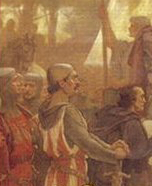
THE KNIGHTS Never a dull moment on the road to Runnymede Fear, discovery, and confrontation The knights of England lived exciting physical lives in conditions we would find appalling but they found invigorating. Stoical about suffering, they could be sensitive to beauty. Superb athletes, they were often well-versed in the law. Keenly committed to personal survival and advancement, many would make sacrifices for deeply held principles. Some of them saw themselves as spiritual seekers inspired by the legends of the Holy Grail and guided by a chivalric code infused with Christian teachings. They lived in a country receptive to education and reason. Oxford and Cambridge had been founded just decades earlier. They lived in an age vivid with the presence of God, sacred symbols, and spiritual persons. They knew what the code of chivalry was, even when they fell short of chivalric ideals, and they knew why it was important. Always pragmatic they had a sane understanding that if abuses The knights admired bravery. Increasingly they saw King John as a coward who had broken the code of chivalry. In search of a leader Many of the knights had met each other at the king's court. The northerners had stood surety for each other for the payment of fines to the king. Other knights had fought together in Normandy and shared bonds of comradeship. Some, such as Fitzwalter and Mandeville or Bigod and Clare and Marshal were related by marriage. Others, such as Aubigné and Ros, were blood kin. Six of the rebel knights were descendants of the same grandparents.
New Temple, London, built by the Knights Templar When they began to talk privately among themselves about what they could do to curb the king's abuses, the knights of England may have thought of the Knights Templar. These monastic knights had built an extremely effective transnational military and economic organization that spanned Europe and Britain. They had extensive holdings in Hertfordshire, Essex, Kent, Warwickshire, Worcestershire, Shropshire, Oxfordshire, Lincolnshire, Yorkshire, and Cornwall, and owned the island of Lundy. They showed what knights who were organized could achieve. But hateful as John's actions were, the knights were at a loss to see what they could do about him. They had sworn to serve him in a sacred oath not lightly cast aside. Their possessions appeared to depend on their fealty to him. They had knelt bareheaded and unarmed before him, placed their hands in his, and swore, "I become liege man of yours in life and limb and earthly regard, and I will keep faith and loyalty to you for life and death, God help me." They had no memory of the ancient Charter of Liberties which promised justice under the law. They had no leader. Any one of the barons who offered to lead a rebellion would be suspected as a power-seeker and usurper of the throne. But there was one man they did not suspect of ambition, one man whose courage they respected, one man they trusted because he had defied the king to protect them. That man was their archbishop, Stephen Langton. The Charter of Liberties According to chroniclers, in 1213 Stephen Langton found the long-forgotten Charter of Liberties which had been promised by Henry I to his knight-barons and bishops in 1100. Langton read the Charter, and understood its significance. On 25 August 1213, he read it aloud to the knight-barons gathered at Westminster. The Charter's first statement must have transfixed the knights. Know that by the mercy of God and the common counsel of the barons of the whole kingdom of England I have been crowned king of said kingdom; . . . Remarkably, Henry I admitted that he was king because his barons had agreed to his kingship. In the same way they had given their common consent to John being king. In exchange John had sworn the Coronation Oath. He had promised to forbid extortion and wrong-doing and to give the people of England peace, justice and mercy. Langton did not have to explain this to them. He went on to read, . . .because the kingdom had been oppressed by unjust exactions, I, through fear of God and the love which I have toward you all, in the first place make the holy church of God free. . . This was important to Langton and the bishops. It was immediately followed by, And I take away all the bad customs by which the kingdom of England was unjustly oppressed; which bad customs I here set down in part: What followed showed that William Rufus, the Red King, had been as abusive as John in many of the same ways. This part of the reading must have met with murmurs of assent from the assembled knight-barons. Then Langton read Henry's great promise. One wonders if they understood how tremendous the promise was. It was but a simple sentence. I restore to you the law of King Edward with those amendments introduced into it by my father with the advice of his barons. King Edward's law was the Common Law established by Alfred the Great and confirmed by Edward and William the Conqueror. Based on Anglo-Saxon and Danish laws and traditions and on Christian teachings, the common Law protected English liberties, and promised justice and equity as their right "as children of God". In binding himself to the law, Henry made the historic claim that even the king was not above the law. No man was. When they understood all that it meant, this simple statement opened up for the knights a new vision of liberty and justice as their inheritance. It declared that John must respect their liberties and obey the law. One of the knights took a copy of the Charter with him when they left London. But they were not yet ready to confront the king and build on these ideas. They awaited news of John's war in France. The French expedition Though none of the parties was aware of it, the first battle for Magna Carta was won when the knight-barons refused to join John's campaign in France. It was not easy to defy him, but the knights and Stephen Langton did. In February 1214 John sailed to France without most of his English knight-barons. He relied on the money he had wrung out of the English people to pay mercenaries to fight for him. He attacked Philip of France from the north. The Germans under Otto IV attacked from the east. John was on the verge of victory when the French people poured out of their towns to defend their king and country, and defeated him at the battle of Bouvines on 27 July 1214. In doing so they increased the odds for Magna Carta. In England, the knights were in secret talks. However, word of a "conspiracy" among them reached Rome. The Pope sent orders to Stephen Langton to denounce the knights by name. Langton refused. Angry and bitter, the defeated John returned to England. Men were beginning to call him "Softsword", but there was little doubt that his sword could still kill. His army of mercenaries came with him.
Abbot's Bridge, Bury St Edmunds A time to act As they thought about the Charter of Liberties that Stephen Langton had read to them, the knight-barons must have realised that their liberties had been mocked and despised. They must have understood that they were the inheritors of the law established by Alfred the Great and King Edward the Confessor and that their freedoms and the freedom of their children were not gifts of the king, to be taken away at a whim, but their birthright as children of God. Like the knights of the Grail, and the Knights Templar, they had found a cause greater than themselves, a cause they could rally round. The teachings that they took from the Charter of Liberties included the unspoken but indispensable lesson that if they acted together, and only if they acted together, would they have a chance of succeeding. It is a lesson that would be learned by Parliament in the 17th century, by British revolutionaries in America in the 18th century, and by the people of the British Commonwealth during World War II. On 20 November 1214, as leaves lay thick in the woods and on the roads, the knight-barons rode to the Abbey of St Edmund on the feast day of the king-saint. The northern knight-barons were joined by those from East Anglia and by knights from the south and the west. Earlier in November, King John had given a grant of liberties to the English church. Stephen Langton had gained the free election of abbots and bishops because John wanted the Pope's support. The knight-barons who were witnesses must have watched thoughtfully, and wondered how their freedoms would be won. They may also have wondered whether Langton would support their quest for justice now that he had what he wanted. Roger of Wendover, a Benedictine monk living at that time in the monastery of St. Albans, describes what happened, About this time the earls and barons of England assembled at St Edmund’s as if for religious duties, although it was for some other reason; for after they had discoursed together secretly for a time, there was placed before them the charter of King Henry the First, which they had received, as mentioned before, in the City of London from Stephen, Archbishop of Canterbury. This charter contained certain liberties and laws granted to the holy church as well as the nobles of the kingdom, besides some liberties which the king added of his own accord. All therefore assembled in the church of St. Edmund the king and martyr, and commencing from those of the highest rank, they all swore on the great altar that, if the king refused to grant these liberties and laws, they themselves would withdraw from their allegiance to him, and make war on him, till he should, by a charter under his own seal, confirm to them every thing they required. . . . . .it was unanimously agreed that, after Christmas, they should all go together to the king and demand the confirmation of the aforesaid liberties to them, and that they should in the meantime provide themselves with horses and arms so that if the king should endeavour to depart from his oath, they might by taking his castles compel him to satisfy their demands; and having arranged this, each man returned home. They had finally understood that they could not depend on the Charter of Liberties to defend their freedom for them. To hold the liberties which they knew were theirs, and to receive the justice due them, they would have to be willing to put their lives on the line. In a ceremony reminiscent of their vigil as squires before they became knights, they had sworn on the altar to support each other. Christmas 1214 was celebrated as it had been for centuries in England - with church services and feasting, minstrels, gleemen, harpers, pipe-players, jugglers, and dancers. But in the new year, the knight-barons rode to London. They arrived at the New Temple of the Knights Templar, where John was staying. They found both the king and William Marshal there. Marshal had returned from Ireland, and had negotiated the release of his sons in 1212. Now he was acting as a mediator between the king and the knight-barons. In the round church of the New Temple, where black columns lift pale arches into the light and the acoustics are so perfect the softest whisper can be heard, the knights presented the Charter of Liberties to Marshal, and told him they wanted the king's guarantee that he would rule according to the law of King Edward the Confessor. Marshal promised the knights that John would respond to their demand. In the meantime, though he stayed to all appearances loyal to the king, he covered the backs of his sons, and the backs of the rebels. By staying with John, he was a step ahead of every move the king made. Langton was also trying to persuade the king to accept the Charter of Liberties. He might have ignored the cause of the knights, or even tried to stifle it as a disturbance to the peace of the kingdom. Instead Langton considered the cause of justice to be Christ's cause. John rejects the Charter of Liberties John angrily rejected the Charter of Liberties. In March, 1215, he wrapped himself in the Cross of the Crusader, and paid for more mercenaries, hired from Poitou and Flanders, to be shipped to England. Easter came, and the knights had still not heard from him. They took the revolutionary step of renouncing their fealty, and gathering under arms. In May an army headed by five earls and forty barons from all over England mustered at Stamford and marched on London. They numbered men as old as Roger Bigod, who was in his seventies, and men as young as William Marshal's son, William. The knights called their army the Army of God and Holy Church. They were led by bold Robert FitzWalter. Giles Briouze, the bishop of Hereford, rode with them. Popular support When they reached London, Serlo the Mercer, the mayor of London, and all the citizens threw open the gates, and welcomed them. This was unprecedented and vital. It is doubtful that the knight-barons could have carried Magna Carta through without the support of the people in England's cities and towns. It is strange that their contribution goes almost entirely unrecognised. Who has heard of Serlo the Mercer? Promises of aid poured in from all England, Scotland, and Wales. Knights who had been sitting on the sidelines defected to the Army of God. “There was a moment when John found himself with seven knights at his back and before him a nation in arms”, wrote Green in his Short History of the English People. John’s mercenaries refused to fight. Marshal coolly pointed out the new realities to the king. By now Stephen Langton knew that a general statement about liberty would not do. For this king they would have to specify every freedom and act of justice they wanted. Together he and the knight-barons described each grievance, and redress. Some clauses were small and picayune; others were shining and great. Inspired by the teachings of Christ, Common Law, self-interest and common sense they filled a large vellum that would become known ever after as Magna Carta, the Great Charter. The knights maintained their unity. No one defected. Their pressure was unrelenting. Langton called on the support of thirteen bishops and twenty abbots.
The complete text of Magna Carta is here. In June 1215, with the verges green with grass and white with flowers, the knight-barons, bishops, and abbots rode to Runnymede, a meadow beside the Thames not far from Windsor Castle. The knights were armed. The host included: William Marshal and Archbishop Langton; The bishops of London, Bath, Winchester, Lincoln, Salisbury, Rochester, Worcester, Ely, Hereford, Chichester, and Exeter; and the Archbishop of Dublin; The abbots of St Edmunds, St Albans, Augustines in Canterbury, Evesham, Westminster, Peterborough, Reading, Abingdon, Malmesbury, Winchcomb, Hyde, Certesey, Sherborne, Cerne, Abbotebir, Middleton, Selby, Cirencester, and Hartstary; Master Pandulf, member of the Papal Household and Brother Aymeric, Master of the Knights Templar in England; and The knight-barons William d'Aubigné, Roger and Hugh Bigod, Henry de Bohun, Richard de Clare, John FitzRobert, Robert FitzWalter, Geoffrey de Mandeville, the younger William Marshal, small William de Mowbray, Robert de Vere, and Eustace de Vescy. On 15 June, in their presence under the open sky of Runnymede, John agreed to the charter that would become known as Magna Carta and in ten years, as the Great Charter of Liberties. Copies were made, and sent out to the nation under the king's own seal. Back in Windsor Castle John threw himself on the floor and screamed with fury. The knights and bishops and abbots gathered in the meadow could not have known that over the next 900 years Magna Carta would become the keystone of liberty in the West. Only a few of them guessed they would be fighting for Magna Carta, and for their lives, within three months. MAGNA CARTA forever establishes
This last security clause was a "boldly innovative proposal of a limited monarchy" (DNB). It indicated that the knight-barons would respond fiercely if John trespassed on their liberties, but they would do so through an elected council of knights acting on behalf of the "community of the realm". John spent a few surly weeks considering his options. By mid-July he had written to the Pope, asking him to annul Magna Carta. While he waited for the Pope to reply, he tried to buy off some of the knights by redressing their grievances, but he was only able to buy one knight. In September the papal letters arrived. The Pope condemned Magna Carta and called it illegal. He ordered the archbishop to publicly excommunicate the rebels, and so end their rebellion and destroy Magna Carta by rendering their lives and possessions forfeit. A triumphant John threw off his mask and prepared to wreak his revenge. But once again he had underestimated Stephen Langton.
Next, the battle to defend Magna Carta and the Sovereignty of England. William Marshal and his son will be in the thick of it.
When you contribute to this website, |