Blog Home | All Posts | Liberty Timeline | Faith in Freedom | Heroes | Science Timeline | Artists | Life | Sports | Calendar | Brits Worldwide | Imagine
|
|
Blog Home | All Posts | Liberty Timeline | Faith in Freedom | Heroes | Science Timeline | Artists | Life | Sports | Calendar | Brits Worldwide | Imagine |
|
What’s In A Name?
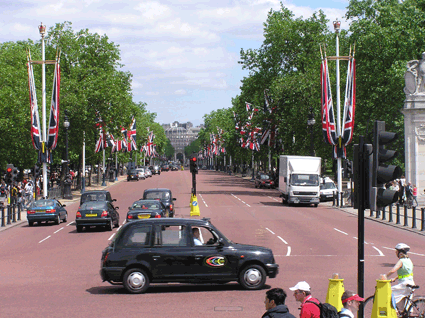
Outside Buckingham Palace, looking up the Mall. Photo by David Abbott The British Isles, We have often heard the Queen described as the Queen of England, which is true, but not at all the whole story. On almost a daily basis we hear the terms England, Britain, and United Kingdom used indiscriminately and inaccurately. It is a confusing business, and for the sake of clarity we offer the following definitions. Great Britain is the island made up of England, Scotland, and Wales and the smaller offshore islands, including Lindisfarne, the Isle of Wight, the Scilly Isles, Anglesey, the Hebrides, the Orkney Islands, and the Shetland Islands. Strictly speaking Britain does not include the Isle of Man, the Channel Islands, or any part of Ireland.
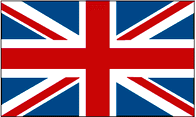
The Flag of Britain Ireland is the island to the west of Britain, comprised of two political parts: Eire, the Republic of Ireland and Northern Ireland, which is part of the United Kingdom. The United Kingdom is comprised of England, Scotland, Wales, and Northern Ireland.
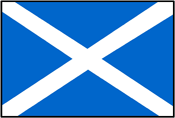
Flag of Scotland Scotland is the country to the north of England on the island of Britain. It is part of the United Kingdom, and is a region of the European Union. Scotland enjoys limited self-government through its own parliament.
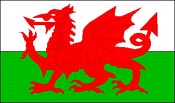
Flag of Wales Wales is the country on the western promontory of Britain. It is part of the United Kingdom, and is a region of the European Union. Wales enjoys very limited self-government in its assembly.
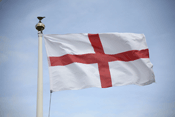
Flag of England England is the country of the Charter of Liberties, Magna Carta, Agincourt and the settlement of America. Unlike Scotland or Wales, England does not have its own parliament and is in the process of being stealthily carved into nine regions answerable to the monstrous European Union. However, England is also the kingdom that will never die.
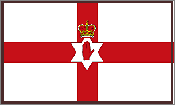
Flag of Northern Ireland Northern Ireland, which is also part of the United Kingdom, is a region of the European Union. It has its own assembly with very limited self-government.
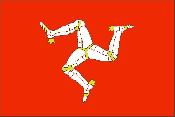
Flag of the Isle of Man The Isle of Man is a self-governing Crown dependency that owes allegiance to the Queen as the Lord of Man. The Manx people have their own parliament, which has authority over domestic matters. The Isle of Man holds neither membership nor associate membership of the European Union, and lies outside the European Economic Area (EEA).
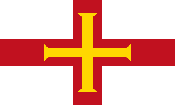
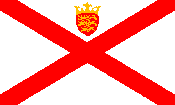
Flag of Guernsey and Flag of Jersey The Channel Islands are a group of British-dependent islands off the coast of Normandy in the English Channel, and comprising the remnant of Normandy that still owes allegiance to the Queen as the Duke of Normandy. They are two separate countries: the bailiwick of Guernsey and the bailiwick of Jersey. Guernsey includes the islands of Guernsey, Alderney, and Sark and the smaller islands. Each has its own legislature. Islanders are British citizens. The islands are not part of the European Union. When one speaks of the British Isles, a geographical term, one means the large islands of Britain and Ireland, together with all the smaller associated islands. (Strictly speaking the Channel Islands are part of the British Islands.) Long ago, Britain was referred to as Albion. This name is still used poetically to refer to Britain or England and, sometimes, and somewhat confusingly, to refer to Scotland. Albion is a state of mind, but then so is Britain, with mystical and material consequences.
When you contribute to this website,
|
A Few Ideas
BRITISH
|
This wonderful book describes Britain's gifts to the world. Adults will refresh their understanding of profound events in British history, and young people will find inspiration. Warning: This book defies aggressive secularism and unthinking multiculturalism. Written by the co-editors of this website, Share the Inheritance is beautifully illustrated with 125 colour images and a timeline. Available at Amazon UK and at Amazon USA.
|
 |
||