Blog Home | All Posts | Liberty Timeline | Faith in Freedom | Heroes | Science Timeline | Artists | Life | Sports | Calendar | Brits Worldwide | Imagine
|
|
Blog Home | All Posts | Liberty Timeline | Faith in Freedom | Heroes | Science Timeline | Artists | Life | Sports | Calendar | Brits Worldwide | Imagine |
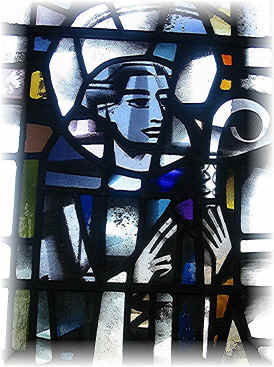
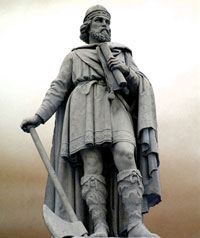
Creating a sanctuary for learning and peace in a war-torn world. Image: City of Sunderland The man who loved Benedict Biscop (biscop means bishop) loved books and was willing to risk his life to obtain them. He inspired a great historian, the Venerable Bede, and he helped to create an England of peace and learning. Through Bede, he influenced Winston Churchill. Benedict lived in 7th century Northumbria, a time when books were thin on the ground and Aidan was trying to bring peace to fighting gangs and murderous chiefs. In a warring world Benedict built a place where men could live safely, cooperate in housing, feeding and clothing themselves and those in need, educate children, sustain a sanctuary of peace and learning and worship God. Because Benedict thought that books and learning could transform life he made dangerous trips to the continent to find them. He managed to acquire and have copied several hundred volumes, each of them written by hand on vellum, for his monastery library at Wearmouth. In some cases his books were one of only two or three copies in existence in the entire world. They included translations of Scripture and classical works of philosophy, poetry and history.
Benedict Biscop's foundation of Wearmouth-Jarrow became an international centre of learning. Image: City of Sunderland A twin monastery Benedict governed the monastery with an eclectic rule based on the Rule of St Benedict and the rule of monasteries he had visited in Frankish Gaul. As the monastery grew, he built a twin monastery at Jarrow. Determined to protect his monks and his books, he had the foundation of Wearmouth-Jarrow built in stone with glass windows, a rarity at that time. The teenage Bede, who had been brought to the monastery when he was seven, found his calling when he read books which opened new worlds to him. He went on to write commentaries on Scripture, biographies of saints and guides to holy places. His crowning achievement was Historia ecclesiastica gentis Anglorum, the history of the Christian English people. There are several striking things about this work. The beginning of AD The first is that Bede used numerous sources. He wrote to and personally interviewed contemporary people in numerous kingdoms and dioceses to create his history. He created a research model for future historians. Second, Bede introduced dating from the birth of Christ. That the West dates a year 1215 or 2009 (or Anno Domini 2009 as Bede would have it) comes from Bede writing in his History of the English People. Third, Bede emphasizes how much Englishmen have learned from Irish teachers. Disaster is not the end Disaster occurred when the Northumbrian king who had protected Wearmouth-Jarrow was slain in battle and plague killed many of Benedict's monks. In AD 689, Benedict was struck down with paralysis, but he had one last statement to make. Struggling to speak clearly as he lay dying, he addressed his brother monks. Two of his warnings remain urgent today - Preserve the library, Benedict said, and elect as abbot a man infused by spirituality and teaching. Don't elect him because he is the member of a particular family. Only the Saxon chancel at Wearmouth-Jarrow, with some of the world's oldest stained glass, stands today. But Bede’s Ecclesiastical History of the English People survives, a tribute to Benedict’s faith in the eternal splendour of the written word.
The History made a tremendous impression on everyone from Alfred the Great to Winston Churchill, who would write a book called A History of the English-Speaking Peoples. Bede made clear that the actions of men and women would be examined and remembered in the light of history. Benedict died on January 12th 689. His willingness to risk danger to create a centre of peace and learning remains an inspiration today. The City of Sunderland recently made Benedict its patron saint.
When you contribute to this website,
|
FINDING A DOOR INTO THE LIGHT
The man who confronted the Red King, freed British slaves, and helped to establish the Charter of Liberties.
Never a dull moment on the road to Runnymede and Magna Carta
BRITISH SAINTS
Bede describes the birth of English poetry in his history, and we recall that strange and incandescent moment here. |
|
 |
||