Blog Home | All Posts | Liberty Timeline | Faith in Freedom | Heroes | Science Timeline | Artists | Life | Sports | Calendar | Brits Worldwide | Imagine
|
|
Blog Home | All Posts | Liberty Timeline | Faith in Freedom | Heroes | Science Timeline | Artists | Life | Sports | Calendar | Brits Worldwide | Imagine |
  Into the Sands of Egypt
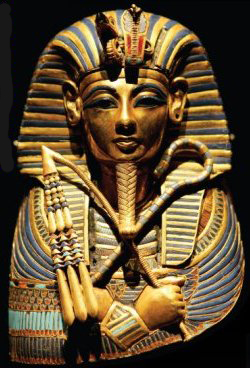
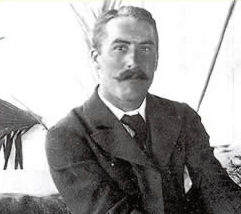
The head of Tutankhamun's Coffinette Howard Carter Unearths Tutankhamun's Tomb The youngest of eight children, Howard Carter (1874 - 1939) never received any formal education. His father, who was an artist, taught him drawing and painting. William Amhurst Tyssen-Amherst, a collector of Egyptian antiquities, thought he would be an asset on archaeological digs, and sent him to Egypt. Carter was only seventeen. Seventeen and working in Egypt Carter went to Beni Hasan to work as a ‘tracer’ of tomb scenes, and helped on archaeological excavations. It was hard work at very low pay, but it provided an archaeological education if he wanted it. Carter did. Glimmering in the sands like a mirage was the possibility of discovering the tomb of a lost pharaoh in the Valley of the Kings at Thebes. His first teacher, William Flinders Petrie, did not think much of his potential, but Carter unearthed several important finds. Appointed the principal artist of the Egyptian Exploration Fund's excavations at Deir el Bahbri, he strengthened his drawing and excavation skills, working all day and sometimes sleeping in the tombs at night. He drew the painted reliefs in the temple of Queen Hatshepsut at Deir al-Bahri, Thebes, which were published in six volumes and are considered some of the finest records of Egyptian inscribed monuments. Disaster He worked hard for the next nine years. Though he had no formal qualifications, his career seemed assured when he was named Inspector General of Monuments for Upper Egypt at the age of twenty-six. He energetically pursued tomb-robbers and restored monuments, and he discovered the tomb of King Tuthmosis IV. Foreign tourists could pose problems, especially when they were drunk. His Egyptian guards became engaged in a fracas with tourists, and Carter refused to apologise. He resigned his job, and was reduced to guiding rich tourists and selling watercolours.
Howard Carter, young, impecunious, and Archaeological exploration is not an inexpensive pursuit, and Carter had no funds. He was sure there was a marvellous tomb still undiscovered in the Valley of the Kings, but no one else did. Luckily the Fifth Earl of Carnarvon was an ardent amateur archaeologist, and he had money. Carter and Carnarvon joined forces. Years passed, and few discoveries were made. and World War One, which saw Carter working in intellligence, intervened. Deadline In the summer of 1922, Carter asked Carnarvon to support one last exploration in the Valley of the Kings. Carter had learned of the existence of a previously unknown pharaoh, Tutankhamun, the 12th Pharaoh of the Eighteenth dynasty of Egypt. Tutankhamun had ruled from ca. 1333 BC – 1322 BC during the period known as the New Kingdom. No one had discovered the location of his tomb, and there was high hope that it could be found with its rich treasures intact. Carnarvon impatiently told Carter to discover the tomb, or lose his funding. Discovery Famous for his hot temper, Carter kept his cool. Under the stone chips and rubble used to build the tomb of Ramses II, he uncovered the steps that he believed led to Tutankhamun's tomb, unplundered and unseen for three thousand years. He telegraphed Lord Carnarvon, who raced to Egypt. On November 5th 1922, Carter went down the steps with Lord Carnarvon and Lady Evelyn Herbert, Carnarvon’s daughter. Carter made the first hole in the sealed doorway of the tomb, and stared inside. Carnarvon asked, “Can you see anything?” “Yes,” Carter said slowly. “Wonderful things.” At first I could see nothing, the hot air escaping from the chamber causing my candle flame to flicker, but presently, as my eyes grew accustomed to the light, details of the room within emerged slowly from the mist, strange animals, statues and gold - everywhere the glint of gold. It was by far the best preserved and most intact pharaonic tomb ever found. On the walls painted scenes showed showed the young pharaoh, who had died at nineteen, hunting with his queen in a lake of reeds and travelling to the afterworld. Inside the burial chamber were 3,000 treasures, including a gold and silver throne, a winged scarab pectoral pendant, made of gold inlaid with semi-precious jewels, and a gold crown. There were little cosmetic boxes, a game box, and an engraved shrine that shows Tutankhamun's wife (and probably his half sister) tenderly anointing him. The coffin Carter recruited a team of expert assistants to help him clear the tomb, and conserve and record its remarkable contents. On February 16th 1923 they unblocked the stones and opened the actual burial chamber. Inside lay the unplundered coffin and body of the dead king. Tutankhamun's mummy rested in the innermost coffin, which was made of solid gold and weighed about 243 pounds. His body was wrapped in linen and over his face was an exquisite gold, blue glass, and lapis lazuli mask. The news of the tomb's find electrified Europe and America. Carter became famous. He masterfully excavated and catalogued Tutankhamun's treasures, a task requiring almost ten years. Despite sustained public interest, and receiving honours from Egypt and America, he was never honoured in Britain. Death The "curse" said to be invoked against the violators of a tomb appeared to affect Lord Carnarvon, who died five months after the discovery from blood poisoning. Carter became ill with Hodgkin's Disease and was never able to complete a full scientific record of his discovery before he died in 1939. Years later, the tomb that Carter found continues to shed light on Egyptian mysteries.
When you contribute to this website,
|
HOME PAGE
Tutankhamun's name was spelled several ways even in ancient Egypt. The public wisely dispensed with these confusions and dubbed him "King Tut".
Told with style, this is the story of the discovery of Tutankhamun's Tomb For UK orders:
For US orders:
PATRICK LEIGH FERMOR, SCHOLAR & SOLDIER He fought the Nazis and wrote travel classics.
In the most war-torn, desperate lands on earth, Baroness Cox risks her life to bring medical supplies, food, and hope. Along the way she makes implacable enemies and steadfast friends.
|
This wonderful book describes Britain's gifts to the world. Adults will refresh their understanding of profound events in British history, and young people will find inspiration. Warning: This book defies aggressive secularism and unthinking multiculturalism. Written by the co-editors of this website, Share the Inheritance is beautifully illustrated with 125 colour images and a timeline. Available at Amazon UK and at Amazon USA.
|
 |
||