Blog Home | All Posts | Liberty Timeline | Faith in Freedom | Heroes | Science Timeline | Artists | Life | Sports | Calendar | Brits Worldwide | Imagine
|
|
Blog Home | All Posts | Liberty Timeline | Faith in Freedom | Heroes | Science Timeline | Artists | Life | Sports | Calendar | Brits Worldwide | Imagine |
  EXTREME JOURNEYS
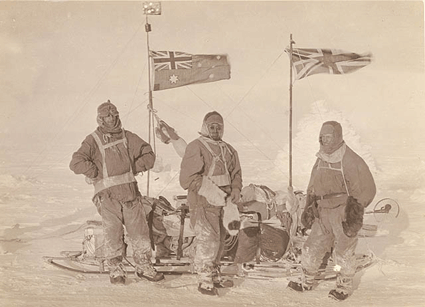
Some of the members of the Australasian Antarctic Expedition. Obviously it's a balmy summer day. Photo: State Library of New South Wales & THE MEN WHO MADE THEM 2 MAWSON'S JOURNEY Continued With their companion and the sledge carrying their food and tent lost in a crevasse, Mawson and Mertz struggled back to the discarded sledge, and improvised a tent by draping the remaining tent cover over skis and sledge struts. The dogs were fed worn-out rawhide straps and mitts until December 15th when they had to kill the weakest dog for food. It was a sad and desperate time, and by Christmas Day their last dog was gone, and they were 160 miles from Main Base. By New Year's Day, Mertz had terrible stomach pains and was becoming delirious, but they continued, resting on the 5th. On the 6th, Mertz was so weak that Mawson hauled him on the sledge. The terrible cold, and probably Vitamin A poisoning from eating the dogs' livers, was taking its toll. On the 7th of January 1912, Mertz died. For hours Mawson lay awake in his bag, wondering how he could continue. He felt "alone on the wide shores of the world," and close to collapse. Nevertheless, he refused to go to sleep in his bag, and die. He thought about his fiancee, Paquita, and marched on. By January 17th he guessed that the Aurora must have arrived, and he was still many weary miles away from the Main Base. The terrain was treacherous. In a single devastating moment he slipped into a crevasse, and dangled at the end of his 14-foot harness. He waited for agonizing seconds to learn whether the sledge above would hold him, or follow and drag him down. When it held, he climbed up the rope, praying the sledge would hold fast. He had just reached the lip of the crevasse, when the edge crumbled, and he fell back, dangling down in the crevasse. His strength ebbing as he swung above the an icy chasm, he thought about cutting the cord, and ending it all. Instead he tried a second time to climb his harness to safety. As he reached the top he gave a wild kick and threw himself out on to the ice and safety. Then on he trudged toward base camp. On January 27th another blizzard struck. His food was nearly gone, but as soon as the weather lifted, Mawson pushed on though he was so ill the soles of his feet had become detached. He wanted to live. He dreamed about Paquita. On the 29th, he found a supply depot, built by members of his expedition who had been out hunting for him. He ate, and read the attached note telling him that the Aurora was waiting. He pushed on to Aladdin's Cave, but another blizzard closed in, trapping him. After a week, he set out despite terrible weather, and reached the Main Base just in time to see the Aurora vanishing over the horizon. The six men who had remained behind to search for him saw Mawson as he dragged himself toward them, but he was so terribly changed one of them shouted, "My God, which one are you?" Weather prevented the Aurora's return so they wintered over. When at last they returned to Australia in 1914, Mawson received a tumultuous welcome – "the hand-grips of many friends – it chokes me!" He married Paquita, and subsequently led several other expeditions to Antarctica, where he made aerial reconnaissance flights, and contributed to the world's growing understanding of the continent. His daughters said he always encouraged them to believe they could do anything.
Ernest Shackleton. His story, familiar to many, still harbours a few surprises. Photo: Scott Polar Research Institute
SHACKLETON & ENDURANCE Standing on a beach in England, fully clothed with his three small children, Ernest Shackleton waded into the sea, turned, and said, "Oh, why is everything all wet?" The children shrieked with joy, and followed him in. The son of Anglo-Irish parents Shackleton loved everything wild and wide open and the chance to walk where no one ever had before. For him this meant returning to Antarctica for the third time, in 1914, in order to become the first man to cross the entire continent. He planned to strike out from the Weddell Sea and finish at the Ross Sea, a distance of 1800 miles. A second party of men would land at the Ross Ice Shelf and build a chain of supply depots to meet and sustain his team. The scourge of Antarctic expeditions is scurvy, a disease easily cured with fresh fruits but deadly if not treated, inflicting exhaustion, muscle and joint pain, nausea, bruising, ulcers, loose teeth, and putrifying flesh and bones. Shackleton had learned that fresh meat will help keep scurvy at bay, and planned accordingly. He never imagined that disaster would strike before ever he set foot on Antarctica. In 1914, Shackleton, his men and their ship, Endurance, reached the coastline of Antarctica, only to be trapped in ice. For several weeks the ship emitted terrible creaking and groaning noises, like a human in agony, until, crushed in the grip of the ice, it sank. Shackleton and his men had scrambled on to ice pack. They watched it vanish. They were standing in the harshest climate on earth, with no radio communications or chance of rescue. "A man must set himself to a new mark directly the old one goes," Shackleton wrote in his journal. Shackleton abandoned his quest for knowledge and glory, and set his eyes on one goal alone: Bringing every one of his men safely home. They began an epic journey across the Weddell Sea ice pack in three small open boats. Together they faced icy storms, killer whales, and constant danger from the treacherous sea. Many fine books and films describe the ordeal in detail. Leadership manuals have been based on Shackleton's methods. These can bring success to businesses, causes and countries today - Dissolve any barriers of class or profession between the team mates, and build camaraderie. Set each person to the tasks he does best, no matter who he or she is. Respond immediately to individual needs within the context of the team. Assure them they will be paid for every day, despite the disaster. Keep them all entertained. Inspire every person with unflagging confidence in fair, tough, self-sacrificing leadership. There are only 18 fur sleeping bags, so the men cast lots for them. They only realize later that there was something odd in the drawing – none of their commanders drew the warm, fur bags. Their names had not been entered. Shackleton had a transcendent goal that was bigger than he was – the safety of his men. The worth of the mark he had set himself transformed him. His leadership became empowered by love. Against all the odds, they arrived safely at the black basalt cliffs of Elephant Island which lies off the Antarctic Peninsula, and is one of the ten most difficult small-craft landings in the world. But there was no safety there. They had to make another effort to reach help which lay more than 500 miles away. They rebuilt one of their small, open boats, the 22-and a-foot-long James Caird.
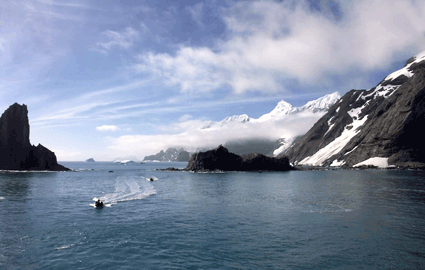
On forbidding Elephant Island off the coast of Antarctica, the crew of the Endurance expedition lived for four and a half months while Ernest Shackleton and five crewmen sailed in an open boat across 800 icy miles to get help. Photo: [email protected] In a desperate bid for rescue, Shackleton and five others embarked for the whaling station on the island of South Georgia, a journey of almost 800 miles through huge and stormy seas. Frank Wild and the men on Elephant Island had to try to survive on rations. Their only shelter will be the hut they build out of their boats. In the Caird, Worsley steered brilliantly – if he had missed South Georgia, Shackleton and his men would have gone down in the open Atlantic and never been heard from again. Thirsty, hungry, tired, they neared the mountainous island after 17 days, and almost capsized in fierce winds. With their boat falling apart, they were forced to land on uninhabited coast. Frantic to get help for the men they had left behind, they crossed the icy spine of South Georgia's mountains to the whaling station in 36 hours, a speed which has never been equalled. Meanwhile, ten men from Shackleton's Ross Sea party had already been dropped off - by the Aurora - to lay supply depots for Shackleton as far south as the Beardmore Glacier. Without radio communications, they did not know that Shackleton had not set foot on the continent. The remarkable story of the long march They were two teachers, a geologist, a physicist, a medical orderly, a clerk, a clergyman/photographer, two sailors, and a college athlete. Anxious to make sure that Shackleton's party will not starve, they continued to work through the bitter winter while suffering frostbite, starvation, and scurvy. Blasted by high winds and cold, facing blizzards and yawning crevasses, they laid in half the supply depots. When they returned to their ship for the remaining supplies, they learned to their horror that the Aurora had been swept away by fierce storms, and was so badly damaged it was unable to return. They were marooned. Still determined to lay the rest of the supply depots on which they thought the lives of Shackleton and his men depended, they set out to build the rest of the food lifeline. They dragged 4,000 pounds of supplies over 1300 miles while living on starvation rations themselves. The heroes included Harry Wild (Frank's brother), Earnest Joyce, and Richard Richards. On their return from laying supplies on Beardmore, they were reduced to eight lumps of sugar and half a biscuit. Several men fell ill from scurvy, and became so debilitated they could not walk. Leaving one man behind in the tent, the men who could still walk raced for Hut Point, dragging two dying men on the sledge, in the hope they could reach fresh meat in time to save them. One man died along the way. They buried him, and went on. Arriving at the Hut, they immediately killed seals for food, and as soon as they had eaten, headed back to retrieve the last man in their party. Wondering whether they would ever return home, they endured another Antarctic winter, making scientific observations all the while, and lost two more men. In the meantime, Shackleton was working desperately to rescue the men on Elephant Island. After three failed attempts in stormy seas, a rescue was successful, and Shackleton discovered to his unspeakable relief that all the men of the Endurance had survived. He arrived in New Zealand in December 1916, only to find his Ross party was still stranded. The Aurora had been repaired, and he set sail immediately to rescue them. In January 1917, they were finally reunited. Shackleton later wrote about those undaunted men who had laid supplies depots for more than a thousand miles - "No more remarkable story of human endeavour has been revealed than the tale of that long march." Before Shackleton and the survivors left Antarctica, they built a cairn for the three men who had died. Their epitaph, which might be called the wish of every explorer, reads - "Things done for gain are nought / but great things done endure."
When you contribute to this website,
|
BACK TO BRITISH HEROES &
Mawson describes the ordeal and triumph of his return from death. For UK orders:
For US orders:
Shackleton in his own words. For UK orders:
For US orders:
Caroline Alexander's superb account includes expedition photographer Frank Hurley's sublime and powerful photographs. For UK orders:
For US orders:
Every superlative has been used to describe the DVD. We'll leave it at "unmissable". For UK orders:
For US orders:
Kelly Tyler-Lewis describes the ten brave, lost men of Shackleton's Ross party in a gripping account. For UK orders: For US orders:
|
SHARE THE INHERITANCE evokes the courageous and compassionate men and women who defied a world of cruelty and superstition to give us gifts of intangible and tangible wealth. Uniquely, this illustrated book collects the gifts of our Inheritance under one cover. A rewarding treatment of British and American history, written for inquisitive adults and intelligent children. Written by Catherine Glass and David Abbott MD, MRCP ORDERS UK ORDERS US AND CANADA
Questions? There is more about the book here.
|
 |
||