Blog Home | All Posts | Liberty Timeline | Faith in Freedom | Heroes | Science Timeline | Artists | Life | Sports | Calendar | Brits Worldwide | Imagine
|
|
Blog Home | All Posts | Liberty Timeline | Faith in Freedom | Heroes | Science Timeline | Artists | Life | Sports | Calendar | Brits Worldwide | Imagine |
|
The man
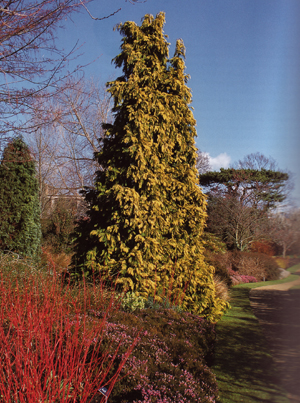
Graham Stuart Thomas studied at the Cambridge University Botanic Garden (above). The grumpy looking conifer, Chamaecyparis lawsoniana 'Winston Churchill, was one of his favourites. Graham Stuart Thomas Graham Thomas began his garden career at the age of six when “My Godfather gave me a large-flowered Fuchsia. . .which set me on my earthly career.” At 17 he became a student at the Cambridge University Botanic Garden where he weeded, and raised plants from the seeds arriving from historic collecting expeditions. In no time he was rapidly advancing through the best nurseries because he seemed to know more about plants than anyone else, and his passion for plants - his real love of them - swept everyone else along. Gertrude Jekyll In 1931, when he was just 22, he cycled over to Mustead Wood to meet Gertrude Jekyll. She had been discouraging guests since 1900, but though she was 87 she welcomed Graham. They discussed all the plants and groupings in her garden which had caught his eye. It seems likely she shared her love of roses with him. Roses Shortly afterwards he became a director of Hilling's wholesale nursery, and began collecting old roses in danger of being lost forever. I can understand Thomas's love for roses, though it took me years to fall under their spell.
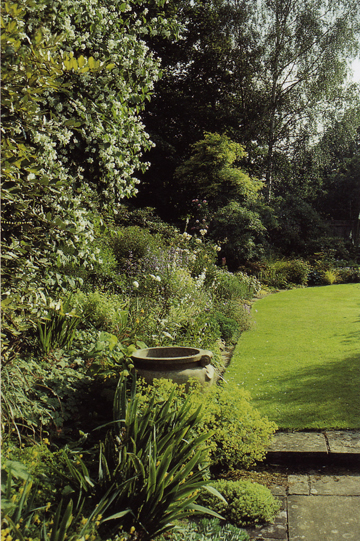
Early summer in a corner of Thomas's garden Image: Garden through the Year Plantsman GST loved plants, and his affection and interest were grounded in an encylopaedic understanding of how plants liked to grow. He knew plants with an intimacy that defies description. He was, simply, the greatest plantsman of the 20th century, or perhaps any century. He was also kind and generous in sharing what he knew. National Trust After becoming partner at the celebrated Sunningdale Nursery, Thomas developed beautiful planting schemes. This exposed his work to the National Trust which had acquired its first garden, Hidcote, and asked him to become a part-time consultant. Soon, as the Trust purchased other gardens, Thomas was travelling all around Britain , creating plans that would preserve each historic garden's character with the minimum amount of maintenance. His 18th century aesthetics did not meet James Lees-Milne's demanding eye - Thomas planted some "horrid little Japanese maples" at Stourhead, Lees-Milne moaned - but he pleased almost everyone else. His commissions ranged from cottage gardens to Penhryn Castle in North Wales and Mottisfont Abbey in Hampshire, which he filled to overflowing with roses. Writer In his spare time, he was writing books. Old Shrub Roses (1955) described favourite early nineteenth century roses - intensely scented Damasks, richly austere Gallicas and elegant Albas. Shrub Roses of Today (1962) identified forgotten species and hybrids from Japan, North America, English cottages and the mountains of China. Climbing Roses Old and New (1965) considered ramblers and climbers such as the "still incomparable" 150-year-old 'Desprez a fleur jaune'.
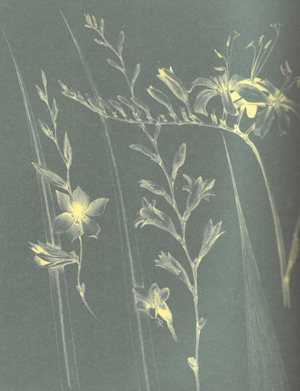
Thomas was a gifted botanical artist. Image: Garden through the Year Thomas saw gardening as an art allied with craft. In his mind it was important not to separate the two. His advice about planting, cold climate zones, plant colours and structure, plant vulnerabilities and strengths were readily shared with anyone who asked and with the readers of Garden through the Year. There you will find: The precise variety of birch for a small garden, slender and silvery white (Betula verrucosa 'Laciniata') The most reliable snow drop (Galanthus nivalis 'Atkinsii') and where snowdrops thrive Prunus mume, the ravishingly fragrant Japanese apricot, which has been treasured for centuries but whose "flowering stems when cut do not appear to enjoy heated rooms" The fragrant early flowers of Daphne mezereum, a British native, which are frost-resistant Helleborus orientalis guttatus - green, pink, murrey, or white, "extremely beautiful, weather-resistant, long-lived and amenable to cultivation in a great variety of soils and positions. On the whole I would give them shade and a good rich soil." Symphytum grandiflorum "a free-spreading ground cover bearing croziers of cream bells for many weeks, the whole not exceeding a foot in height. A little taller are the hybrids known as 'Hidcote Blue' and 'Hidcote Pink'. They completely take care of shady banks being weed-proof. . ." "Magnolia conspicua (M. heptapeta) snowy white, every flower a globe of simple purity". The secret to getting wisteria to bloom "is to remove all the long lanky shoots in summer, and thus to encourage the short side shoots to produce flower buds". The silvery leaves of the willow Salix alba sericea, "a delight through the summer" In August Anemone x hybrida 'Honorine Jobert', "with its silky white petals, pale green central knob and circlet of yellow stamens. . .nothing more beautiful has appeared during the whole year." Thomas had thousands of wonderful ideas about plants and planting. His concern over the loss of plants led to the National Council for the Conservation of Plants and Gardens (NCCPG). When he died in the spring of 2003 at the age of 96, he had received every honour that his country and gardening societies could give him - an OBE, VMH, DHM, and VMM. He would have liked to see another spring become summer become autumn become winter. He found beauty in every season.
When you contribute to this website,
|
EXPLORE THE ENGLISH GARDEN
The Graham Stuart Thomas Rose Book brings his trilogy of rose books together, revised and updated. For UK readers
For US readers
Traditional English gardens in the care of the National Trust include Ham House and King Henry's hunting lodge. For UK readers
For US readers
For UK readers
For US readers
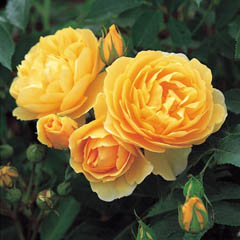
David Austin Roses created the hardy short climber named after Graham Thomas. It has Thomas's sunny, elegiac personality. IMAGE: David Austin
Memories of great gardens and gardeners - Edward Bowles, William Robinson and Vita Sackvill-West. . . For UK readers
For US readers
Heathers for autumn and winter Image: Garden through the Year
For UK readers
For US readers
|
This wonderful book describes Britain's gifts to the world. Adults will refresh their understanding of profound events in British history, and young people will find inspiration. Warning: This book defies aggressive secularism and unthinking multiculturalism. Written by the co-editors of this website, Share the Inheritance is beautifully illustrated with 125 colour images and a timeline. Available at Amazon UK and at Amazon USA.
|
 |
||