On the trail of royal quarrels, southern voyages, and the storied Gardens
In a bend in the river Thames between Kew and Richmond, a royal deer park became the site of a royal palace, king and courtiers arriving swiftly by river. One hundred years later, the Duke of Ormonde leased the lodge, built a summer house, and had walks cut through the woods. The numbers of birds made "a most delicious habitation.” Lovely while it lasted, the property was swept away from the Duke after the unsuccessful Jacobean Rebellion, and the Prince and Princess of Wales, exiled by George I, moved in.
The Princess, later Queen, Caroline, who would become the secret power behind George II’s throne, decided to landscape her estate. In 1719 she called a parliament of gardeners, invited suggestions, and selected two of the greatest British landscape designers, Charles Bridgeman and William Kent, to set about "helping Nature, not losing it in art".
She took the words from their mouths. At Richmond Lodge, as the estate was called, Bridgeman designed a free and informal landscape of woods and fields. He carved out Merlin’s Cave, established the Amphitheatre and Oval connected by the Duck Pond, and laid out a canal garden. Kent built a classical pavilion and a romantic folly. Large crowds strolled along the promenade, and Caroline enjoyed some rural idylls there before dying, deeply in debt, in 1737.
The Hanovers maintained a family tradition of hostile relations. Just as George I had quarreled with the future George II and Caroline, and banished them from court, so George II and Caroline quarreled with their son, and banished him. This Prince and Princess of Wales also took refuge at Richmond. The Prince died in 1751, but not before he made changes to the gardens – redesigning gardens was apparently another family trait. A year after her Prince died, Augusta decided to see them finished. It was soon rumoured she was having an affair with John Stuart, 3rd Earl of Bute, the tutor of her son, the future George III. Bute, however, had fallen in love with the garden, too, and he and Augusta made plans to establish a serious botanic garden, a garden which would “. . .contain all the plants known on Earth".
The dream of a botanical garden was realized in 1759, when the Physic or Exotic Garden was created. It is the direct ancestor of today's establishment, and “1759 is now accepted as the foundation of the Royal Botanic Gardens, Kew.” Augusta had a quixotic spirit, and she hired William Chambers to build the legendary 10-storey red Chinese pagoda.
When George III came to the throne, he naturally decided the garden needed alterations, and hired Lancelot ‘Capability’ Brown, who contributed to the garden’s design mainly by sweeping away previous contributions, and introducing sweeping vistas to the scene. Despite his best efforts, however, it is still possible to see Bridgeman and Kent's work in the Gardens.
Meanwhile, as the website of the Royal Botanic Gardens, Kew points out,
The garden in William Aiton's charge covered an area of about 10 acres (4 hectares) and was devoted to medicinal plantings. It continued to grow and flourish under Aiton's care and Princess Augusta's patronage, but it was not until after her death in 1772 that Sir Joseph Banks began his involvement with the site and it developed an international significance. . .
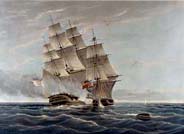
Joseph Banks was twenty-five when he joined Lt. (later Captain) Cook on HM Bark Endeavour, a ship designed to handle reef-strewn oceans and archipelagos. They rounded Cape Horn, and arrived in Tahiti in 1769 to observe the transit of Venus across the Sun as part of the Royal Society's scientific effort to establish planetary distances. By then Banks was already filling the ship with his South American plant specimens and irritating Cook no end. Once Tahiti had been reached, Cook opened his sealed orders, and learned they were to sail south, to search for the continent of Terra Australis. They reached New Zealand and sailed along the east coast of Australia. Banks was ecstatic. There were thousands of plants he had never seen before and since the ship required a long layover for repairs, he had time to collect buckets of them.
Less than ten years later Banks would be dispatching explorers and botanists to all corners of the globe, and botanical specimens would pour into the Royal Botanic Gardens, which he now headed. The English Garden, Part 2, describes a few of those horticultural adventurers.
In the 1840s, William Jackson Hooker became director, and initiated the great metamorphosis and flowering of the Gardens. Hooker established the museum, the library, the crucial department of economic botany, and the extraordinary glass palaces that are the Palm and Temperate Houses. As a result of his work and those who followed him, the Gardens now contain the largest plant collection in the world. Research has led to the commercial cultivation of the banana, coffee, tea, the rubber tree, and medicinal drugs. Classes for adults and Midnight Ramblers for children have become a feature, along with exhibits such as the upcoming Tropical Flower and Orchid Festival inside the Princess of Wales Conservatory, which is brimming with 30,000 tropical plants and exotic flowers. Reflecting in a tropical pool a large fallen tree 'drips' with orchids. . .epiphytes fall like curtains. . .
And so at long last must the curtains fall on this tale. The Tropical Flower and Orchid Festival opens February 3 and runs to March 4.