The Fellowship to abolish slavery - William Wilberforce

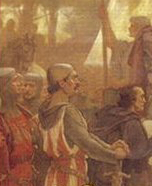
Under an English oak in 1787 three young men pledge to abolish the slave trade. They are William Pitt, William Grenville, and William Wilberforce.
William ‘Wilber’ Wilberforce liked to have a good time. At Cambridge he gambled, rarely cracked a book, and usually kept “a great Yorkshire pie in his rooms to which all friends were welcome”. He was always generous with money. His father had died when he was nine and he had inherited a fortune. He would have laughed incredulously if anyone had suggested that whether he believed in the teachings of Christ would determine whether 700,000 Africans lived or died.
In 1780, when he had just turned 21, Wilber decided to stand for Parliament. The diarist Boswell caught sight of him giving a speech to four thousand in the freezing cold in York, and wrote, “I saw a perfect shrimp. . .who swelled into a whale.” With the dispersal of about £8,000, a large sum at the time, Wilberforce was elected MP for Hull. Pitt, who was Britain’s youngest Chancellor of the Exchequer at the age of twenty-one, became his best friend. After the House had sat all night, they used to talk politics and fence with swords. The American War of Independence was ending. The wars that would engulf Britain and Europe lay just beyond the guillotines of the French Revolution, which were about to fall.
Wilber maintained a relentless schedule at fashionable balls and gambling clubs. He was hospitable, witty, and charming. Those who heard him speak in Parliament thought he had one of the most persuasive speaking voices in the world, but aside from supporting Pitt and sticking up for Hull’s maritime interests, he seemed at a loss. His bills did not impress his fellow MPs or the House of Lords. However, his sardonic repartee, flashing like a sword, was devastatingly effective.
His life might have continued in this pleasantly forgettable way except for an accident – unless it was no accident and Wilberforce had unconsciously chosen to follow a track he barely saw.
When a friend dropped out of a trip to the south of France, Wilber, who didn’t think he could stomach his mother’s company alone, asked a young Cambridge don to come along. Isaac Milner, who later held the Lucasian professorship of mathematics, had been a poor weaver who had earned a scholarship to Cambridge. Merry in public, uproarious in private, he was a big, brilliant man. When he and Wilber were climbing an icy hill and Wilber’s loaded carriage and horses began sliding backwards, Milner caught them, and held them fast.
Wilber believed that only the vulgar and uninformed held enthusiastically Christian views. He doubted Christ’s divinity, and he expounded on his beliefs, or rather his lack of belief, as he and Milner rattled in the coach toward Nice. Milner listened silently, then told him if he wanted to discuss the topic in a serious way he would be happy to oblige. To Wilber’s surprise, Milner, who had read the New Testament in Greek, proceeded to explain “the intellectual heart of Christianity.” They argued the rest of the way down and on the way back to London, discussing a book Wilber had borrowed, Philip Doddridge’s Rise and Progress of Religion in the Soul. Back in the capital Wilber resumed a life of dinners, cards, theatre, and politics, and their discussion faded from his mind.
Strange then that he should make a second journey across France with Milner the next year, and thrash out the New Testament once again. Another person’s conversion is mysterious even to those who believe. To those who do not, it is inexplicable. His mother heard he had become a melancholy and mad Christian evangelical, but when he visited, she found him warm and cheerful and, for the first time, no longer irritated with her. A friend quipped, “If this is madness, I hope he bites us all.” Wilberforce was happy, but struggling with a problem. Having placed his trust in Christ he thought he had better live a strictly religious life and give up his seat in the House of Commons.
He stewed for months. Finally he wrote his friend Pitt, who had become Britain’s youngest Prime Minister, and told him he was quitting politics. Pitt wrote back, asking him not to make his talents “useless both to yourself and mankind”. Wilber turned for advice to an old parson, John Newton, who had been at various times a sailor, a slave trader, and a slave. Newton had heard God’s voice in a storm when he thought his ship was going down, had eventually abandoned the slave trade, and had written three hundred hymns, among them one of the world’s most popular, “Amazing Grace,”
Amazing grace, how sweet the sound
That sav’d a wretch like me.
I once was lost, but now am found,
Was blind, but now I see.
Despised by fashionable society, Newton shunned politics as worldly, but he told Wilber what he did not expect to hear – that the Lord needed him to do some good in the House of Commons.
The question was what. Open to ideas, the monstrousness of slavery hit him in the face. How could he have missed it before? We have had the same experience, I think. What was in the shadows, what we were too comfortable to see, lunges out of the dark. We can run or we can do something about it.
In 1786, after reading James Ramsay’s book, Wilber talked with Ramsay and the Middletons in Teston. He saw that slavery, which was accepted around the world, was morally wrong. They urged him to take on the abolition of the slave trade in Parliament. Middleton believed he had the courage and faith to endure a long, hard battle. His reputation for independence, high principles, and the "singular charm of his character, which made him popular even with his antagonists, marked him out as an ideal leader of the cause (DNB)”.
In May, 1787, Wilber sat with Pitt and William Grenville under an oak tree and discussed what he should do. By the time he stood up they were agreed: He would lead the charge in Parliament to abolish the slave trade, and they would support him. Later that month, he told Thomas Clarkson, Granville Sharp, and the Friends that he would be their man in the House.
They faced the most powerful entrenched interests in Britain and violent men. None of the members of the Fellowship, except possibly Middleton, had any idea how long or hard the battle would be.