Blog Home | All Posts | Liberty Timeline | Faith in Freedom | Heroes | Science Timeline | Artists | Life | Sports | Calendar | Brits Worldwide | Imagine
|
|
Blog Home | All Posts | Liberty Timeline | Faith in Freedom | Heroes | Science Timeline | Artists | Life | Sports | Calendar | Brits Worldwide | Imagine |
|
Laurie Baker
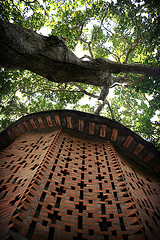
“Transformed" by a meeting with Mahatma Gandhi in the 1940s, British architect Laurence Wilfred Baker (Laurie) went to India to design buildings for a leprosy mission. He spent the rest of his life designing visionary and durable buildings at low cost that were beautifully responsive to climate and country, to the needs of poorer Indians, and to the tradition of Indian craftsmanship. Practical delight Described as “droll” and unassuming, with “no more than four sets of shirts and trousers, all made of handwoven khadi fabric” to his name, Baker lived simply with his Indian wife Elizabeth, a doctor, and their two daughters and son in a home he had built.“His respect for nature, instilled by his Quaker upbringing, guided his on-site improvisations." Two favorite motifs, uniting beauty and function, were his brick towers and pierced Mughal-style brick screens "which allowed natural air movement to cool the interior and create intricate patterns of light and shadow. ""The results," noted the architectural commentator Alan Powers, "are delightful, practical and, in a country where craftsmanship has not yet been systematically effaced, they show exactly the joy in work for the maker and the user that William Morris talked about, combined with low energy consumption in materials and running costs" (Telegraph Obituaries). Building with ingenuity and a respect for craft “His coup de théâtre was his Centre for Development Studies, a 10-acre postgraduate campus built in the early 1970s on a hill above Thiruvananthapuram, and which gave full rein to his ingenuity and imagination. Rippling brick walls coil around trees enclosing shady, circular courtyards, a network of raised walkways, roof terraces and an eight-storey library tower."
Tower designed by Laurie Baker “. . . In the 1980s Baker's ideas caught the imagination of a younger, environmentally-aware generation of Indian architects, nearly 100 of whom now work for Costford (the Centre of Science and Technology for Rural Development), a non-profit organisation that practises Baker's approach. The Centre has built homes for 10,000 poor families, for which it charged no design fee." (Telegraph) Laurie died at 90 in March, 2007. At first we could not find many images on the web of Baker's work. This website, created by the Baker family, corrects that and describes his ideas in some depth.In a tribute in 2001, Islamic Voice wrote, “Walls are not plastered. The bricks are exposed. . .Kerala has a lot of such modern buildings. Many people in this beautiful state now prefer to build their homes in this style. Most people would tell you that these houses and buildings were first designed by an architect known as Laurie Baker. Now Kerala has several thousand such homes, fishing villages, boat houses, and public buildings. You can spot them by their arches, pyramidal roofs, slender towers and jutting out roofs. Whenever you visit Kerala, try to take a hard look. Even their sight is so pleasing.”
When you contribute to this website, |
BRITISH ARTISTS ONLINE
SEEING MUSIC IS HERE The luminous links between Georgian architecture, music, and breaking waves.
SHAKESPEARE'S HEROINES
Elton John's Six Dark & Dazzling Decades HERE
STEPHEN LANGTON'S GOLDEN SEQUENCE HERE
BRYN TERFEL |
SHARE THE INHERITANCE evokes the courageous and compassionate men and women who defied a world of cruelty and superstition to give us gifts of intangible and tangible wealth. Uniquely, this illustrated book collects the gifts of our Inheritance under one cover. A rewarding treatment of British and American history, written for inquisitive adults and intelligent children. Written by Catherine Glass and David Abbott MD, MRCP You can purchase your copy at PayPal UK, Amazon UK or Amazon US. With PayPal you can choose to pay using either your credit card, or your PayPal account. PURCHASE WITH PAYPAL UK PURCHASE WITH PAYPAL USA
Questions? There is more about the book here.
|
 |
||