Blog Home | All Posts | Liberty Timeline | Faith in Freedom | Heroes | Science Timeline | Artists | Life | Sports | Calendar | Brits Worldwide | Imagine
|
|
Blog Home | All Posts | Liberty Timeline | Faith in Freedom | Heroes | Science Timeline | Artists | Life | Sports | Calendar | Brits Worldwide | Imagine |
|
Georgian style embodies the mathematical Photo: Courtesy: NASA Hubble Telescope SEEING MUSIC GEORGIAN ARCHITECTURE You are aware that some Ancient Greeks believed there is a "music of the spheres". Modern scientists scoffed at the idea, until astronomers discovered that stars like our Sun sing. This requires a bit of explanation. If the singing of the stars leaves you cold, you are welcome to fly down the file and find something more to your taste. The heat of the Sun generates sound waves which resound through the interior, and are reflected on the surface in oscillations. Astronomers call these oscillations and the periods of silence between them the “ringing” of the Sun. They say that the vibrations of stars are faint, and difficult to hear, but they have translated their ringing into sound waves audible to the human ear. Curiously, these waves sound like music. In particular they sound like a melody that is sung by one voice and answered by a second voice in a different key with a third voice entering and singing the melody an octave higher or lower. The first voice returns with a different melody that begins another series of musical variations. . .as every musician knows, the Sun is singing a fugue. How this music bears on Georgian architecture we will see, but first we have to look at three Italians of whom we are very fond.The Italians The great Italian Renaissance poet, architect, mathematician, and cryptographer Domenico Alberti (1404-1472) was sure that divine truths governed mathematics, music, and the universe, and he thought he could see their underlying unity. He had studied the work of architect and engineering genius Filippo Brunelleschi (1377-1446) who researched the "secrets" of Classical architecture. Brunelleschi invented a new Classical style based on the proportions he discovered, and though no one knows exactly what secrets Brunelleschi found or how he applied them, it is believed that Alberti's ten books on architecture describe at least one of his guiding principles: The mathematical ratios that create musical harmony can be used to design a beautiful building. Andrea Palladio (1518-80) based his designs on the ideas of Alberti and Brunelleschi. He also believed in the cosmic significance of numerical ratios, as did ancient Britons and Anglo Saxons. Palladio built villas in the Italian countryside based on "divine" proportions and his pragmatic understanding of how a farm works. Then he wrote up his ideas in detail. The Earl of Burlington and William Kent Years later, Richard Boyle, the Third Earl of Burlington and 4th Earl of Cork (1694-1753), was travelling in northern Italy. While there he saw Palladio's Villa Rotonda. We imagine his steps falling silent, his lips opening mutely. He was falling in love. He looked. He listened to the visual music of the house. He resolved to build a house like this for himself, and as money was no object, it appeared that he would.
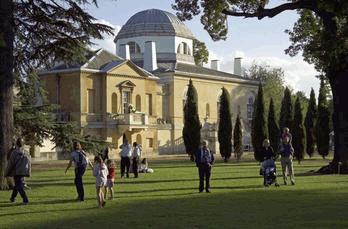
With the help of William Kent, Palladio's architecture manuals, Image: English Heritage Chiswick House sounds the opening notes of a new, serene and festive architecture – Classical architecture with a distinctly English accent that will come to be known all over the world as Georgian. (Burlington also leads the way in creating a new and liberated landscape park, but that is a different story, told in The English Garden). Urban transformations Architects such as John Wood the Elder, John Wood the Younger, and John Eveleigh transformed the city of Bath, while London saw the development of new and elegant squares of homes.
The Royal Crescent, Bath, designed by the architect John Wood the Younger. The formality of its front facade contrasts with the intimacy of the rear facade and private gardens. Image: Adrian Pingstone
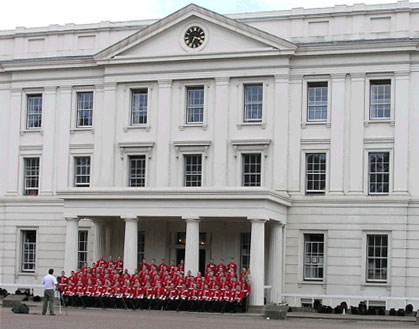
Georgian buildings were not built only for the well-to-do. Photo: [email protected] Georgian style looks at ease with itself and makes people feel at home. It is formal, but the beauty of its formality frames us and makes us look and feel good. Then again, Georgian sometimes dispenses with charm to look decisively commanding.
Wellington Barracks, London, and Image: David Abbott The name Georgian, which comes from the three Georges who ruled Britain between 1714 and 1820, is used everywhere but in America. Avoiding references to their bête noir, George III, Americans call buildings in the Georgian style colonial. Some of America's loveliest homes and most loved public buildings are Georgian.
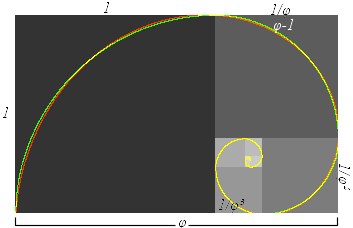
The White House Photo: [email protected] The Golden Ratio The width and length of many Georgian room dimensions are based on the harmonic proportions of music. One harmonic proportion that can be identified is the Golden Ratio encapsulated in the infinite Fibonacci sequence. In this sequence every number (after the first two) is the sum of the two preceding numbers: 0, 1, 1, 2, 3, 5, 8, 13, 21, 34, 55, 89, 144, 233, 377, 610. . . Each number is approximately 1.618 larger than the one that precedes it, creating a ratio called the Golden Ratio or ϕ (phi).
Image: Wiki By drawing a series of golden rectangles nesting inside each other, and connecting the centres of the squares with a line (it will curve), we can see how the infinitely expansive spiral galaxy is based on the proportions of the Golden Ratio. This proportion makes a beautiful appearance in Western music, whose musical scale consists of 8 notes with the fundamental chord, the triad, consisting of three pitches that fuse their sound: Two pitches are a perfect fifth apart and a third pitch is a major or minor third lower.
This Georgian home in Britain shows barely a hint of Palladio's balanced three-part or five-part profile. The temple facade is faintly echoed by the slender and unobtrusive pilasters and the modest pediment above the door. Photo: [email protected] The Golden Section also appears in the relationship between the width and length of Georgian house exteriors, rooms, and windowpane sizes and in the proportions of the delicately shaped iron staircases that spiral inside houses. Staircase. Perfection. Just a line, and a curve, and another line, and another curve. In short, a Georgian staircase. When one has said this, one has said all that is necessary to say. We know exactly what he means - we've seen it - but we can't find a photo to do that staircase justice.
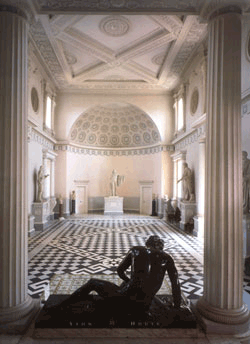
Robert Adam (1728-1792) occasionally used white and black to dramatic effect, as here at the great hall at Syon House, but his preferred palette was pastels and rich reds, blues, and golds. The red drawing room at Syon House is flamboyant. Robert and his brothers James and John designed wall and ceiling treatments, tables, chairs, commodes, mirrors, sconces, and even beds. Image: Syon Park Colours - lots of them - and dancers
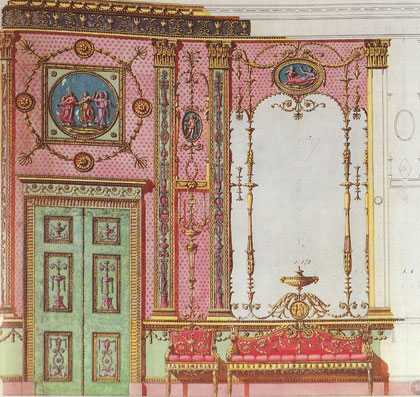
An Adam design for the mirror room at Northumberland Place. The Georgians loved colour. In the hands of the Adam brothers, the subtle and enthralling music of Georgian interiors can be seen in the counterpoint of floor patterns and ceiling designs, the rhythms of wall, door, window and hearth decorations, and the sinuous solos of tables, chairs and sofas. Georgian rooms naturally suggest music. They were designed to hold dancers. Guests walked into a hall that spanned the length of the house, and gave easy access to every room, creating the circulation necessary for the dances and routs of which they were so fond. The furniture - beautiful but there was a minimum of it - was pushed back against the walls. It was moved into a room when it was needed and returned to the walls at night, a convenience when they holding exuberant balls. We would say more about the furniture, but that deserves a file of its own. Living in a Georgian house Georgian rooms were painted in pale lime green, apricot, ruby red, brilliant blue and celadon. It is said that the trick is to stipple the colour on the walls with artist's oils, and wash it with a darker scumble glaze that intensifies the underlying colour. When light pours in through the tall, deep-set Georgian windows, the colours become translucent.
This room is furnished quite differently from an original Georgian. For one thing, there are less dancing possibilities. The cornice molding of Ionic dentils and the height of the white ceiling create a sense of airiness. The dog makes us feel at home. Image: Christopher Simon Sykes, English Country Living in a Georgian house requires some funds, but that is always the case with civilisation - even at its simplest it requires money. (Living without civilisation requires lives.) In the case of the Georgians, living required bold men willing and able to take ships round the world. Even middle-class Georgians depended on servants to wash and cook and haul coal to the fire. As the Ingenious Timeline shows, Georgian and Victorian inventors freed us from using servants for these tasks. Like Georgian designers, British inventors will look for beauty, function, and structure, and find their most significant insights in nature and numbers. Georgian architecture balances competing interests to create stability and light, harmony and pleasure.
When you contribute to this website,
|
BRITISH ARTISTS ONLINE
A set and costume designer with a genius for architecture though he has no formal training,
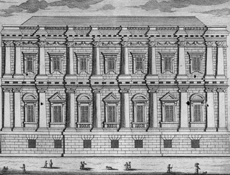
In his 20s, Inigo Jones studied classical architecture in Italy, and returned to Britain to become Britain's first great architect. Influenced by Palladio, he designed the Banqueting House (1622) for James I. Note the pilasters (columns set flush to the wall), the windows, and the jovial dogs on the street outside.
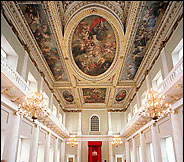
Inside, the Banqueting House is built with soaring columns and windows that flood the white and gold room with light. At one end sits the red throne. The vast ceiling, painted by Rubens, swirls with figures. Image: Norton
Stratton describes the mathematical principles that create a luminous unity in classical architecture. For UK orders:
For US orders:
Versaci's text and photographs show you traditional design principles integrated with modern needs. For UK orders:
For US orders:
A surfer exploits a wave's Golden Section spiral.
A brilliant book about all things Georgian published by the National Trust for Historic Preservation. For UK orders:
For US orders:
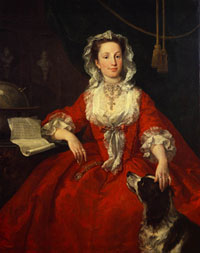
HOGARTH HERE
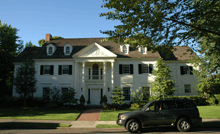
American colonial.
Sometimes even the garages are Georgian.
. . .he may be standing in a Geeorgian doorway, and the sun may shine on it, and he may look up and suddenly perceive that he is standing in a frame that is as perfect as a melody by Mozart. ~Beverley Nichols, Merry Hall
The movement to abolish slavery began with the Georgians in the 18th century. |
This wonderful book describes Britain's gifts to the world. Adults will refresh their understanding of profound events in British history, and young people will find inspiration. Warning: This book defies aggressive secularism and unthinking multiculturalism. Written by the co-editors of this website, Share the Inheritance is beautifully illustrated with 125 colour images and a timeline. Available at Amazon UK and at Amazon USA.
|
 |
||