Blog Home | All Posts | Liberty Timeline | Faith in Freedom | Heroes | Science Timeline | Artists | Life | Sports | Calendar | Brits Worldwide | Imagine
|
|
Blog Home | All Posts | Liberty Timeline | Faith in Freedom | Heroes | Science Timeline | Artists | Life | Sports | Calendar | Brits Worldwide | Imagine |
|
Seeing Visions
William Blake first saw angels when he was about eight years old. Despite poverty and professional obscurity, he had the courage to tackle the unspeakable and the grace to describe joy in his naturalistic and mythic poetry and art. WILLIAM BLAKE Childhood Born November 28th 1757 in London, William Blake was about eight when he had his first vision, and told his mother he had seen a tree filled with angels "bespangling every bough like stars." His mother beat him. His father thought his headstrong son was imagining things, but he respected his passion for art. He sent him to a drawing school on the Strand. The young Blake scoured dealers and auction houses for old prints and engravings by Raphael, Michelangelo and Dürer. He already had an eye for the beautiful “bounding line”. He first learned to draw by copying these Old Master prints. The apprentice and the artist When he was fourteen, Blake was apprenticed to an engraver, and spent seven years gaining the necessary skills. This "involved considerable drudgery" (Oxford DNB). He spent long afternoons sketching in Westminster Abbey, to create the drawings that would be used for engravings. It was there he learned to love British history and medieval art. Engraving illustrations for books, he also learned about the natural sciences and archaeology. At 21, with his apprenticeship over, Blake became a commercial engraver. But what he longed to become was an artist. Working to earn a living, he applied to the Royal Academy, and was accepted. He began to study, and to make friends with other artists. Around this time Blake was swept up in a London protest, and saw the storming of Newgate Prison and the freeing of its prisoners. He fell in love, was rejected, met kind Catherine Boucher, and married her. Marriage might not seem to suit the prophetic visionary he was to become, but Catherine became his most loving and steadfast supporter. "She was the most important person in Blake's adult life, a constant companion, helpmate, and faithful believer in his genius" (DNB). He may have depicted her as Eve, in the engraving below.
Adam and Eve, engraving for Paradise Lost, 1799-1800 Blake had been writing poetry since he was twelve. He was in his mid-twenties when his first collection of poems, Poetical Sketches, was published with the help of patrons. Around the same time, in 1784, Blake and his brother Robert opened a print shop. They managed to make a living, but the expense of printing was costly. Blake could not reproduce his own art unless he could find another way to reproduce it.
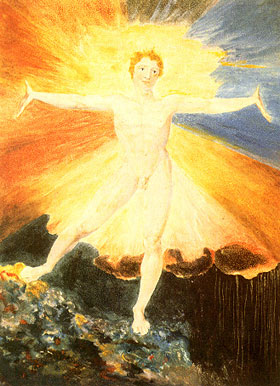
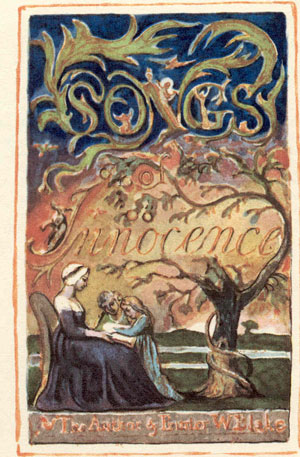
Glad Day, c. 1794 He who binds to himself a Joy Death and a new invention Blake deeply loved his brother. When Robert fell seriously ill he nursed him for exhausting weeks until Robert died. A year after his brother's death, Blake had a vision of his brother telling him how to invent a new method of printing - one that would free him to publish his own work. “His new method was more direct, faster, and required less technical expertise (and expense) than intaglio printmaking. It permitted Blake the artist to paint his images directly on a copperplate in acid-resistant varnish; Blake the poet could write his words in the same medium. The text must be executed in reverse, so that impressions would print right-way around, but this was only a slight impediment for a trained engraver. After the uncovered areas of the metal were etched away, the images stood in relief and could be inked quickly on, and printed with low pressure from, the surface. The process embodied a unity between conception and execution—a practice that became a principle of Blake's later aesthetic doctrines—rather than the divisions between invention and production embedded in eighteenth-century print technology and its class distinctions among authors and printers, artists and engravers" (Oxford DNB). Blake had made a breakthrough advance and created "a symbolic union of his twin creative forces” (British Library). The first of his 'Illuminated Books', as he called them, appeared in 1788 and 1789. Illuminated Books
For the first time Blake united poetry with visual art. The sun does arise,
Decades later, about 1826, Blake depicted Cain fleeing his murdered brother under a stormy sky shot-through with light as his parents gaze in horror. Blake's mastery of his art and his evocation of conflict are breathtaking. The feeling heart Blake's visions and ideas were deepening. His heart ached to see the ‘misused’ horse and the ‘wounded skylark’ - A Robin Red breast in a Cage (Decades later, Richard Martin would share his feelings and protect domestic animals from cruelty under the law.) Blake was especially concerned for the impoverished country people who had come to London looking for work. He believed that their degrading poverty was not due to Britain’s industrialization, but the result of greed and exploitation and the deliberate abandonment of Christ's teachings. Over the next few years his horror at the suffering of the poor, the unequal treatment of women and the failings of the established church inspired his Visions of the Daughters of Albion (1793) and Songs of Experience (1794). He intuited that each person contained 'two contrary states’ - the child's and the adult's - which needed healing. (His observation prefigured the modern epidemic.) Blake found healing in the world of the Spirit, which inspired his art, and which he believed infused the world we see. His childlike, mystical sight created the awe and glory of divinity in the most anthologized poem in English literature - THE TYGER
The Ancient of Days, from The First Book of Urizen, 1794 Creating mythic art and paying the bills In 1790, Blake had executed his largest engraving commission, Beggar's Opera, after a painting by William Hogarth. That same year he published The Marriage of Heaven and Hell (1790), a fiery call to Liberty and the revolutionary overthrow of tyrannies religious and secular. He began working again with Joseph Johnson, a radical publisher. Johnson’s house was a meeting place for scientists such as Joseph Priestley and Richard Price and writers William Godwin and Mary Wollstonecraft. Johnson hired Blake to both design and engrave illustrations for Mary Wollstonecraft's Original Stories from Real Life (1791). But Blake did not remain interested in radical politics. He was interested in the soul's mythical history and psychology, and the excesses of the French Revolution had disillusioned him. You could hardly doubt this if you looked into his large, haunting and 'hypnotic' eyes. In 1794 Blake published The First Book of Urizen, a strange and gripping mythical tale that establishes "an ur-myth in which material creation—spatial, temporal, and biological—is one with the fall. Urizen and Los are representatives of cosmic and psychic forces" (DNB). These great creative projects were not profitable successes. To pay his bills, Blake embarked on the largest commercial project of his career - designs for Edward Young's poem, Night Thoughts. Working carefully, he translated Young's words into pictures using his own vocabulary of images, and by 1797 had produced 537 large watercolours. But the printer who had hired him went bankrupt, and paid Blake next to nothing for his work. In a desperate effort to make a living, he moved with Catherine to the coast to create visual art for a patron. But he became disconnected from the wellspring of his art. He lost his visions. After three years he felt he was in 'a Deep pit of Melancholy’., fighting 'thro a Hell of terrors & horrors. . .in a Divided Existence. . .’ The Blakes fled, and moved back to London. There they Thomas Butts, a clerk to the government office in charge of military pay. Surprisingly Butts became Blake's major patron. It's not certain where he found the funds, but he commissioned over eighty watercolours from Blake between 1800 and 1805.
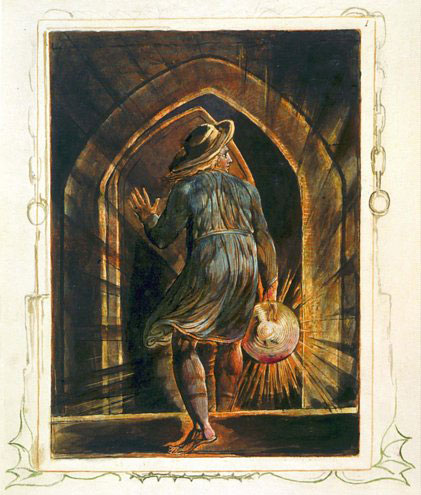
The Giant Albion from Jerusalem, 1804 Imagining a new-born world Around this time, Blake began to rise ‘in the middle of the night’ and ‘write for two hours or more’. His renewed creative powers culminated in two epics of illuminated printing, Milton and Jerusalem, dated 1804 on their title-pages. He told Butts that he wrote ‘from immediate Dictation. . .without Premeditation’. The lyric now known as the hymn ‘Jerusalem’ appeared in the ‘Preface’ to Milton. Its question, accusation, inspiration and promise mingle, voices ringing out in England, in the world - JERUSALEM Bring me my bow of burning gold: I will not cease from mental fight, For Blake, Jerusalem represented God's love and creation, just law, courage, ethical purpose and beauty. He clearly saw the misery that terrorized men, women and children when love and justice, courage and freedom were lost. The book Jerusalem had one hundred plates and took for its subject "all of history as a record of desire struggling for fulfillment" (DNB). Blake beautifully hand-coloured one complete copy, but it remained unsold at his death. George Cumberland, one of the founders of the National Gallery, was among the few who recognized Blake’s genius. Critics mauled him. Even his friends doubted him. Blake wrote painfully - "Now I may say to you, what perhaps I should not dare to say to anyone else, that I can alone carry on my visionary studies in London unannoy'd, & that I may converse with my friends in Eternity, See Visions, Dream Dreams & prophecy & speak Parables unobserv'd & at liberty from the Doubts of other Mortals; perhaps Doubts proceeding from Kindness, but Doubts are always pernicious, Especially when we Doubt our Friends" (Blake to Thomas Butts, 25 April 1803). Despite poverty and doubts, Blake persevered, and continued to see visions of paradise. At the end of his life he was comforted by a group of young artists who gathered around him, enthralled by his art, charmed by his gnomic remarks and determined to help him survive by providing him with commissions. Mortally ill, perhaps from fumes inhaled from years of etching, Blake was working on illustrations when he knew he was dying and up to the very day he died, on August 12th 1827. Auguries of Innocence In his incandescently wise Auguries he wrote, It is right it should be so; Joy and woe are woven fine,
Close-up of Angels from Seeing Blake today Blake was a major influence on the poetry of Yeats. In 1916 Charles Hubert Parry set the ‘Jerusalem’ lyric to music, and it became one of the favourite hymns in the Anglican Communion. In 1947 Northrop Frye published a distinctive study of Blake's art, Terrible Symmetry, and brilliantly described his philosophy. In 1949 the Blake Prize for Religious Art was established in his honour in Australia. In 1957 a memorial was erected in Westminster Abbey, where Blake had worked so many years before, to the memory of Blake and his wife Catherine. In 2001, not quite two hundred and fifty years after he was born, the Tate and the Metropolitan Museum of Art mounted exhibitions of his work. His hope for England and the world remains as green as ever.
When you contribute to this website,
|
BRITISH ARTISTS ONLINE
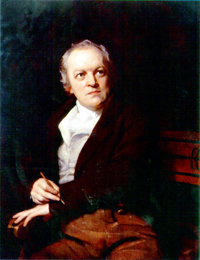
Portrait of Blake
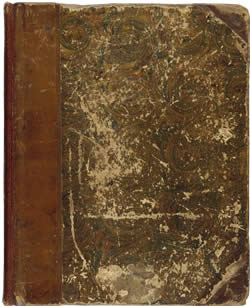
Blake's Notebook The British Library owns Blake's notebook, which he inherited from his dying brother Robert, and which he used to record sketches and draft poems for over thirty years. “The dense, closely-filled pages provide insights into Blake's compositional process, and allow us to follow - line by line, correction by correction - the genesis of some of his best-known work, including poems such as London and The Tyger. An interactive version of Blake’s notebook is here.
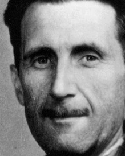
Writer George Orwell takes the stand.
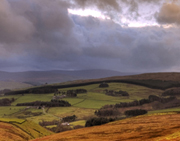
COWBOY SINGER IS HERE English poetry is born when a cowboy in England gets a call to sing.
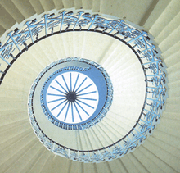
SEEING MUSIC IS HERE The luminous links between Georgian architecture, music, and breaking waves.
IAN MCEWAN FINDS
BRYN TERFEL
COMPOSING FOR A LAND OF HOPE AND GLORY HERE
George Stubbs and the Kingdom of Animals HERE
In the hymn Jerusalem, Parry changed the word these to those.
|
This wonderful book describes Britain's gifts to the world. Adults will refresh their understanding of profound events in British history, and young people will find inspiration. Warning: This book defies aggressive secularism and unthinking multiculturalism. Written by the co-editors of this website, Share the Inheritance is beautifully illustrated with 125 colour images and a timeline. Available at Amazon UK and at Amazon USA.
|
 |
||