Blog Home | All Posts | Liberty Timeline | Faith in Freedom | Heroes | Science Timeline | Artists | Life | Sports | Calendar | Brits Worldwide | Imagine
|
|
Blog Home | All Posts | Liberty Timeline | Faith in Freedom | Heroes | Science Timeline | Artists | Life | Sports | Calendar | Brits Worldwide | Imagine |
|
Hogarth
Chairing the Member in Love In his late twenties Willliam Hogarth (1697-1764) was painting portraits of families, and he was bored. As is often the case, boredom was a mask for something else - he just didn't particularly want to paint people he didn't like. One night Hogarth went to the theatre to see John Gay’s Beggar's Opera, a rousing depiction of London’s underworld. He went back to make sketches, turned the sketches into paintings, and had an immediate success. He had created a visual style perfectly suited to his eye for vivacious detail and his satirical streak. He was about to become the first visual artist who was also a social critic. In 1732 Hogarth released the series of engravings and paintings called A Harlot’s Progress, which included a narrative, intriguingly recognizable London scenes, and a moral ending. (The poor harlot dies.) The series had the compressed appeal of a violent movie preview, and was so popular that Hogarth was forced to fight publishers who were pirating his prints. In 1735 Parliament passed “Hogarth’s Act” to protect the copyright of visual artists, a great advance for the protection of intellectual property rights (see the Liberty Timeline). Assured of profiting from his hard work, Hogarth released A Rake’s Progress, a tale of debauchery ending in horror.
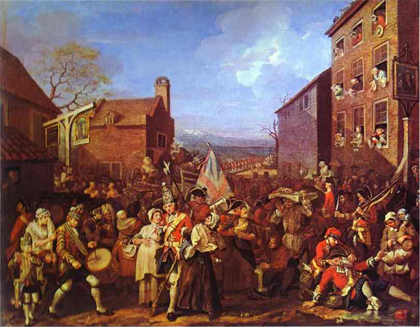
The rake ends his life in Bedlam. Over the course of his career, Hogarth engraved more than 200 plates, each one bristling with caricature and drawn with zest. He was also painting. Some were deliciously rambunctious scenic works, like the hullabaloo depicted below. Others were portraits.
The March to Finchley, 1749-1750, oil on canvas, Thomas Coram Foundation for Children. Hogarth contributed paintings and money to his friend Thomas Coram's home for foundlings. This painting's theme was not, perhaps, an obvious choice for a home for boys. Then again, maybe it was. The portraits have a quite different spirit. In one of them it seems obvious that Hogarth cared for his sitter, and perhaps loved her. Her name was Mary Edwards. Mary is lovely, with beautiful, intelligent eyes and lovely smiling lips. However, looking at her portrait quite closely in the Frick Collection here. She is sitting by a half-opened scroll and patting a dog whose eager look makes me think she took him on long walks. Mary was Hogarth's friend and arts patron, and had been since at least 1733, when he painted her young son bouncing in a cradle.
Mary Edwards, Frick Collection Mary repudiated the dissipated father of her son, who had tried to steal her fortune. She loved liberty. The words on the scroll read: Remember, Englishmen, the Laws and the Rights. This gorgeous painting wordlessly testifies that Hogarth cherished Mary. She died in 1743, a year after he finished the painting. Tate Britain featured Hogarth in an exhibition in early 2007 that filled ten rooms, and showed the extraordinary volume and range of his work. His scenes have surprisingly modern elements. "Gin Lane" could easily be a depiction of drug abuse today. Hogarth decried the fashionable preoccupation with foreign cultures to the detriment of Britain. On the other hand, he admired what foreign cultures had to offer. He was a patriot, not a xenophobe.
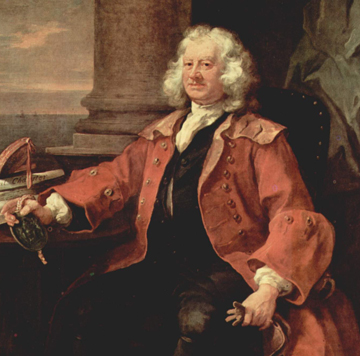
Self-Portrait with Pug-Dog, 1745, oil on canvas, Painfully for him, other painters tended to dismiss his art. It's not the first time, we guess, that experts failed to understand what they were seeing. Hogarth saw his friend Captain Thomas Coram very clearly. Returning from voyages to America, Coram was horrified to find children abandoned in London streets.
Captain Coram opened his home to foundlings, built a large refuge for them in 1739, and turned to friends like Hogarth for help. Hogarth donated his paintings to the cause. Wonderfully the synergy between children, patrons, and artists led to the very first public art gallery in Britain and, in 1768, to the Royal Academy. The work of Captain Coram continues today, as does the Foundling Museum. Hogarth helped children, helped to establish copyright for artists and created socially incisive and psychologically tender paintings and prints.
When you contribute to this website,
|
BRITISH ARTISTS ONLINE
SEEING MUSIC HERE
George Stubbs and the Kingdom of Animals
WILLIAM BLAKE HERE
CONSTABLE HERE
|
This wonderful book describes Britain's gifts to the world. Adults will refresh their understanding of profound events in British history, and young people will find inspiration. Warning: This book defies aggressive secularism and unthinking multiculturalism. Written by the co-editors of this website, Share the Inheritance is beautifully illustrated with 125 colour images and a timeline. Available at Amazon UK and at Amazon USA.
|
 |
||