Holbein in England
Lady with a red squirrel
The National Gallery, London
When he first arrived in England from Basel in 1526, Hans Holbein hoped “to scrape a few angels together”. Holbein had illustrated the satires of Erasmus, but found no one else in Basel interested in paying for art. In search of patrons, he crossed the Channel, and found the English court full of men and women eager to be painted and willing to pay in angel, those gold coins stamped with the Archangel Michael.
I imagine that Holbein learned English as he painted. He may have been silent much of the time, observing the inner lives reflected in the faces of his sitters. Undistracted by conversation he did not understand, he saw into people – strong, educated women, young, determined girls, headstrong men, corrupt, idealistic, or ruthless servants of the King. Holbein’s hand captures them – particularly he captures their eyes.

Sir Thomas More, who died for his principles
The Frick Collection, New York
Holbein’s pencil drawings are fresh and immediate, as if the sitter, absent an odd Tudor hat, were still alive and strolling in Hampton Court. The paintings with their smoldering velvets and caressable furs look of their period, but the faces are alive, and the quality of the painting is so vivid it is no wonder that Henry VIII ordered Holbein to paint his portrait.
The King had everything; Holbein had nothing except the tools of his trade and genius. Yet it is possible that Henry VIII owes the artist everything, for Holbein created an iconic image of Henry that blazes with power. I remember Henry for his lurid marital history and his break with Rome, but it is really Holbein’s painting that puts him in my mind’s eye, and keeps him there. The glaring white stockings on the King pull my eyes to his strong, planted legs, as if men approached him on their knees. My gaze travels up his bejeweled clothes and over an embellishment assuredly odd to modern eyes, and then up to Henry’s red-haired, commanding face where I meet his imperious, cold, and supremely confident eyes.
Holbein returned to Europe at Henry’s command to paint the portraits of a number of ladies. Henry was trying to select for his fourth wife a woman who would bear him more sons, and thought a portrait could help him choose. He was pleased with Holbein’s painting of Anne of Cleves, but not with the lady when he met her in person. Anne could not speak English, and struck Henry as dull and unappealing. Holbein spoke her language, and has painted her looking quietly serene. Perhaps I imagine the slightly amused look in her eyes.
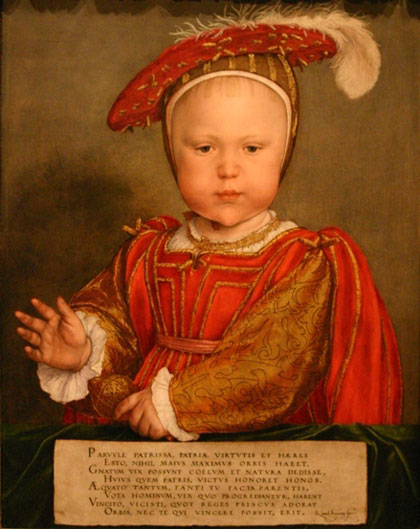
The future Edward VI, Henry's son by Jane Seymour
Denver Art Museum
Obliged to marry Anne, since she had arrived in England and he could not upend the diplomatic apple cart, Henry never consummated the marriage, and is supposed to have described her as a Flanders mare. Presumably this was a sardonic remark, as Henry's Flanders mares were the best brood mares in his stable.
Henry's ministers choreographed an end to the marriage. Anne was made Henry's sister, and he set her up in a fine home at Richmond, and married a lady more to his liking. Anne was happy to be free of Henry and Cleves.
A year after they had first met, on January 3rd, she rode over to visit the king from her house in Richmond. She had discarded the dowdy clothes she had worn when first meeting Henry, and had gifts for Henry’s new queen. For Henry she brought two horses with violet velvet trappings. I like to think they were Flanders mares.
All this is to say that Tate Britain’s Holbein in England showcases one of the world’s great artists, who was able to create due to the patronage of the English court. The sheer beauty of his paintings and drawings has always captured me, and biographies of his sitters add to the fascination. I hope Anne is there, and that I will be able to visit. The show, open now, runs at Tate Britain, London SW1 until Jan 7. Its sponsor is the British Land Company. For more details, TATE BRITAIN
| E-mail This | Permalink |