

Raffles
Borobudur is an astonishing, 8th-century stone mountain of exquisitely wrought sculpture in Central Java - two million cubic feet of fine-grained, mellow gray stone that were carved to illustrate the Buddha’s life and teachings. Its concentric terraces are lined with more than a mile of continuous sculpture, not including 504 life-size statues of the Buddha.
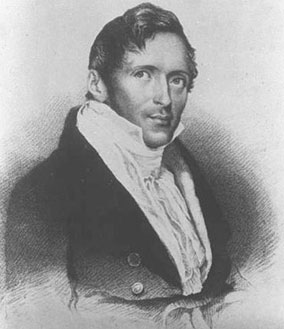
Borobudur had lain hidden under volcanic ash and jungle vegetation for centuries until Stamford Raffles, just 30 years old, "dispatched an expedition to locate and excavate the legendary monument, commencing the modern age of scholarship and study. . ."
Raffles was an astonishing man. Small and sickly, impoverished as a boy, a clerk at age 14, Raffles rose to become one of the great leaders of the British Empire, to end slavery wherever he encountered it and to found Singapore. His life casts interesting gleams of light on all our lives.
Raffles loved to learn and he liked to work hard and that brought him his first piece of good luck. In 1805 the British East India Company made him assistant secretary in Penang, and quintupled his salary.
One week later Raffles married. She was "a Madras assistant surgeon's penniless widow, of Irish and possibly Indian extraction, who was ten years his senior but strikingly beautiful, vivacious, and intelligent. . .On the voyage Raffles taught himself Malay and soon embarked on a lifetime study of the history, flora, and fauna of the region. His meagre schooling left him with a passion for acquiring knowledge. . ."
When he was a young man Raffles had an uncanny ability to make setback a step forward. Working three jobs in Penang, he fell ill under the strain and was sent to Melaka to recuperate. He arrived just in time to prevent the city from being demolished. Sailing to Calcutta in hopes of advancing his career, Raffles was rebuffed, but impressed Governor-General Lord Minto, who named him his agent in preparation for the Java campaign.
"With his customary industry and attention to detail, Raffles amassed voluminous information, sent agents to Madura, Bali, and Java, and won over the sultan of Palembang". The invasion was a success, and Raffles was unexpectedly named lieutenant-governor, with far-reaching powers.
He immediately began to dismantle the Dutch system of monopoly and forced labour, remodelled the judicial administration and introduced a jury system.
Raffles travelled all over Java to gather information about the island's history, languages, and products, and was meticulous in respecting local culture. He hired scientists to study the flora and fauna and to send specimens to London. Like him, they were fearless in the face of malaria.
In 1814 Raffles was heartbroken by the death of his wife, and he was accused of making Java less profitable than it had been under the Dutch. Since he had ended the practice of forced labour without compensation this charge was initially true. World politics intervened in 1815. A new treaty called for handing Java back to the Dutch. Raffles fought it, was accused of persevering imprudence and was ordered to take a post in Sumatra.
But Raffles was his own man. He sailed to London first, fought the personal charges of malfeasance against him and was cleared, wrote and published a two-volume history which introduced Java to the world, was knighted, became a member of the Royal Society and married for a second time. He accomplished all this in less than two years. In November 1817 Raffles and Sophia embarked for Sumatra and Bencoolen. Their first child was born at sea.
Raffles's arrival at malaria-ridden Fort Marlborough on 22 March 1818 was sobering. Recent earthquakes had destroyed most buildings, the administration had long been in chaos, pepper production (which represented Bencoolen's sole livelihood) was neglected, and Raffles was horrified to find slaves belonging to the East India Company. He immediately freed the company's slaves, prohibited gambling, and set about reorganizing the administration, improving pepper production, and introducing an enlightened convict labour system.
Raffles also arranged for a botanist to take Sophia and himself on an arduous exploration of central Sumatra. Two flowers which he discovered bear his name - Rafflesia arnoldi and Nepenthes rafflesiana - as do several birds, a fish and a spider.
However, Raffles' main object was to protect free trade. This required ingenuity, negotiating treaties with various local rulers and the brilliant stroke of founding the city of Singapore. Raffles expected that the Dutch would oppose his efforts. That he was also undermined by British bureaucrats was a little disappointing.
Raffles laid down the rules for governing Singapore in 1819 before returning to Bencoolen. Unfortunately the East India Company's military administrator was not up to the job. Meanwhile, in Bencoolen, Raffles and Sophia lost three of their four children to illness, barely survived themselves and were making plans to retire and return to Britain.
Before he did, Raffles resolved to pay a last visit to Singapore. On arrival he was dismayed by the distinct lack of interest in enforcing the rule of law. Despite blinding headaches, Raffles stripped the military commandment of his office, took over as resident and laid down permanent principles for the island city-state -
Absolute freedom of trade was declared a permanent principle, not merely a temporary expedient to build up commerce. Supported by a committee comprising European officials and merchants, with representatives of the various Asian ethnic groups, Raffles drew up a town plan and resettled a large part of the population according to their different communities. He established a magistracy administering English law, with Malay social custom where appropriate for the indigenous people. Prohibiting slave trading, he provided for existing debt slaves to work off their obligations in five years. . .He banned the carrying of arms, gambling, and cock-fighting outright, and introduced deterrent taxation on other vices, such as alcohol and opium. . .
Raffles also founded a university (now the University of Singapore) with generous donations from himself and Sophia and a pledge for annual funding from the East India Company. His ideal was to revive Asian cultures in alliance with the best of Western tradition.
On their return to London, Raffles and Sophia barely escaped a fire on board ship that destroyed all their worldly possessions, his thousands of botanical and zoological collections, his notes on the history of Sumatra and Singapore and irreplaceable scientific papers, drawings and paintings.
Back in Britain with his wife and only surviving child, and still hopeful, Raffles became a farmer. In 1826 he was elected the first president of the Zoological Society and began plans for the London Zoo.
That same year a bank failure took his remaining capital. The East India Company recognized all that he had done, and the soundness of his administration, but demanded that he pay them thousands of pounds in alleged overpayments, and denied him his pension.
A month later, one day before his 45th birthday, Sophia found Raffles lying dead at the foot of the stairs. He had been felled by a brain tumour.
His most enduring monument was Singapore. Under the rule of law and free trade the smallest nation in Southeast Asia has become the 6th wealthiest country in the world in terms of per capita GDP.
A host of museums, hospitals, schools, hotels and the famous club bear his name. The first statue to Raffles in Singapore was erected by the British. The second statue was erected by the people of Singapore.
Quotations describing Raffles come from Oxford's Dictionary of National Biography.












Comments (1)
Hey there! Check out my website at www.runwiththewave.com Come and experience the waves of Penang! Join us for a BBQ buffet at the beach with watersports activities included!
Judith Yen | September 23, 2008 08:58 PM
Posted on September 23, 2008 20:58