William Fox Talbot
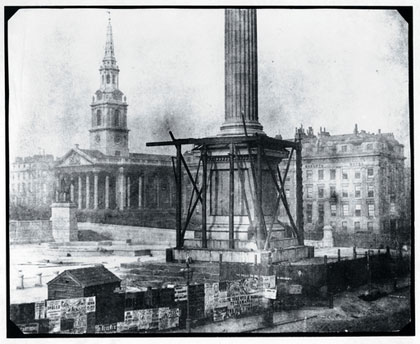
Nelson's Column under construction, c. 1843
William Fox Talbot
William Fox Talbot loved nature, and wanted to capture beauty. He is the largely uncredited person who developed the negative/positive photographic paper process in the 1830s, and reduced exposure times in the camera to less than one minute.
Talbot's father died when he was four. His mother restored Lacock Abbey, which had been left in a shambles, inspired Talbot's language studies because she was so proficient with languages herself, and his interest in botany because she was an intense gardener. She took the whole family on travels abroad. When Talbot entered Cambridge he became a classicist and mathematician and shortly afterwards a young MP. As you can imagine, with these interests, he did not find Parliament particularly interesting, and hurriedly exited after a year.
He poured his energy into photography, mathematics (Talbot's curve), physics (Talbot's law) and light (Talbot's unit of luminous energy).
Some of his work is represented in the British Library's exhibition - Point of View, Capturing the 19th century in photographs.
| Permalink
|