A passion for landscapes and people - Paul Sandby
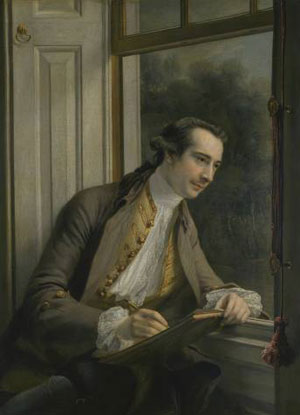
I like how he seems to smile as he sketches, and how intently he looks.
Image: Portrait of Sandby in 1761 by Francis Cotes, Tate Collection. Reproduction: Wikimedia Commons
Paul Sandby (bap. 1731, d. 1809) learned to watercolour and draw from his elder brother. They were the sons of a framework knitter in Nottingham. Sheer talent, hard work and some government opportunities - Scotland needed to be mapped and sketched - helped Paul Sandby to establish a career as an artist that was so successful he became the 'father' of watercolour painting. He bought the work of struggling artists when he had money and helped to found the Royal Academy.
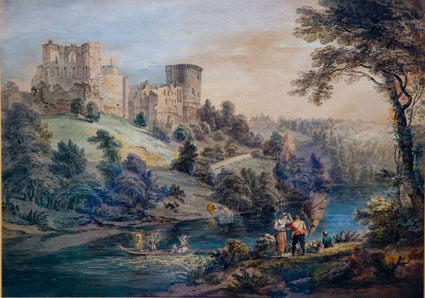
Bothwell Castle
Image: Laurence Oxley, Alresford, Winchester
In London, Sandby married and raised children. Painters and scientists gathered weekly in his house on Sunday afternoons to talk.
His drawings, watercolours and paintings are now found in the Royal Collection, the British Museum, the British Library, the Victoria and Albert Museum, the Yale Center for British Art, the Ashmolean Museum, Oxford, the Fitzwilliam Museum, Cambridge, the National Museum and Gallery of Wales in Cardiff, the National Gallery of Scotland, Edinburgh and the City of Hamilton Art Gallery, Australia.
The National Galleries Scotland are hosting the exhibit of his work, Picturing Britain, now on display. The exhibit suggests that beyond his artistry Sandby created a vivid visual record of Britain's 18th century - its urban and rural landscapes and its people.
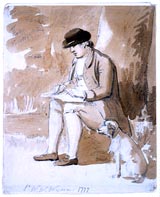
Lovely. He enjoyed people.
| Permalink
|