Blog Home | All Posts | Liberty Timeline | Faith in Freedom | Heroes | Science Timeline | Artists | Life | Sports | Calendar | Brits Worldwide | Imagine
|
|
Blog Home | All Posts | Liberty Timeline | Faith in Freedom | Heroes | Science Timeline | Artists | Life | Sports | Calendar | Brits Worldwide | Imagine |
Loving Freedom Christ's ideas were sane and practical. They involved making and keeping promises, treating others as you would wish to be treated, forgiving so you were not imprisoned by bitterness and hatred, valuing beauty, keeping wealth in perspective, sharing meals with others, protecting children, taking care of the poor, and building communities of trust. Since Brits were human they realized these ideas imperfectly, but the ideas had power. Brits were also influenced by Celtic and Anglo-Saxon ideas about freedom, independence, and the soul, and their responsibility for handling quarrels fairly, according to the law, and by Classical Greek ideas about democratic government. They began to think that their prosperity did not come from material things but from their ideas, laws, culture, knowledge, attitudes, morals, values, and personal and business habits. The synthesis of their ideas, their love and their pragmatism created their country.
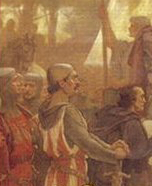
To the Anglo-Saxons and the Celts, the word free meant dear. They used it to describe persons who were close to them, and not slaves. They wanted the person dear to them to be free, because they valued liberty of action. The word liberty comes from the Latin word that means children. Most of all Brits wanted their children to be free. Jesus Christ stood by his friends. When they were arrested, he told the soldiers, "I am the man you want, let these others go." Alban protected a Christian from Roman soldiers, and pretends he is his friend when the soldiers come to arrest him. Told to deny Christ or lose his life, Alban refuses. He is one of the first Brits in recorded history to die for freedom of worship and freedom of conscience - and for a friend. THE RELUCTANT EXECUTIONER - 4th c The executioner refused to execute Alban even when he threatened by death. Does he know Alban? Is he outraged by Roman injustice, or is he suddenly inspired to live his "one wild and precious life" in an entirely new way? We don't know. We don't even know his name. He is one of the first persons in recorded history to refuse an unjust order. A Celtic Christian, Morgan believed in the God-given freedom to choose. He believed that being good is choosing to be good, and we ought to make that choice more often. He leaves Britain to travel to Rome, and gets into hot water with the Roman Church which insists that choosing good requires God's grace. Free will is an important theme in British history. Kidnapped from Britain and forced into slavery in Ireland, Patrick escaped after six years, and only returned to Ireland when he was middleaged. There he establishes communities of peace and learning, and confronts the slave traders, telling them that every person is a son or daughter of God, and for that reason is free by God's law and cannot be a slave. Slavers kidnapped Bathilde, a young woman in Britain, and sold her in the land that is now France. There she meets the young King of the Franks, who falls in love with her, frees her and marries her. She is still in her twenties when he dies, and she becomes Regent for their son. History reports she freed French slaves for love of Christ - and with the memory of her own enslavement still fresh. Raised to the throne of Wessex when his elder brothers fall in battle against invaders, Alfred led his countrymen to victory over the plundering Danes, persuaded the Danes to adopt Christianity, and united them with his people. This takes some time. Along the way Alfred learns from reading the Old Testament that bad kings come to bad ends, and he mends his ways, becoming a better man and a better king. Alfred codifies existing laws and makes some good new ones. This is the beginning of Common Law – the law for everyone. (Common Law continues to be the basis of justice in Britain, the United States, and core Commonwealth countries.) He founds schools, creates a navy to protect his people, and translates works in Latin into English, creating the first English prose literature. He earns his people's love and respect because they know he loves them and is willing to die for them. Alfred creates a safe, fair, and civilised environment where people can live in peace. This is a rarity in the world. THE LADY OF THE MERCIANS - 10thWhen King Alfred was being hunted as a fugitive in the swamps of Somerset, his six-year-old daughter Aethelfled was with him. When she became a woman, Aethelfled married the Lord of Mercia, the kingdom immediately north of Wessex. Here Aethelfled faces the terrors of invasion as her people are robbed, raped, and killed by Danes. Christ famously urged his followers to turn the other cheek, but this does not mean that a Christian should turn the cheek of a child or a vulnerable woman who is being hurt. Christians believe they must defend those who are defenceless, preferably without force, but with force if necessary. When her husband dies, the lady of Mercia defends the people and land she loves, wins back their towns from the Danes, and raises forts to protect them. Dunstan was a musician, a scholar, and a lover of beauty who survived physical abuse and exile before creating the Coronation Ceremony which establishes a covenant of justice between the English people and their sovereign. His Coronation Oath, first pledged by Edgar in 973, binds the Servant King to uphold what is right and to give equity and mercy to his people. BARONS & CHRISTIAN CLERGY - 11th cIn 1100 Christian barons and clergy forced Henry I to sign the Charter of Liberties when he took the throne. He promises to obey "the law of King Edward", the king who bridged Anglo-Saxon and Norman rule. The law of King Edward is the Common Law. The makes the ground-breaking declaration that no man is above the law, not even the King. This is one of the foundations of liberty, and has remained a cornerstone of British law. Anselm, Archbishop of Canterbury is loved for his fairness and kindness. In 1102 he gathers the clergy at the Westminster Council and calls for the end of slavery in England. In a move remarkable for its time, when slavery is a worldwide institution, slavery in England is outlawed. No saint, Henry II was keen on fair courts because they were profitable to him (few Brits would bother to bring a case in an unfair court) and because he loathed disorder. For practical reasons he works to establish a more equitable justice system. He establishes the grand jury, which will lead in time to trial by jury. He also seeks his kingdom's independence from the Pope and Church. Archbishop of Canterbury during the reign of Richard the Lionhearted, Hubert Walter faced the ticklish task of raising ransom for Richard who had been captured by an enemy while trying to return to England. To help raise the enormous sums, Walter relies heavily on city merchants. In exchange for their help, they demand charters of freedom for their towns, which Walter gives them. These recognize their rallow them greater self-government. STEPHEN LANGTON, KNIGHTS & BISHOPS - 13th cIn 1215 John granted the rights to justice in Magna Carta because he was compelled to do so. Archbishop Stephen Langton, supported by many of the bishops, was one of the prime movers. Standing with the bishops when John granted Magna Carta were the barons: "William Marshal, earl of Pembroke, William, earl of Salisbury, William, earl of Warenne, William. . ." It was a time for Williams. How John hates them. Both bishops and barons are fighting for justice and freedom, but if the bishops had cared only for the Church they need not have fought for anything more than the first paragraph of Magna Carta, which affirms that "the English Church shall be free. . . " In fact Magna Carta protects the rights of common people to forests and rivers, the right of widows not to remarry, the right of merchants to travel freely, the liberties of chartered towns, and the right to property which is fundamental to freedom as it gives a person the ability to make a living and to protect his livelihood. Magna Carta also establishes the right to justice, habeas corpus, and jury trials. The Great Council called for in Magna Carta to make sure the king does as he has promised is a forerunner of Parliament and representative government. See THE KNIGHTS . William, known simply as "the Marshal", was known as "the greatest knight who ever lived". His tumultous career began when his was five and became a hostage to the king. His own father betrayed him, but when he became a man William's word was regarded as an unbreakable pledge. Battling to remove the French invasion forces from England, serving as Regent to the young boy King Henry III after King John dies, William reissues Magna Carta under the boy King's and his own pledge of honour. See THE KNIGHT . A poor boy who became a mathematician, scientist, and bishop, Robert Grosseteste saw that mathematics could be used to describe the order underlying God's world. He analyses tyrannical rule with an exacting eye, and inspires Simon de Montfort's ideas about just government. He is a man who loves God's world and the truth. SIMON DE MONTFORT - 13th cSimon de Montfort was a brave soldier, a literate cosmopolitan, and a great earl with vast estates. He was viewed by those who knew him as either highly principled or unbearably arrogant. A passionate man, he attended Mass every morning, and detested injustice when it affected him personally. He falls in love with the King's sister, and elopes with her. When Henry III tramples on Magna Carta and the Provisions of Oxford and Westminster, Montfort and many knight-barons and townspeople oppose him. Montfort calls the first Parliament into session, inviting representatives from the towns and counties as well as the big barons. He does not fear death, and dies fighting the forces of Henry III at the battle of Evesham in 1265. Because his sons have rallied to the cause, and he loves his sons, and because his great friend Simon de Montfort was involved Peter de Montfort (a neighbour but no relation) was drawn into the struggle for honest government promised in Magna Carta and the Westminster Provisions. He dies fighting beside Simon de Montfort at the battle of Evesham. The bachelor knights were young knights who believed in Magna Carta, incorruptible government, and Simon de Montfort. They were idealistic, and brave, and refused to leave Montfort when the armies of Henry III's son, Prince Edward, surrounded them, and Montfort urged them to escape. They stand by Montfort at the battle of Evesham. A few of them, including Peter's son Piers, survive. PRINCE LLYWELYN OF WALES - 13th cA big, brave man who was married to Simon de Montfort's daughter, Llywelyn battled Edward I for an independent Wales. He dies in the struggle. Brits living in the north and west of Britain want the freedom to govern themselves. They have the sensible idea that government that is local will be more accountable and responsive to their needs. John Pecham was a Franciscan, a writer of songs, and Archbishop of Canterbury. One of his first acts as Archbishop is to have Magna Carta posted on every church door, an act that angers King Edward I. The Archbishop calmly declares that those who do not defend Magna Carta will be excommunicated.ABBOT BERNARD DE LINTON - 14th c "It is in truth not for glory, nor riches, nor honours that we are fighting, but for freedom – for that alone, which no honest man gives up but with life itself.” Bernard, Abbot of Arbroath, writes these words for Scotsmen who pledge their hands and their lives to supporting their defiant independence.SCOTTISH SIGNATORIES OF ARBROATH DECLARATION - 14th c The thirty-eight Scottish Lords who sigedn the Arbroath Declaration asserted that they spoke for the whole community of the realm of Scotland, that Robert the Bruce was their King, and that “As long as but a hundred of us remain alive, never will we on any conditions be brought under English rule." They will have to battle for their freedom. For centuries Brits have heard the Bible read aloud in Latin, and most did not understand it. Wycliffe, an Oxford don, believed people should be able to read the Gospels in their own language. Defying the Church, he makes an early translation of the Bible into English, an unprecedented act that will inspire the Lollards.In the 15th century the Lollards read Wycliffe's English Bible, and felt empowered to live Christ's teachings. They believed in a personal relationship with God that was free of the established Church. They also call for the equality of men and women. They endure torture and death to defend their beliefs. Brave and poetic, William Tyndale made a new English translation of the Bible in the early 16th century. He was inspired by Bishop Irenaeus who wrote in the 2nd century that "all equally and individually possess the Gospel of God". Tyndale aimed to make the English Gospels accessible – and true to the beauty and wisdom of their original language. Hunted by government agents, barely surviving a shipwreck in which he loses his manuscript, starting all over again, he manages to get his translation published and secretly distributed in England. Tyndale creates some of the most memorable phrases in English – the “apple of his eye,” the “living God,” and “stranger in a strange land". He meets his death at the stake with unparalleled courage. When he is interrogated about the so-called crime of his beliefs, John Lambert refuses to "confess" and accuse himself. He loves the Common Law, and the law is on his side, but the authorities are against him. He dies bravely. His sacrifice for the right to silence will help people in Common Law countries to achieve freedom from torture. ROBERT & WILLIAM KETT - 16th c Robert Kett was strong enough to admit he had done wrong. He had enclosed common land – land belonging to all the people. Confronted by his neighbours, he tore down his fences, and he and his brother William led the farmers of the north against the injustices of the big landlords who were enclosing common lands. Justice is done, but the government sends troops against him. Four thousand farmers die, and Robert and William Kett are executed. ANNE ASKEW, A PROTESTANT, & CATHOLICS - 16th c Anne Askew was tortured on the rack, but refused to name women who agreed with her Protestant views. Offered a pardon if she denied her faith, she refuses, and dies at the stake. She is not the first and not the last Brit to die bravely for love of their faith. Catholics die bravely for love of their Catholic faith. The courage of Protestant and Catholic martyrs will help to establish freedom of conscience in Britain. Stripped of his title, afraid of the fiery stake, the former Archbishop of Canterbury finally realised how much his word meant to him. He dies at the stake defending his freedom to worship as he chose and to speak the truth as he sees it. Hoping for a new life with freedom of religion, they travelled thousands of miles across the Atlantic to America to build "a shining city on a hill". They agreed to govern themselves in the Mayflower Compact. Just three sentences long, their Compact rests on the Old and New Testaments which call them to love God and neighbour, and do justice. CHIEF JUSTICE EDWARD COKE - 17th c Edward Coke loved ancient English liberties and the Common Law, and for their sake he defied the King who believed he was above the law. Coke has an expansive interpretation of Magna Carta. Where others might see old and limited safeguards, he sees modern rights and freedoms. The five Knights dared to protest the King's taxes, which had been levied without the approval of Parliament, and were thrown into prison. Their incarceration ignites a popular outcry, and leads to the Petition of Right, a reaffirmation of the right of habeas corpus. Loving the liberties enshrined in the Common Law, John Selden defended the five knights in court. He does this at considerable risk to himself and his career. ROGER & MARY WILLIAMS - 17th c Love of religious freedom brought Roger and Mary Williams to Massachusetts. Exiled by their compatriots, they head out into the wilderness to found a community where people of all religions might live in peace. The Indians, who respect them, give them land, and they found the colony of Rhode Island. GEORGE COLLIER, ROBERT BEALE & THOMAS CARTWRIGHT - 17th c George Collier made hats. When he denounced the illegality of the dreaded Star Chamber he endured five years in jail. For love of liberty, lawyer Robert Beale and Thomas Cartwright, a Puritan minister, joined Collier and other Brits in fighting Star Chamber persecution. What amazing people the Agitators were. John Lilburne was thrown into prison for refusing to accuse himself and confess when he was interrogated by officers of the King in the Star Chamber. He will help to bring an end to the Star Chamber and later, when the King is in the dock, to defend the King's right to a jury trial. Advocating representative government, Lilburne and Richard Overton are jailed by Cromwell. Their wives Elizabeth and Mary support them, drumming up popular support, advocating fearlessly for their liberties and rights, and joining them in jail. GEORGE MONCK RETURNS RULE TO PARLIAMENT - 17th c The leaderof the Ironside Army, Monck might have tried to seize control of England after Oliver Cromwell died. Instead, he marches the army to London, relinquishes power, and calls for new, free elections to Parliament. GEORGE FOX & THE SOCIETY OF FRIENDS - 17th c George Fox's spiritual journey toward "the inner light" of Christ brought him into conflict with the authorities and landed him in prison eight times. A patient man, he becomes the founder of the Society of Friends and an advocate for women and Native Americans. His tireless work, supported by his wife, Margaret Fell, leads to Parliament's 1689 Act of Toleration, which frees thousands of Friends from prison. A dazzling poet of spiritual ideas, Milton defended freedom of ideas and freedom of publishing against the crushing power of government. A member of the Society of Friends accused of disturbing the peace, William Penn was blazingly witty at his trial, where he defended his right to speak freely about his faith. He is imperturbably courageous with Indians in America. He wins their respect by negotiating with them unarmed, and is impeccably fair about observing the terms of the treaty. This solid Englishman served on Penn's jury and refused to convict him. As a result he was thrown into jail and his business was threatened with bankruptcy. His appeals to the High Court, and sues successfully for the protection and freedom of juries. We have said little about Parliament here, but certainly there were many lovers of freedom in Parliament when it confronted Charles I, insisted there was no divine right of kings and that Parliament must have a voice in the governing of the nation. Parliament passes the Petition of Right in 1628, the Declaration of Rights in 1688/9 (after it was affirmed by a convention representing the people), and the Habeas Corpus Act of 1679. The younger son of an Earl, Algernon Sidney's book on freedom and government brought him to the block, and he was executed. Years later his Discourses Concerning Government will have a huge and salutary effect on revolutionary Americans. A doctor, John Locke wrote Two Treatises of Civil Government which argued that every individual has a natural right to life, liberty, and property, and that government was established by the people to protect these rights and should be overturned if it does not. In his Letter on Toleration Locke declared that the state should be free from the dictates of religion and that the religious must have religious freedom as "the fundamental and immutable right of a spontaneous society. . . " Unpopular with the government, Locke has to flee abroad. His ideas will inspire the American Revolution. THE CATO WRITERS – JOSEPH ADDISON, JOHN TRENCHARD & THOMAS GORDON - 18th c Addison wrote Cato, a play about a hero of the Roman Republic. It took audiences in London and the American colonies by storm. American revolutionaries quoted the play for the next fifty years. John Trenchard and Thomas Gordon anonymously published the Cato Letters in London newspapers. Their Letters cause a sensation because they advocate unqualified freedom of speech and representative government. The master artist loved his art, and believed he should be able to profit from it. He is instrumental in pushing Parliament for a law that will protect copyright. Every artist and inventor today owes him a debt of gratitude. With a wit like a rapier, the rakish Wilkes cannot be cowed. He embodied the motto "publish or die". Despite the threat of imprisonment, he publishes daily accounts of debates in Parliament. His intrepid pursuit of press freedom will contribute to Parliament lifting the censorship laws. William Blackstone's Commentaries on the Common Law crystallised the freedoms and rights won over the centuries in England in hundreds of court cases and precedents. The Common Law is part of the British Constitution and is the foundation of law in America and the core Commonwealth countries. A young doctor and a father in Boston, Joseph Warren was an energetic advocate for American independence and self-government. He survived a charge of sedition, but sacrifices his life for the cause at the Battle of Bunker Hill. Adam Smith described the promise and practicality of free markets. He believed that free markets will help men and women to be prosperous and happy, and proves why in The Wealth of Nations, a classic still read today. Smith gives much of his money to the poor. George Washington was a British subject who risked "his life, his fortune, and his sacred honour" to lead and win the American Revolution. His integrity and strength of character may be the single most powerful reason the Americans achieve independence. According to Virginia law, slaves could not be freed unless their owner established a trust fund that would support them all their lives. Washington saves enough money to free his slaves before he dies in 1799. The last slave to receive payments from his trust fund dies in 1841. John Adams looked like Bilbo Baggins, and made journeys of equal danger. A British subject until American independence is declared, and a Christian, John Adams is in love with America, the British constitution, representative government, and his wife Abigail.She loved John, her faith and freedom, and kept the farm going when he was gone. Without her, it is doubtful John could have made indispensable contributions to the American Revolution and the U.S. Constitution. A practical and profitable thinker and scientist Bejamin Franklin's diplomacy in France won essential French support for the American Revolution. His call to prayer at the Constitutional Convention when it was on the brink of dissolving helps to create the U.S. Constitution and a new nation. JOHN CARTWRIGHT - 18th - 19th c A man who refused to give up, Major John Cartwright battled for the right for all men and women to vote. He is a forerunner. Without him, expansion of voting rights might never have occurred. Helped by his brother Charles, who wrote 9,000 poems and hymns, including "Hark! the herald angels sing", John Wesley established the Methodist denomination of Christianity, and called passionately for the abolition of slavery. On his deathbed, he writes his last letter to William Wilberforce, urging him never to stop advocating for abolition until all slaves are free. Granville Sharp taught himself Greek so he could read the Gospels in their original language, and taught himself law so he could help to abolish slavery. When slave masters from the colonies attempt to bring slaves to Britain, he stops them cold in the courts. A prize-winning young Cambridge Classicist, at the age of twenty-five Thomas Clarkson was riding to London when he felt called by God to end the monstrous abomination of slavery. He pursues this goal to the end of his life, and with Granville Sharp, William Wilberforce, and others, succeeds in abolishing slavery in British colonies. A brave shoemaker, Thomas Hardy joined forces with other working Brits who believe Parliament was hurting them with unjust laws at home and foreign adventures abroad. Hardy is arrested for treason. His vindication by a jury of his fellow Brits is one of the first great breakthroughs for freedom of association. A rich and witty gambler, 'Wilber' Wilberforce became an evangelical Christian, and realised that the slave trade was an abomination he must end no matter the cost. He determines to end the slave trade and slavery in all British colonies. The task takes forty years of his active and happy life, but just before he dies, he succeeds. CHARLES MIDDLETON (LORD BARHAM) and LADY MIDDLETON 19th c An abolitionist who reformed the Navy and became First Sea Lord, Lord Barham helped to defeat Napoleon at Trafalgar. He and his wife Lady Middleton were instrumental in helping James Ramsay bring his personal experiences of slavery before the public. They decide Wilberforce is the MP to lead the campaign against slavery in Parliament, and plan strategy with him and Thomas Clarkson. In 1807, when Parliament abolishes the slave trade, the Royal Navy takes to the sea to enforce the law. William Grenville was all too aware that rich merchants do not want the slave trade abolished. However, he remained true to the pledge he made when he was a young man, sitting under an oak tree with William Pitt the Younger and William Wilberforce, to end slavery. When he becomes Prime Minister, Grenville supports Wilberforce's campaign in Parliament to legislate the end of the slave trade. LORD GREY & LORD JOHN RUSSELL - 19th c Charles, Lord Grey and Lord John Russell were determined to reform Parliament. They wanted to sweep out the rotten boroughs and to expand the number of men who can vote. By staying focused through thick and thin, and with the help of many middle class and working class Brits, they finally achieve their goal. At great risk to themselves, James and George Loveless, Thomas and John Standfield, James Hammett, and James Brine insisted on the right to start a trade union to negotiate better wages. When they were jailed and transported to Australia, a million furious Brits, including Lord John Russell, rise up and successfully demand their deliverance, and they are released. JOHN BRIGHT & RICHARD COBDEN - 19th c They were angered by the Corn Laws, tariffs which made corn (wheat) and consequently food very expensive for the poor. They devote more than ten years of their lives to repealing the corn laws and advocating free trade, and they win repeal. RICHARD OASTLER & ANTHONY ASHLEY COOPER (LORD SHAFTESBURY) - 19th c During the rapid advances of the Industrial Revolution, many people closed their eyes to working conditions in factories and mines. Evangelical Christians Richard Oastler and Lord Shaftesbury saw how appalling these conditions were. They push through Parliament reforms that protect women and children. The Chartists advocated that all men should have the right to vote, and by secret ballot. Millions of men who cannot vote support them. Parliament slowly and reluctantly responds to their petitions, and enlarges the franchise. Prime Minister William Gladstone risked electoral defeat by advocating Home Rule for Ireland. He and his Party established secret ballots to protect voters from intimidation. He loses his campaign to expand suffrage, but all is not lost. A daring man who converted from Judaism to Christianity and became a novelist and Prime Minister, Benjamin Disraeli adopts Gladstone's reform act. He persuades Parliament to dramatically expand the number of men who can vote. RICHARD & EMMELINE PANKHURST - 19th & 20th c Richard Pankhurst fought in court for a married woman's right to her property, then fell in love and married Emmeline, who joined him in the struggle for a woman's right to vote. After Richard dies, Emmeline and their daughters carry on with demonstrations and in jail until they finally achieve success, sixty years after Emmeline began. A soldier, a writer, a wit, a father and Prime Minister, Winston Churchill has been rightly credited with saving Western Civilisation from the Nazis. He is passionately in love with Britain, and its empire, and with freedom and fair play. See Going Through Hell » BRITS WHO DEFEND FREEDOM IN WORLD WAR II - 20th c Men and women from Britain, India, Nepal, Australia, New Zealand, Canada, America, South Africa, and other countries suffeedr exhaustion, terrible injuries, bombardment and death to defend freedom and to free Europe from tyranny. For more details see the Liberty! The Timeline, 1939 TREVOR HUDDLESTON OPPOSES APARTHEID – 20th c Serving the people of a township in South Africa, Fr. Huddleston became one of the first to oppose the evil of racial segregation in South Africa. He advocates economic sanctions to pressure the South African Government to end apartheid. Many individuals and eventually Great Britain and the United States support sanctions, and in 1990 South Africa ends apartheid. 20th century British Prime Minister Margaret Thatcher advocated free markets, and against fierce opposition attempted to limit the power of the state. She is an ardent champion of freedom in Eastern Europe against the tyranny of the Soviet Union. She believes that Christian ideas combine ethics with creativity, abundance, and freedom. She makes mistakes, but not for want of trying.
Most of the Brits sketched above were guided by
When you contribute to this website,
|
BRITISH HISTORY THE STORY of
Freedom & justice walk hand in hand
HERE
FOUR IDEAS CRUCIAL TO FREEDOM HERE
THE HISTORY OF SCIENTIFIC ENQUIRY IN BRITAIN is led by Christians who believed that God had created the world and wanted them to understand it.
The LORD loves the just; and cares for the stranger; The LORD helps the orphan and the widow, and frustrates the way of the wicked. . . Psalm 146
And they asked Him, "Lord, when did we see you hungry, and feed you, or thirsty, and give You something to drink? And when did we see you a stranger, and invite you in, or naked, and clothe You?" . . .And He said, "Truly I say to you, when you did this for one of mine, even the least of them, you did it for me." Matthew 25:37-40
"You know that the leaders of nations dominate their people and exercise tyrannical rule over them. That's how it is in the world. But that isn't how it must be with you. Whoever would be great among you, let that person serve you; and whoever would be your leader, let that person minister to your needs." Mark 10:42-44
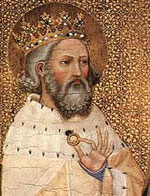
King Edward the Confessor
THE SERVANT KING & WHY HE MATTERS TODAY HERE
SAINT ANSELM & THE RED KING
The Old Testament shows how a people can move from "an eye for an eye" and the payment of tribal blood for injury to equality and justice under the law. Psalm 15 puts it simply:
Never a dull moment on the road to Runnymede and Magna Carta
The Old Testament says that God created us "in his image". The Brits who opposed slavery believed that each of us bears the divine image, and that we are called by Christ to live in community with each other as equals.
"Put on the whole armour of God, so that you may be able to stand fast on that evil day. Fasten the belt of truth around your waist, and put on the breastplate of justice. As shoes for your feet put on whatever will make you ready to proclaim the gospel of peace. With all of these, take the shield of
The Old Testament inspired the Brits who forced King John to agree to Magna Carta. One OT theme is that God is just. "Justice and judgment are the habitation of thy throne: mercy and truth shall go before thy face." (Psalm 89) A second theme is that God makes covenants with individuals and with a whole people. When God covenants with the people of Israel he gives them 10 commandments including "Thou shalt not steal, thou shalt not murder". A third theme is that kings who are unjust have broken their covenant with God and their people and can be deposed. Brits will depose kings they believe are unjust.
English translations of the Bible put its words into the hands of men and women, and they – and not the Church – interpret it and meditate on its meaning for themselves. They understand that the Bible is the word of God mediated by men, and hence not the perfect word of God, for no man is perfect. And perhaps most importantly, they understand that Scripture is only one way that God speaks to them. God also speaks to them in silence, in love of family and friends, and in nature.
Christian Brits believe that God created men and women with free will. Why did God give us free will? Because God wants the only love worth having – freely given love.
"I have put my trust in God, and will not fear what men can do to me."
"No one has greater love than this, to lay down his life for his friends."
A song of freedom runs through Old and New Testaments:
There was also a warning:
Brits believe passionately in the Old Testament idea of a covenant between people and rulers. They rid themselves of several unjust kings, including William II, Richard II, Richard III, Charles I, and James I. In America, Brits win free of George III.
When the disciples hear of a famine, they send help "each according to his ability" (Acts 11:28). Earlier, Christians sold their possessions and distributed the proceeds to those in need (Acts 2:43). Some think this was an early form of communism. However,
“Of all the dispositions and habits which lead to political prosperity, religion and morality are indispensable supports. . ."
Judeo-Christianity teaches the Ten Commandments and Christ's command to love God and love your neighbour as yourself. Though each of us probably falls short of these teachings, a community that believes in telling the truth and not stealing or murdering is going to be light years ahead of communities or nations where lying and stealing are the norm.
"A great gem for Christian and non-Christian." For UK orders: For US orders:
According to the Old Testament, God created us
"in his image, male and female created He them". In the 19th century, women assert that since both men and women share in the divine image, women deserve to vote.
It is for liberty that Christ has set us free" (Galatians 5:1). |
This wonderful book describes Britain's gifts to the world. Adults will refresh their understanding of profound events in British history, and young people will find inspiration. Warning: This book defies aggressive secularism and unthinking multiculturalism. Written by the co-editors of this website, Share the Inheritance is beautifully illustrated with 125 colour images and a timeline. Available at Amazon UK and at Amazon USA.
|
 |
||