Blog Home | All Posts | Liberty Timeline | Faith in Freedom | Heroes | Science Timeline | Artists | Life | Sports | Calendar | Brits Worldwide | Imagine
|
|
Blog Home | All Posts | Liberty Timeline | Faith in Freedom | Heroes | Science Timeline | Artists | Life | Sports | Calendar | Brits Worldwide | Imagine |

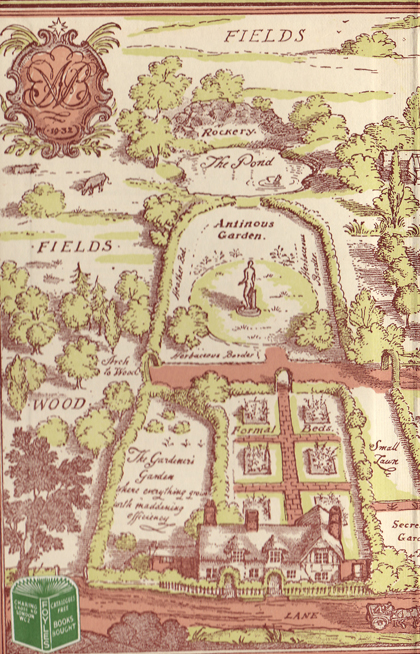
Funny and charming, theatrical and horticultural, Down the Garden Path with Beverley Nichols Beverley Nichols bought his cottage and garden in 1929, “when Wall He sent a wireless with an offer from a ship at midnight, with a fierce storm lashing the decks, after noticing in an old paper that Mr So-and-So had died, leaving his cottage and beautiful garden to his sister, who was somewhere in Timbuktu. When he finally arrived at his cottage, he found the garden had almost vanished under neglect and its hulking caretaker refused to get up out of bed, but Beverley went about salvaging and restoring, planting and writing and tearing down - We had to burn, and destroy and ravage before we could really create. And the extraordinary thing about it was that gradually my impatient desire for immediate results which is the besetting sin of all beginners, died down. I began to take a joy in the work for its own sake. Exactly. We like Beverley because he is relaxed. His gardening advice includes have a couple of cocktails before you go to the nursery to buy plants. Beverley managed to garden intensively while travelling the world - dragging stories out of "hard-bitten senators in Washington, "crashing about Africa in very rickety aeroplanes" and serving as a war correspondent in "the Swat valley, on the North-West frontier of India, a desolate no-man's-land that lurks in the shadow of the Himalayas" (Merry Hall). He wrote sixty books – children’s books, political books, mysteries, three autobiographies (three – you see what we mean about intensively), and two books about cats.
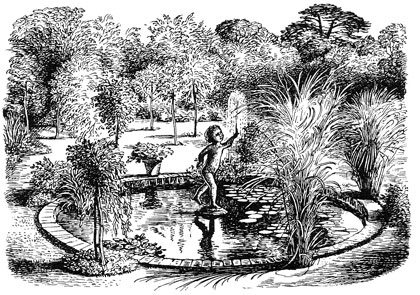
His first garden book, Down the Garden Path, was illustrated by Rex Whistler (1905-1944), a dazzling artist who died during the Normandy Invasion after dashing through machine fire to obtain Thirty years on, in Garden Open Today (1963), Beverley tells us essential things about garden design, on having the blues (and rare blue flowers), and on the mystery of whether we vibrate to peat, sand, clay or chalk soils - and whether certain plants vibrate with us. There is something to this, as there is to everything Beverley writes. Beverley shares his three great principles of garden design - 1. A garden without water is not a garden at all. Even a back-yard should have a miniature water-lily in a tub.
Beverley's description of digging a pool and maintaining it is simple and does not include horrendous expense, large-scale construction or tedious cleaning. Illustration by William McLaren Gardening through two feet of snow begins with Beverley's customary tone of amused outrage - A psychiatrist once hinted that my special love of winter flowers was a complex – a sort of regrettable Peter Panism, which caused its victims subconsciously to reject the inevitable natural sequence of growth, decay and death. If, by this, he meant that I refused to admit that there was ever a time of the year when the garden need cease to bloom, that there was not a single day, even in the snow, when it must be shrouded in dust sheets, then he was perfectly right. . . Beverley recommends planting winter cherry, Prunus subhirtella autumnalis, which will blossom from November to the end of February, and makes winter “much easier to put up with when one’s friends send one postcards from Jamaica.” To read about how you can grow blue irises flecked with gold and pick them in a blizzard and watch them bloom indoors, or how you can have South Seas perfume “drifting up through the sharp crisp air, mingling with the wood-smoke from the bonfire over the way,” pull Garden Open Today from your bookshelf, or ask Amazon to send you a copy. If you like it you will not be able to resist Merry Hall (1951), Laughter on the Stairs (1953) and Sunlight on the Lawn (1956). If financial disaster strikes, we are going to follow Beverley's advice and make the long-term investment of planting a garden.
When you contribute to this website,
|
BRITISH LIFE IS HERE
THE MAN WHO LOVED PLANTS
DAVID AUSTIN'S ENGLISH ROSES HERE
THE ENGLISH GARDEN IS HERE
|
|
 |
||