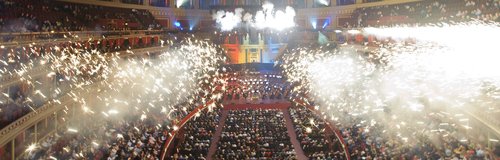
The choir of St Paul's Cathedral sings Samuel Sebastian Wesley's "Blessed be". A good anthem to celebrate the first anniversary of Prince William and Kate.
"Blessed be the God and Father of our Lord Jesus Christ" was composed for Easter Sunday, 1834, when the young Wesley (1810-1876) was choirmaster of Hereford Cathedral. At that time the choir had only a handful of boy choristers and one baritone soloist. Wesley inventively worked through this handicap. Happily St Paul's choir is full today, and the boys' voices shimmer with beauty.
English music has travelled abroad. This video was created with German subtitles for a German audience.
Evolution and Belief: Confessions of a Religious Paleontologist
Robert Asher, a biologist at the University of Cambridge, has written "a richly detailed account" of the evolution of mammals "with many wonderful insights that will be new to readers". Published by Cambridge University Press, his book tackles the deficiencies of Intelligent Design while still contending that modern science does not rule out religious belief.
Don't know why, but I'm not interested in the interiors of most big houses. I like Mottisfont's grey eminence from the garden.
Before the abbey was built in the 13th century, and long before its dissolution and transformation into a country house, local people held their moots around the font which was their spring.
Barry Singer on Churchill's books, cigars, dining, fashion, home, libations, and pastimes.
'Churchill was constantly confronting setbacks in his life and career,' Singer said. 'Home was an important place to him so whenever he was beaten he returned and found something to rejuvenate himself with.'
'As one's fortunes are reduced, one's spirit must expand to fill the void.' - Churchill
'Mr. Churchill is easily satisfied with the best.' - Lord Birkenhead
A lark, to climb the highest peak in Chinese-occupied Tibet, turned deadly serious. Sydney Wignell and his companions were captured, interrogated, and repeatedly forced to experience mock executions, which seemed very real to them.
Eventually the Chinese bowed to international pressure, and on December 10, 1955, the three men were escorted to the Nepalese frontier. They were faced with making their way across the mountains via the 18,482ft Urai Lekh pass and the avalanche-prone Seti Gorge which, as Wignall recalled, locals assured him had never before been forced in winter. For provisions, they were given a sack of flour, a bag of sugar and a small piece of meat. The Chinese, they reasoned, did not intend them to survive.
The "lark" was actually more serious than it seemed. Wignall was spying, and obtained important information while being interrogated.
A self-taught apprentice electrical engineer who became an adventurer, he left the mountain heights for the depths of the sea, learning how to dive and exploring ships from the Spanish Armada which had sunk off the Irish Coast. He discovered why the Spanish, though firing thousands of rounds at English ships, had failed to hit any.
Outside the hut I stood awed and bemused between two realities and two dreams. The rain had ceased but the clouds hung low and heavy overhead. It was a still morning and the smoke from the cookhouse rose straight to the leaden sky. A cart-track, once metalled, then overgrown, now rutted and churned to mud, followed the contour of the hillside and dipped out of sight below a knoll, and on either side of it lay the haphazard litter of corrugated iron, from which rose the rattle and chatter and whistling and catcalls, all the zoo-noises of the battalion beginning a new day. Beyond and about us, more familiar still, lay an exquisite man-made landscape. It was a sequestered place, enclosed and embraced in a single, winding valley. Our camp lay along one gentle slope; opposite us the ground led, still unravished, to the neighbourly horizon, and between us flowed a stream - it was named the Bride and rose not two miles away at a farm called Bridesprings, where we used sometimes to walk to tea; it became a considerable river lower down before it joined the Avon - which had been dammed here to form three lakes, one no more than a wet slate among the reeds, but the others more spacious, reflecting the clouds and the mighty beeches at their margin. The woods were all of oak and beech, the oak grey and bare the beech faintly dusted with green by the breaking buds; they made a simple carefully designed pattern with the green glades and the wide green spaces - Did the fallow deer graze here still? - and, lest the eye wander aimlessly, a Doric temple stood by the water's edge, and an ivy-grown arch spanned the lowest of the connecting weirs. All this had been planned and planted a century and a half ago so that, at about this date, it might be seen in its maturity. From where I stood the house was hidden by a green spur, but I knew well how and where it lay, couched among the lime trees like a hind in the bracken. Which was the mirage, which the palpable earth?
Blinded in an accident when he was a small child, Stanley had a brilliant memory and became a church organist at the age of eleven. He had only to hear a piece once to know it by heart.
Handel used to sit in Temple Church, London, listening to Stanley play the organ and the harpsichord.
Stanley's Trumpet Voluntary (usually played on the organ using the trumpet stop) is exuberantly performed here on an electronic organ. I enjoyed the footage of the organist's skate-shoe clad feet.
Stanley (1712-1786) wrote concertos, cantatas, and oratorios, some of them now lost. He deserves to be better known.
The Venerable Chapel at Winchester Cathedral, recently dedicated to the murdered hero St Alphege. /Image: Winchester Cathedral
One thousand and one years after his death on April 19th 1011, St Alphege was recognized in Winchester Cathedral, where he had once served as bishop, with the dedication of the Venerable Chapel to his memory.
A beautiful Sunday service presided over by the new bishop of Winchester recalled his life and death:
Alphege became a monk at Deerhurst near Gloucester but withdrew in later life to be a hermit in Somerset. Dunstan, the Archbishop of Canterbury, drew him back to be Abbot of Bath and, in 984, Bishop of Winchester. In 1005 Alphege was made Archbishop of Canterbury, where his austere life and lavish almsgiving made him a reverend and much-loved man. In the year 1011, the Danes overran southeast England, taking Alphege prisoner. They put the enormous ransom of £3000 on his head, but Alphege refused to pay it and forbade anyone from doing so, knowing that it would impoverish the ordinary people. He was brutally murdered by his captors at Greenwich on April 19th 1012.
They attacked Alphege with bones, the heads of cattle, and finally an axe. Thorkell the Tall tried to save him, but could not. "Appalled by the brutality of his fellow raiders" he deserted to the English side (Wiki).
I am touched by Alphege's love of solitude, where he could pray and praise God, his willingness to serve when asked, his refusal to oppress his people with financial demands, even to save his life, and his defiance of his kidnappers.
I have just finished the latest--but apparently not the last--of Bernard Cornwell's historical novel series on Alfred creating England: The Death of Kings. They are a fascinating combination of sometimes sparse history and intelligent conjecture to make a rousing good story. And the narrator, as a grumpy Viking ally of Alfred, is ingenious. Highly recommended for any who are as curious as the author about the creation of England and like a good read for a long night.
Sheldonian Theatre, Oxford, designed by Christopher Wren / Image: Wikimedia Commons
Aubrey de Grey:
I’m writing to notify you of a rather interesting event happening this coming Wednesday evening (April 25th at 7pm UK time) in Oxford, at the University’s spectacular Sheldonian Theatre: a debate between myself and Prof. Colin Blakemore, whom I’m sure you know as a high-profile neuroscientist and science communicator and also ex-head of the Medical Research Council, the UK’s largest funding body for biomedical research. The debate will be entitled “This house wants to defeat ageing entirely” and will address both the feasibility and the desirability of bringing aging under comprehensive medical control. See here for details.
. . .I expect that this will be quite a watershed event, since it’ll be the first time that a bona fide grandee of the British biomedical establishment has risen to the challenge of describing publicly, in a forum where he can be challenged, why intervention against aging is not in fact medicine’s most pressing priority.
Sure to be interesting. I can think of half a dozen reasons why intervention against aging is not medicine's most pressing priority.
Hands off our playing fields, says Prince Harry as he presents marathon prizes
"Prince Harry spoke out against the rampant development of school playing fields as he presented prizes at this year's London Marathon. . . .saving "what is left" of sports fields was something very 'close to his heart'.
"He said that the marathon had helped out "massively" by raising money for the charity Fields In Trust."
Thank you, Harry. Our sentiments exactly.
The same government selling off fields complains about growing numbers of obese young people. Government would seem silly if it weren't so wrong - to take fields away from children!
We're glad Prince Harry raised the standard. We hope good men and women will flock to it.
In an interview with the Wall Street Journal the buccaneering British billionaire explained -
I've always believed in befriending your enemies. Years ago British Airways went to extraordinary lengths to put us out of business. After the court case, I rang up Sir Colin Marshall, who ran BA, and said, 'would you like to come out for lunch?' I think he wondered why on earth I was doing it. But we had a delightful lunch at my house in London and became friends and buried the hatchet.
George's colours and England's: the red Cross on a white ground. Never mind those who opine that George is not the right saint for England.
George is the perfect saint for England because:
He liked to travel, he liked adventures, and he rallied to hopeless causes.
Following the Christian code of chivalry, he defended a vulnerable woman and her city. With his polished offensive skills, he confidently tackled the resident dragon.
Like many English who fought for justice, George knew that death might be right around the corner. Like them, he believed it was better to do right than worry.
Finally, and not to be sneezed at, George was successful.
He slew the dragon and saved the girl and her town. Then he galloped off to England from the Mideast. Some historians say he never arrived.
But that is to assign an entirely material view to a saint. George appeared in a stained glass window at the monastery of Jarrow in the 7th century and in the history of the Venerable Bede in the 8th century.
First George became known as the patron saint of English farmers (his Greek name combines the words for land and tilling). Then he became the patron saint of English knights.
Not long after Magna Carta, at the synod of Oxford in AD 1222, George was given a feast day. In 1381 the farmers and artisans who marched on London seeking economic justice in the Great Revolt, marched under his banner.
George was finally recognized as patron saint of England in the 15th century, during Henry V's reign, and given Shakespeare's stamp of approval 180 years later - 'God for Harry, England and St George!'
The English thoroughly vetted him.
Right at home
As the patron saint of England, George was 'linked by name to beneficent institutions of all kinds, to hospitals and charities as well as churches. . .' (Oxford DNB). Guilds and associations called him their champion. Appealing to a nation of theatregoers, George became an action hero in plays.
As late as the early 20th century, the Scouts named him their patron saint. George Orwell took the name George in affection for St George and England.
It's hard to dislike a hero who invites us to have a beer.
George's personal attractions are evident in cheerful English pub signs. Some show him reviving with an ale after his encounter with the fiery reptile, just as you might do, reptiles coming in many shapes these days.
Considerable hot air has been blown at George of late. Happily he has retained his cool.
"Michael Ross, who has died aged 94, spent more than a year on the run in wartime Italy, falling in love with — and eventually marrying — the daughter of one of the partisans who sheltered him."
He published From Liguria With Love, the story of his experiences, when he was eighty.
One of the greatest archbishops of Canterbury, Anselm ended slavery in Britain in 1102. At the beginning of the 12th century, he denounced, outlawed, and eliminated the selling of men and women in Britain.
We believe this is part of Britain's Constitution, the principles we live by - "Britons never will be slaves".
"The last people now living on Earth to witness a transit of Venus"
"On June 5 and 6 (depending on where you live), we are likely to be the last people now living on Earth to witness a transit of Venus.
". . .As we look skyward this June to see a planet almost as big as our own dwarfed by the immensity of the sun, we might pause for a moment to remember the hundreds of men who watched the exact same spectacle some 250 years ago."
Among them, Brits and Brits soon to become Americans, working together in a great international venture.
The descendant of an English family, Washington was born a British subject and fought with the British army. When he felt compelled to defend his freedom, and the freedom of Americans, he became Britain's greatest foe because he had the greatest character.
For one thing, he was absolutely incorruptible.
I know of very few men who have given up power because they knew it was best for their country.
The London Marathon is the largest annual fundraising event on the planet – runners have raised over £500 million for good causes since the race began in 1981. Expectations are high for Sunday's event, which will see thousands of runners streaming through the streets of London for 26 miles and 385 yards.
David writes -
As you may remember, the Marathon at the 1908 Olympic Games in London had been set at exactly 26 miles. It was to be run from Windsor Castle to White City Stadium in the west of London with the start in the magnificent avenue of trees in Windsor Castle grounds.
Historians, who are so frequently vague and contradictory, tells us that the day before the race King Edward VII had a cold, so his doctor advised him not to go out, and the beginning of the race was moved back 385 yards so the King could start it off. Another story, which I've recently heard, is that the distance was changed so that the Queen could easily view the finish.
Whichever royal intervention you choose, the distance was extended to 26.2 miles (26 miles and 385 yards). After various other distances were tried in subsequent Olympics, 26.2 miles was adopted as the official marathon distance.
Having run 22 marathons, I can attest that it is often that last bit that is the trickiest and most sublime.
Obama called the Falklands by the wrong name. He was trying to say Malvinas, but his tongue drifted 8,000 miles away.
This is a president who thought while campaigning that there were 57 US states. (As you know, there are 50.) He has since claimed that there is an Austrian language and a president of Canada. More brutally he has put millions of people out of work with his antiquated financial policies.
But he's awfully smart. He tells everyone is.
Make no mistake, though. He was dead serious about not supporting Britain and the free people of the Falkland islands.
Sir Tim Berners-Lee said that it was moves by governments to control or spy on the internet that 'keep him up most at night'.
The government's controversial plans to allow intelligence agencies to monitor the internet use and digital communications of every person in the UK suffered a fresh blow on Tuesday when the inventor of the world wide web warned that the measures were dangerous and should be dropped.
Sir Tim Berners-Lee, who serves as an adviser to the government on how to make public data more accessible, says the extension of the state's surveillance powers would be a "destruction of human rights" and would make a huge amount of highly intimate information vulnerable to theft or release by corrupt officials. In an interview with the Guardian, Berners-Lee said: "The amount of control you have over somebody if you can monitor internet activity is amazing. . .
The government has not suggested any overview protocols.
We do not believe there are any protocols that could resist corruption and exploitation.
Sir Tim: "The most important thing to do is to stop the bill as it is at the moment."
Visitors from America claim that the British beef they have eaten is delicious, the fish is delectable, and the dozens of local ales they have tested are superb. We await word on the rhubarb trifle.
In 1993 Rebecca Stephens became the first British woman to climb Everest. She is now a mother of two who leads treks for 15 days at a time.
Ann Daniels, "a housewife from Bradford", with 18-month-old triplets, was part of the first women's team to ski to both Poles. Her leadership has triumphed over storms, wet gangrene, and carbon monoxide poisoning. With the triplets now 18 and her youngest child eight years old, she intends to be the first woman to ski solo across the Arctic.
Despite maggots in her armpits and suffering from malaria six times, herpetologist Jenny Daltry has discovered dozens of new reptile and amphibian species in the remoter parts of our earth. She's survived minefields, too, and has a husband who loves conservation as much as she does.
Roz Daniels holds four world records for ocean rowing. She's the first woman to row the Atlantic, Pacific, and Indian oceans. Clothes chafe her, and she usually rows naked. And reads.
After bursting into tears when she first landed alone on the ice, mental toughness and resilience came flooding back to Felicity Aston. She became the first person to cross Antarctica alone without kites and parasails.
How do these women imagine these adventures beforehand? Read Stella to find out.
Without banging on about it, I'd like to add that they grew up in a Britain where they saw women becoming queens and prime ministers, and where women had long ago led armies, rescued wounded soldiers on the battlefield, travelled into the heart of Africa, written books, and run breweries and forges, to mention but a few of their exploits. And of course, most importantly and essentially, they were mothers.
Sir Tom Hunter attacks government cap on charitable giving
Among the many philanthropists to have expressed strong public criticism of the Chancellor’s proposed cap on the amount of money that can be given tax free to charities is Scottish billionaire Sir Tom Hunter, knighted in 2005 for his services to entrepreneurship and philanthropy in Scotland.
Urging the Chancellor in this week’s Sunday Times to reconsider his decision, he offers some timely advice to him by quoting a piece of practical wisdom from an earlier great Scottish-American businessman and philanthropist, Andrew Carnegie which runs:
He that cannot reason is a fool. He that will not is a bigot. He that dare not is a slave.
Roger Scruton explains that his environmentalism is based on localism and reform, not alarmism and radical upheaval. He notes that the first modern environmentalists were English Tories who resisted industrialization and the imposition of the railways on the countryside.
. . .Long-term political order, he says, depends on responsible stewardship. Here Mr. Scruton calls upon Burke's concept of trusteeship, which broadens Rousseau's social contract to encompass not only current members of society, but the dead and unborn too. Our responsibility to them offers us a natural incentive to conserve our habitats—one that strong, centralized states usually crowd out, as the environmental devastation in Russia and China suggests.
The temptation for transnational solutions to environmental ruin is equally apparent. "But of course they never work," Mr. Scruton says, "unless the people who subscribe to them have a motive for obeying the result. It's finding that motive that is the real problem."
. . .He continues: "I think this whole environmental movement has arisen because people recognize that we do need that spiritual discipline, and they're looking for it, partly in the wrong place by trying to get the government to do that discipline for us."
Mr. Scruton is hopeful that environmental degradation will be reversed from the bottom up, as countless other problems have: through civic associations, community groups and local organizations. . . ."What is to be done," he says, "is essentially a work of education, opening the space for volunteering, reminding people in one way or another that the responsibility is theirs, and not confiscating the space in which they can act."
None of that can happen without the love and transcendent bonds that sustain any society. . .
Picking up litter along a footpath or not dropping it in the first place might be a loving place to start.
Scruton says, "The love of the English people for the place that is theirs, for the landscape, the way of life and the institutions that have hallowed it, has been the greatest single cause of environmental stewardship."
I think he's right.
I'd add, if a conservative--someone who wants to preserve and conserve the best--doesn't want to conserve and preserve the countryside, he might think about calling himself something else. Barbarian comes to mind.
The 19th century historian Macaulay reminds us that many people arguing about politics, society, and science have very little rational support for their opinions. No doubt we've been guilty of this on occasion, too.
It has never occurred to him, that a man ought to be able to give some better account of the way in which he has arrived at his opinions than merely that it is his will and pleasure to hold them. It has never occurred to him that there is a difference between assertion and demonstration, that a rumor does not always prove a fact, that a single fact, when proved, is hardly foundation enough for a theory, that two contradictory propositions cannot be undeniable truths, that to beg the question is not the way to settle it, or that when an objection is raised, it ought to be met with something more convincing than ‘scoundrel’ and ‘blockhead.’
All the seafood served in Restaurant Nathan Outlaw in Cornwall "is freshly caught by day boats that go out with the tide, or if it is mussels, oysters, cockles or clams, gathered less than half a mile away on the shoreline. Even the accompanying produce is local. The asparagus in a dish of lemon sole with bacon, wild garlic and pumpkin-seed dressing is grown on the hill behind the restaurant."
Chef Nathan Outlaw is a big, happy bloke of 34 with the only 2-star Michelin fish restaurant in the world. He likes to explain how to break down the cooking of fish into simple steps, and that's what he's done in his new book.
We referred to the wonderful charitable contributions of Britain's people below. This stone speaks more personally about giving and about friendship, too. It can be found in the small and simple church of St Swithun's in Winchester, a place with an ancient and holy spirit. The tone and style of the inscription recall Jane Austen's most tender expressions.
Wm WIDMORE
He was, (which is most rare)
A friend without guile,
An Apothecary without Ostentation.
His extensive Charity in his profession
Entitled him to be call'd
The Physician of the poor.
Let other inscriptions
Boast Honours, Pedigree, and Riches,
Here lies an honest Englishman,
Who died the 19th Day of June 1756.
Aged 63.
"Britain's amazing philanthropy culture" under attack
By the government, of course, which thinks that all money should go to it, really, everything you make, which it might then dole back to you unless it found a better and greater use for it, which you can be guaranteed it would.
Chancellor, George Osborne has authorised the Treasury to pass a new law limiting the amount that can be donated, and counted against tax.
Government cannot bear that your ideas about where to spend your money might be better than its ideas.
Shameful.
What. . .Cameron’s ministers miss is the fact that Britain has an amazing philanthropy culture, which dwarfs that of our European neighbours. The Hudson Institute’s Index of Global Philanthropy, which counts private donations to overseas charities, shows just how generous we are. The average Brit donates four times more than the average German, seven times more than an Italian and nine times as much as a Spaniard.
This has been true for almost two hundred years.
Cameron's avowed "policy was to place trust in the courage and the character of the British people, bowing to their greater collective wisdom."
But what a minister vows, his actions too often disclaim. Once again the politicians have abandoned the greater collective wisdom of Britain's people.
Clarke, who was born in 1674, was a pupil at St Paul's Cathedral, and later became organist at the Chapel Royal.
The Prince of Denmark's March, also called the Trumpet Voluntary, is a joyous piece so I was startled to learn that Clarke, who wrote the music when he was 27, committed suicide seven years for love of a lady.
Intense happiness followed by drowning sorrow.
For a long time his music was attributed to Purcell, but that at least has been straightened out. This popular voluntary is Clarke's.
St Cross is an ancient almshouse, which stands beside the water meadows of the River Itchen. It was built in 1136 by Henry de Blois, bishop of Winchester, who is said to have been inspired by a starving girl he encountered in the meadow. He housed thirteen poor men and fed one hundred local people a day, and the custom has continued to this day. Older men without means still live here, and Wayfarer's Dole, a morsel of bread and a horn of beer, is still distributed.
The church is a crusaders' chapel, with "lofty vaults and heavy piers" (Simon Jenkins, England's Thousand Best Churches). During the Maundy Thursday service, the stone tower, full of light by day, echoed with the voices of sopranos and the quiet words of the former Navy chaplain.
He recalled the laughter on Christmas Day when, throughout the armed services, the officers serve the men, even the captain wearing an apron around his waist and a napkin on his arm, serving the young sailors. This, he thought, was an equivalent of the idea of Maundy Thursday.
British sovereigns were particularly identified with the liturgy for the Maundy Thursday service, which is celebrated today. (Maundy is the charming English abbreviation of Mandatum, the Lord's commandment to love.)
According to the Gospel of Luke, a dispute arose among the disciples as to which of them was to be considered greatest. Jesus gave to them and to us one of the most radical ideas of all time: 'The kings of the Gentiles lord it over them; and those who exercise authority over them call themselves Benefactors. But you are not to be like that. Instead, the greatest among you should be like the youngest, and the one who rules like the one who serves' (Luke 22: 24-27).
In the Maundy Thursday ceremony, kings followed the example of Jesus, who washed the feet of his disciples, and washed the feet of the poor. In York, The Queen handed out Maundy money to pensioners from all over the country as a sign that the monarch is to serve her people.
The radiant meaning of the ceremony has eluded some kings, and eludes some prime ministers and presidents today. They are not to rule us, they are not to tell us how to think and feel and live, and they are not to be our supposed 'benefactors'. They are to serve us.
That is the mandate of representative, constitutional government.
Literate, well organized, and often well-to-do business people, the Friends organized in the 17th century in the turbulent period after the English Civil War. They refused to doff their hats to anyone, or to take oaths, and so were easily identifiable. They soon attracted the hostility of local and national authorities. They were stoned on their way to meeting, denied jobs, whipped, pilloried, and jailed. Thousands were incarcerated, and received sentence of praemunire, which meant that their house was forfeit to the crown.
The Friends defied these adversities. They believed that every person, man, woman, and child, could experience the inner light of God, that men and women were equals, and that freedom of conscience was essential to society. They went on to fight successfully for the abolition of slavery.
I caught the BBC's thoughtful programme on the Friends while driving. It was interesting, even inspiring, and can be heard again tonight at 9:30pm.
By the way, is there some reason why the BBC masthead for In Our Time programmes apparently features a mosque? It's the Hagia Sophia in Istanbul, which was once a Christian basilica. Frankly, I'm shocked. I can think of many good reasons why the mosque should not be on the masthead. Freedom of conscience, which is not tolerated in Muslim countries, would be number one.
Founded by Britain, Canada is a parliamentary democracy and a constitutional monarchy. HM Queen Elizabeth is head of state. Within a federal framework, Canada's ten provinces and three territories have considerable responsibility and power to govern locally.
Not too many years ago, Americans could get away with cracking jokes about spendthrift Canada, its weak dollar and the long wait for MRIs. These days, the joke is on Americans, as Canada's government has cleaned up its fiscal mess and focused on private economic growth.
Here's another teachable moment, from the EU and the continent where fascists, communists, napoleons, czars, inquisitions, emperors, high taxes, bureaucrats, and bloody wars have been wont to make their home -
Shortly before Monday's release of Europe's unemployment figures, the European Commission issued its quarterly "Employment and Social Situation" report, which ventures that "the transition towards a greener economy is expected to have a significant impact on employment." Will it ever: This week German solar-panel maker Q-Cells, with its 2,000 employees, filed for bankruptcy.
With solutions like that, it's no surprise that the EU's unemployment rate is expected to rise to 11% by the end of this year from an already dismal 10.2%, which is up from 9.5% a year ago. . .
She told The Daily Telegraph: “The islanders have always been fiercely British and want to stay that way. I hope we would do it all again if we had to."
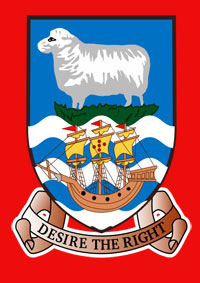
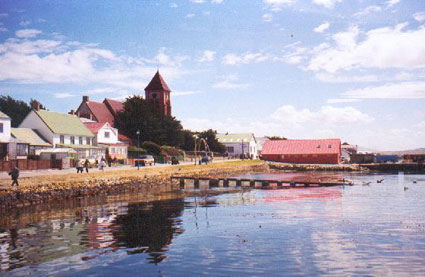
Stanley. The Falkland Islands is a self-governing territory of the United Kingdom with three thousand people.
When the military dictatorship of Argentina invaded on April 2nd,1982, a local radio presenter repeatedly played 'Strangers in the Night' to warn Falklanders. They were determined to remain British.
The British Government, led by Prime Minister Margaret Thatcher, took the wishes of the island people and the principle of self-determination so seriously that Britain went to war to protect them from armed aggression and to assert the rule of law.
Britain had been taken by surprise by the attack and scrambled to launch a naval task force to engage the Argentine Navy and Air Force, and retake the islands by amphibious assault if necessary.
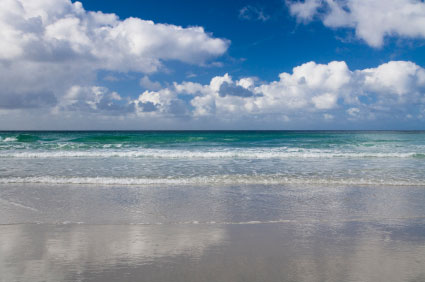
Falkland Islands beach.
While British ships streamed across the Atlantic, the Argentine government refused to withdraw as requested by the UN.
After intrepid combat, the British prevailed.
They did so with the help of the United States. President Reagan's administration made supplying essential military supplies its top priority. Caspar Weinberger, the US Secretary of Defense, later received a knighthood from The Queen for his services.
Happily, the Argentine defeat increased popular protests against the military junta, which fell.
"It was," wrote Luigi Barzini, "a highly pragmatic operation undertaken in defense of international law and morality and surely not for gain." The islands were restored "to the government desired by their inhabitants".
Postscript
Jim Hodge sent a link to this WSJ article, which reminded us that America almost sided with Argentina. It includes a gorgeous photo, which shows two little girls waving goodbye to British servicemen.
Last summer, she took the unprecedented step of writing to every National Trust member asking them to join a highly political campaign against the Government’s proposed changes to planning regulations, which were meant to encourage growth – but which she thought read “like a property developer’s charter”.
Happily, the National Trust is "an organisation with four million members spread across England, Wales and Northern Ireland - 10 times more than all the political parties put together".
The Trust, says Dame Fiona, "is about access to beauty, access to nature, access to history". That is why the organisation fought the government's planning proposals, which were arrogant and out of touch with the real needs of the people of Britain.
As a result of the campaign by the National Trust and The Telegraph, the Government published a rewritten National Planning Policy Framework on Tuesday.
As you know, the devil is in the details. We like very determined women who can keep their hands on all the details.
Now Dame Fiona will now be urging her four million members to get involved with planning decisions where they live, to make sure the countryside - lands and rivers, woodlands and meadows and downs, small birds and shy deer, footpaths and views - really is protected.
They brought honesty and common sense, fair play and compassion, bravery, daring, and self-discipline, and a passionate love of liberty to a 2000-year-long struggle to achieve freedom.
Allegedly unwritten, but called "the most stupendous fabric of human invention" in the world, and extremely important to your well-being, no matter where you dwell.
FRIENDS & SUPPORTERS
Our gratitude to ADAM HILEY of Essex for his contribution to the website.
Our happy thanks to BARRY AND VIVIENNE HOOPER of Australia, who purchased a book and made a donation to the website. They wrote, We thank you both for your wonderful website which you share with many.
Our warm thanks to STEWLAC for buying copies of the book, making a donation to the website, and sharing our hopes.
Thanks to JASON BARNES for contributing to Brits at their Best and buying a copy of the book. Hope he likes it.
In appreciation of the file on abolishing slavery, TOBY ROWE has supported Brits at their Best with a contribution.
WILLIAM EHRET made a donation to Brits at their Best.
WILLIAM ROBINSON supported Brits at their Best with a contribution.
M. SCOTT ANDERSON, USA, supported Brits at their Best with a contribution.
DAVID ARLAN made a donation to Brits at their Best.
ANTHONY FRANCIS supported Brits at their Best with a contribution.
JAMES HODGE, USA, made a donation to Brits at their Best.
KATERINA EYRE BREWER, USA, made a contribution to the website in memory of her beloved father, JOHN MEREDITH EYRE. He died at the age of 43 after serving in the British Army and raising his children to love music and to cherish their English heritage.
GILL CHANT, UK, made a gift to the website in memory of her mother ‘MAC’ CHANT, who loved the arts.
SIMON JACKSON, UK, made a contribution to Brits at their Best, which he called ‘an excellent and important site’.
ANONYMOUS made a donation to Brits at their Best because ‘It lifts my spirit to visit your site’.
JOHN WRAKE, UK, made a contribution to the website in memory of T/141188039 SGT. C.R. RITTER, Workshops Section, 3 Company, Royal Army Service Corps, killed on active service in the Cameron Highlands, Perak, Malaya, on 2nd March 1950, aged 21. While trying to recover a civilian vehicle that had broken down, he was ambushed by Communist terrorists.
GREGORY J. BURROWS supported Brits at their Best with a gift.
Friends indeed. Many thanks,
David and Cat
Brits at their Best Sidebar Copyright 2006-2014 David Abbott and Catherine Glass
The people of Britain and the Anglosphere defied a world of cruelty and superstition to create life-changing gifts. This is your inheritance. Glorious. Hardcover, 140 pages, 125 colour illustrations.
Available at PG Wells Bookshop, Winchester, 01962 852 016 and at Amazon UK
Amazon USA
The cost is £5.99 (plus £3 shipping) in the UK, $15.99 (plus $3.99 shipping) in the USA.
The authors — Dr David Abbott and Catherine Glass Abbott — are the publishers of this website.
DAVID ABBOTT MD, MRCP
I have practiced medicine in England, America and Canada for the last four decades. I believe in the principles of Magna Carta and the Bill of Rights. I am a father, grandfather, bell ringer, environmental campaigner and marathoner.
Brits at their Best produced thousands of indispensable inventions, developed wildly popular sports, designed romantic houses and gardens, created astonishing literary masterpieces, lived with style and humour, tackled dangerous missions with daring and ingenuity, and fought with indomitable courage to establish and protect the free world.
We describe their superb achievements and extraordinary lives.
CATHERINE (CAT) GLASS
I saw tyranny firsthand in Eastern Europe. (My background is English, Irish, and Czech.) I received my degree in Classical Greek from Columbia University, New York, worked in publishing in the United States for twenty years, and helped the homeless for seven years.
We write about liberty, reason, imagination, fair play, a generous and forgiving spirit, love of God, the rule of just law, representative government, books, gardens, music, art, sports, inventions. . .the most wonderful things in the world.
“Brits at their Best. A magnificent site, particularly the Liberty Timeline. . .” Hugh Hewitt, radio talk-show host, author, law professor and blogger