Blog Home | All Posts | Liberty Timeline | Faith in Freedom | Heroes | Science Timeline | Artists | Life | Sports | Calendar | Brits Worldwide | Imagine
|
|
Blog Home | All Posts | Liberty Timeline | Faith in Freedom | Heroes | Science Timeline | Artists | Life | Sports | Calendar | Brits Worldwide | Imagine |
|
In 1620, at Southampton, 101 men, women, and children and two dogs clamber aboard a ship just 106-feet long (imagine 8 mid-sized cars lined end to end). The 102nd man, William Brewster, is already hidden on board, evading authorities who want to imprison him for his religious beliefs. Determined to worship God as they wish, they head west toward America, into the teeth of equinoctial storms. Painting: The Mayflower by Mike Haywood MAKING A REVOLUTION An intrepid judge tells the King he must obey the law. In the New World, the Pilgrims establish majority rule. Five Knights defy the King. A hero challenges the power of the Star Chamber, and Parliament goes to war with the King.
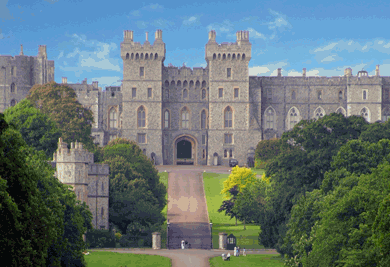
Living in Windsor Castle may have given some kings the notion they are above the law. Parliament will disabuse them of the notion. Photo: [email protected] 1603-1625 PARLIAMENT FENCES WITH JAMES I Clever and obnoxious King James I believes that kings are above the law and have divine rights. Since Magna Carta has made clear for 400 years that no king is above the law, Parliament is dismayed. The Commons reminds James that the people must agree to his laws and taxes. James brushes them aside. He is contemptuous of Parliament’s 467 elected members and its rambunctious sessions. However, James needs money, and if he wants money, he has to deal with Parliament.
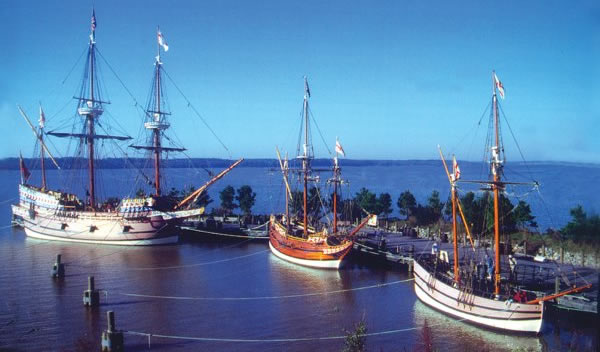
The stockholders of the Virginia Company in London invest in an expedition to America and sponsor the first settlers, who land at Jamestown. Photo: Jamestown-Yorktown Foundation 1607 VIRGINIA COMPANY SENDS EXPEDITION TO NEW WORLD, FOUNDS JAMESTOWN The founding of the first English colony in America may not appear to have much to do with freedom. It's an example of a freedom that seems almost invisible to many people, though it is essential to our well-being, and that is economic freedom. The King, James I, had granted the Virginia stockholders - or adventurers as they were known - a charter to settle, but their decision to invest in America was their own. The inspiration for this first foray can be found in Armchair Adventurer Landing in what is now Virginia, the Brits expect to trade with the natives, but this hope proves desolate. The place they settle and call Jamestown is baking in a seven-year drought. The native Indians attack. To protect themselves with a palisade, Jamestown settlers cut and split more than 600 trees weighing 400 to 800 pounds each, and set them in a trench three football fields long and 2 1/2 ft. deep over 19 sweltering days (William Kelson, The Buried Truth). Drinking the water in the James River they fall ill with typhoid and dysentery. Starvation kills hundreds. By 1609, during "the starving time", the survivors are ready to abandon America. Charismatic and intrepid Captain John Smith is not ready to abandon America. He survives death after capture due to the intervention of Pocahontas, the daughter of Wahunsonacock, chief of the Powhatan, who controls 30 local tribes and 15,000 people. In another example of writing that can change the world, Smith writes an account of America so intriguing that investors send out another fleet of ships with settlers and supplies. Jamestown is reorganised to produce a steady, cash crop. (Tobacco, alas.) The seeds of representative government are about to be planted as well. 1613-1618 CHIEF JUSTICE COKE DEFENDS LAW FROM PRESUMPTUOUS KING King James I announces that the King’s Prerogative – his right to do whatever he wants to do – trumps any law. In a sensational riposte, Chief Justice Edward Coke declares that conflicts between the Royal Prerogative and the Common Law are to be resolved by the Law and judges. Coke rests his opinion on the ancient tradition that the Common Law declared in the courts is superior to any law made by the government. This is an early, brilliant example of the principle of separation of powers. (See EU THREAT on whether EU legal rulings trump Common Law.) 1600s COMMON LAW AFFIRMS THAT A MAN'S HOUSE IS HIS CASTLE By the 1600s, Common Law has established a person’s home as his castle, a place where men and women have the right to protection from prying and violent attack. Freedom from search and the right of self-defence are protected by the law, which extends to the right to own property such as a house and which prevents government from taking that property away. The right will be confirmed by William Blackstone in his Commentaries on the Laws of England, published in 1765. The right to property and the freedom to own and dispose of it is essential to free, prosperous societies. 1618 VIRGINIA COMPANY SETS UP REPRESENTATIVE GENERAL ASSEMBLY The Virginia Company is made up of investors who would like to see their colonists less lawless and creating more profits. In a brilliant and practical move, the Company establishes a general assembly. The burgesses, or representatives, are elected under the practical theory that "every man will more willingly obey laws to which he has yielded his consent." The general assembly meets for the first in the summer of 1619, and discusses gambling, drunkenness, the price of tobacco, church attendance, and Indian relations. Their numbers increased as Brits were drawn to America by freedom of religion, the freedom to own property, and self-government. In 1622, the Indians launched raids on plantations and settlements, killing 347 colonists, a quarter of the total population. Jamestown, warned by an Indian boy who had converted to Christianity, escaped. The settlers regrouped. Eventually their general assembly will become the self-governing House of Burgesses, the elective house of Virginia's colonial legislature where George Washington and Thomas Jefferson will debate representation and revolution and the Virginia Bill of Rights will be drafted. 1620 PILGRIMS BRAVE ATLANTIC, ESTABLISH A CHARTER OF FREE GOVERNMENT A group of families determined to live in religious freedom in a new land sets off in two small ships for America. They are forced to turn back when one ship, the Speedwell, proves neither speedy nor well. Crowding all the passengers into the Mayflower, including three pregnant women and the mastiff and the spaniel, with space so tight some of the men sleep in a rowboat on deck, they head for Virginia. British settlers in Virginia had almost perished several times, but by 1620 they were shipping 350,000 pounds of tobacco to London. As James I caustically observed, their fortunes were built on smoke. The Mayflower pilgrims were hoping to reach Virginia would be alright, but after being hammered by the Atlantic's equinoctial gales for 65 days, they are far off course, and ready to land anywhere. Anchoring off Cape Cod in a bleak November, they wonder whether they should settle in this northern wilderness, devoid as far as they can tell of houses, warm fires, roads, or any people. They make two momentous decisions: They decide to land. They decide how to govern themselves. With just three sentences the Pilgrims establish the Mayflower Compact, a unique agreement implicitly grounded in Judeo-Christian ethics that calls for cooperation and self-government under majority rule. Before a year had passed, half of them are dead of exposure and malnutrition, but the Compact survives. The mastiff and spaniel help to hunt deer for food, and the survivors discover that the waters off New England are teeming with fish. Buoyed by their belief in God, and helped by the Indians, the pilgrims build a community. By 1640 there are 20,000 Brits in Massachusetts. The Indians are less lucky. The diseases the pilgrims unwittingly bring with them – smallpox, influenza, and diphtheria – kill 90% of the indigenous people of New England. 1625-1628 BRITS RISK PRISON TO PROTEST TAXES There is a growing feeling among Members of Parliament that they should have a larger voice in national affairs, including foreign policy, since they represent the taxpayers who are paying for foreign entanglements. The new King, Charles I, disagrees and dissolves Parliament. He tries to obtain forced loans without Parliament’s approval. In protest at these high-handed actions, some knights refuse to loan the King money. The King has them imprisoned "by his special command". They include Sir Edmund Hampden, Sir Thomas Darnel, Sir John Corbet, Sir Walter Earl, and Sir John Hevingham. Five of the King's prisoners, the “Five Knights,” bring a writ of habeas corpus. John Selden defends them based on their rights to habeas corpus under Magna Carta, and argues that they are being held without cause. In a horrifying setback, the King’s Bench rules that they cannot be bailed because they had not been accused of specific offenses. Edmund Hampden dies as a result of his imprisonment. Brits across the country rise in protest, and demand the Petition of Right. 1628 PETITION OF RIGHT AFFIRMS OLD FREEDOMS, ASSERTS NEW ONES Desperate for cash, Charles I brings Parliament back into session. Parliament agrees to give him what he needs, but only if he agrees to the Petition of Right. The Petition, which Sir Edward Coke helps to draft, is one of the great charters of liberty. It reaffirms the freedoms the Brits have held since Magna Carta, and adds several new freedoms:
In the Petition of Right Brits affirm the principle of habeas corpus and assert that a person can be arrested only for a defined criminal act. The definition of what is criminal has to be specific and agreed to by the people. Otherwise governments will call 'criminal' Photo: [email protected] 1636 ROGER AND MARY WILLIAMS FOUND COLONY TO PROTECT RELIGIOUS FREEDOM Roger Williams is an idealist who loves reading Scripture in its original Greek and Hebrew. He is one of those Brits who wants to build "a shining city on a hill". As John Winthrop describes this city in 1630, it is a place where men and women follow the Counsel of Micah, "to do justly, to love mercy, and to walk humbly with our God". Inspired, Roger and his wife Mary sail for the New World to help build the shining city. There Roger serves as a minister, and is well-liked. Gradually he discovers that the Massachusetts Bay Colony is confiscating the land of Indians without payment and oppressing religious dissenters. Shocked, he calls for fair compensation and advocates civic and religious freedoms, which he calls "soul-liberty." The Bay Colony banishes him, and casts him out into the wilderness. This is akin to a death sentence, but Williams takes refuge with Indians, whom he has always treated as his equals. They give him land around Narragansett Bay for a new settlement.
Roger and Mary Williams establish the Colony of Rhode Island as a democracy and a sanctuary for those escaping religious intolerance. It is almost alone in the world in allowing complete religious freedom. 1637 - 1638 JOHN LILBURNE IS WHIPPED 200 TIMES BUT CONTINUES TO DEFY THE STAR CHAMBER Begun in 1487 to hear cases against the powerful, the Court of the Star Chamber at the Palace of Westminster had become a tool to destroy political and religious opponents in secret without jury or appeal. (The bright gold stars in its ceiling give the chamber its name.) A haberdasher named George Collier endures five years in jail because he resists interrogation in the Star Chamber. Robert Beale, a Common Law and Canon Law lawyer, Thomas Cartwright, a Puritan minister, and many other Brits fight Star Chamber persecution. They slow Star Chamber proceedings and undermine its authority, but the Star Chamber continues its oppressions, apparently unstoppable. John Lilburne walks deliberately into the maw of the Chamber. He throws away a dazzling career so he can protect liberty. The Star Chamber accuses him of shipping what it calls seditious books into England, and forces two confederates to accuse him to save themselves. Then the Star Chamber demands that he confess. Lilburne denies the charge and refuses to answer the questions. He is found guilty of contempt because he refuses to accuse himself. The Star Chamber sentences him to a £500 fine, punishment in the pillory, imprisonment until he agrees to speak, and a whipping. Lilburne is to be whipped through the streets on his way from Fleet Prison to the pillory. The sentence is carried out on April 18, 1638. Lilburne is whipped over 200 times on the two-mile walk to the pillory, but his defiance makes him famous before night falls, and a massive anti-government demonstration erupts. In the pillory, John Lilburne continues to defy the Star Chamber by asserting that being forced to testify on oath against himself is against both the Petition of Right and the law of God. He serves three years in jail, and endures four months in solitary confinement, but this is not the last the Star Chamber will hear from John Lilburne or his ardent wife Elizabeth. 1638-1639 A FATALLY UNPOPULAR MOVE To make money, the government of Charles I fines Brits who do not attend the Church of England. The fines anger Puritans who worship in their own churches, and they protest.
Charles I has not called Parliament into session for eleven years. Scotland is told to adopt the English Prayer Book, and revolts. The Scottish Assembly invades England. Charles asks Parliament for money to help repel them. But there is the little matter of the piper to be paid. 1640 PAYING THE PIPER Under the leadership of men such as John Pym and John Hampden, Parliament intends to discuss eleven years of grievances before handing over any funds to the King. An angry Charles dissolves Parliament. Six months later, he is forced to recall it. He has lost battles and cities to the Scots and desperately needs cash to broker a peace. Meanwhile, John Liliburne has written nine pamphlets denouncing the Star Chamber, and smuggled them out of prison. In session, Parliament immediately:
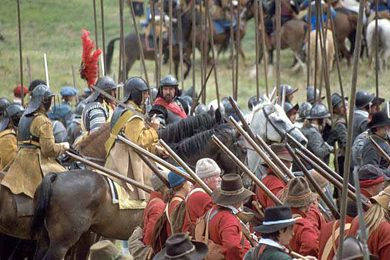
John Liliburne's imprisonment is declared "illegal and against the liberty of the subject." He is released from prison, and a great precedent begins to take root: refusal to answer a question in a court of law is a right, and does not carry a presumption of guilt. 1640s KING AND PARLIAMENT COME TO BLOWS; ROUNDHEADS BATTLE CAVALIERS Charles I asserts his divine rights and refuses to share power. Parliament insists the King does not possess divine rights, and must share power. Religious hatreds also play a part. Some Puritan members of Parliament fear that the King wants to reintroduce "Popery" and end freedom of religious conscience. Cavaliers (the nom de guerre of the King’s supporters) and Roundheads (supporters of Parliament) battle each other in a Civil War that divides and destroys families and friendships, and lays waste to farms and towns. Peter Hitchens remarks that it was a conflict "between the Wrong but Romantic Cavaliers and the Right but Repulsive Roundheads". In truth men on both sides die courageously in the belief they are defending their principles. Brits will preserve their rights and freedoms and expand on them.
Thomas Rainborowe believes that the men who fight for parliament and representative government should have the right to vote for their representatives even if they are poor. Image: Jeff Parker, English Civil War Society 1644 - 1654 MILTON DEFENDS FREEDOM OF IDEAS AGAINST GOVERNMENT CENSORSHIP EVEN WHEN BLIND On June 16, 1643, Parliament established a Licensing Order designed to bring publishing under government control by creating a number of official censors. Authors would be compelled to submit their work to the censors for approval before it could be published. The great poet John Milton, who will write Paradise Lost and Paradise Regained, had been campaigning for civil and religious liberty as a pamphleteer since 1640 when he was 32. He had been a defender of Parliament, but he was appalled by its plan to suppress books before they were published, and in 1644 he published Areopagitica as an appeal to Parliament to rescind their Licensing Order. Milton argues that God has given us reason and the freedom to choose, for God does not want our forced obedience but our willing love. He observes that the opinions and judgments of mankind are often mistaken, and can only be corrected by open discourse, when truth will win out. He ends by warning that when printing is regulated, music and dancing and every gesture will have to be regulated, too. Milton's Areopagitica has almost no effect on Parliament, but it will tremendously influence the principle of freedom of the press later in Britain and in the U.S. Constitution. Milton continues to write, completing The Second Defence of the People of England in 1654, though by then he is blind. To 1645-1699
When you contribute to this website,
|
BRITISH HISTORY THE STORY of
LIBERTY! THE TIMELINE Freedom & justice go hand in hand
Brits create dramatically different cultural experiments in Massachusetts, Rhode Island, and Virginia. For UK orders:
For US orders:
Catherine Bowen Drinker's prize-winning biography of Coke is out of print, but can still be obtained. Readers have called THE LION AND THE THRONE breathtaking and hard to put down. For UK orders:
For US orders:
Full of fascinating details about Jamestown. For UK orders
For US orders
Boyer's fascinating biography brings us Coke the practical idealist at work during an enthralling age. For UK orders:
For US orders:
Charles I was called aloof and prevaricating, kind, principled, and brave. Carlton's biography examines the complex character of the King and the actions of the men who opposed him. For UK orders:
For US orders:
Pauline Gregg's biography of Lilburne shows a fearless man who laid the foundations for the US Bill of Rights. For UK orders:
For US orders:
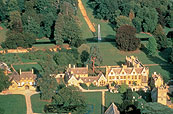
Stanway House was completed just a decade before the Civil War. Photo: Stanway House
Gallantry is admirable, and gallant Prince Rupert almost wins the Civil War for Charles I. For UK orders:
For US orders:
Lindley's sourcebook on the Civil War has been called the best ever produced. For UK orders:
For US orders:
Tackling Milton's two great poems about man's disobedience and God's justice, we find themselves in a world of fire and light familiar to the Brits who took part in the Civil War. For UK orders:
For US orders:
|
This wonderful book describes Britain's gifts to the world. Adults will refresh their understanding of profound events in British history, and young people will find inspiration. Warning: This book defies aggressive secularism and unthinking multiculturalism. Written by the co-editors of this website, Share the Inheritance is beautifully illustrated with 125 colour images and a timeline. Available at Amazon UK and at Amazon USA.
|
 |
||