BRITISH HISTORY
THE STORY of
FREEDOM
1st CENTURY BC -
6th CENTURY AD »
17th CENTURY
1600-1644 »
17th CENTURY
1645-1699 »
18th CENTURY
1787-1799»
20th CENTURY
1946-1999 »
21st CENTURY »
Four crucial ideas emerge as Brits fight for freedom.
FREEDOM NETWORK »
Beginningin 1787, Alexander Hamilton and James Madison, with a little help from John Jay, fire arguments at the opponents of the U.S. Constitution, and urge ratification. Their newspaper essays have been read ever since.
For UK orders:
For US orders:
Mark Steyn » ironically observes that "Americans' misguided attachment to this yellowing parchment may explain why, for the past century, they've lagged so far behind in technological innovation, economic performance, military prowess, cultural influence, etc." The American founders are opposed to creating a ‘democracy’ (understood at the time to mean rule by the majority without checks and balances and with the rights of the individual left unprotected). They intend to create a republic.
Their definition of a republic is a people granting some of their powers to a government that rules according to the law. This idea had appeared in abbreviated form in places such as San Marino, the Netherlands, Poland, the Swiss cantons, ancient Dalmatia, Rome, and in England for a brief period during the Commonwealth.
Surely some of Mary Wollstonecroft's unhappiness was self-inflicted, and she is not always well-served in this biography, but her courage is astonishing and her contributions to the well being of free women are undeniable.
For UK orders:
For US orders
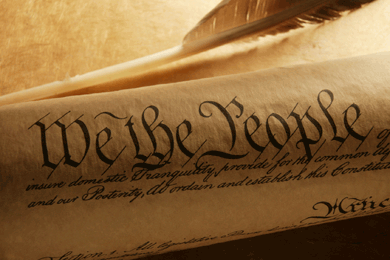
The U.S. Constitution begins "We the People of the United States, in Order to form a more perfect Union, establish Justice, insure domestic Tranquility, provide for the common defense, promote the general Welfare, and secure the Blessings of Liberty to ourselves and our Posterity,
do ordain and establish this Constitution. . ."
Photo: [email protected]
BUILDING ON BRITISH RIGHTS
TO ESTABLISH
THE FRAMEWORK OF FREEDOM
After winning a long, hard war, Americans create the U.S. Constitution on what they like best about the British Constitution. Brits in Britain embark on the struggle to end the slave trade.
While sitting under an English oak in 1787, three young men decide they are going to end the slave trade in British colonies. They are William Pitt the Younger, at twenty-four Britain's youngest Prime Minister, and his friends William Grenville, and William Wilberforce. They decide to act, inspired by Granville Sharp and by another young Brit, Thomas Clarkson.
Photo: www.cheshire.gov.uk
1785 - 1789 THE FIGHT TO END THE SLAVE TRADE BEGINS
Granville Sharp is indefatigable. He has resigned his government job in protest against Britain waging war in America. He has won the Common Law ruling that slavery is illegal in England. Now he becomes Chair of the Committee for the Abolition of the African Slave Trade.
Working with him is Thomas Clarkson, just twenty-five. He has just won a Classics prize at Cambridge for writing an essay in Latin on the subject of slavery. To write it, Clarkson researches his subject, and is appalled at what he learns. Travelling on horseback between Cambridge and London, he experiences what he calls a spiritual revelation from God: "A thought came into my mind, that if the contents of the Essay were true, it was time some person should see these calamities to their end." He devotes his life to abolishing the trade. He translates his essay into English, publishes it, and proceeds to travel 35,000 miles, establishing local anti-slave societies in every city he visits.
Working with Sharp and Clarkson is a small, happy man (“a perfect shrimp who swelled into a whale,” Boswell remarks in his diary) called William ‘Wilber’ Wilberforce. Wilber is independently wealthy and a Member of Parliament with a rapier wit. He, too, has a Christian conversion experience that convinces him that slavery must be abolished. Dying, John Wesley, founder of Methodism, writes his last letter to Wilber, urging him to continue the struggle against slavery. Affirming that they are accountable to Christ, the abolitionists take on the richest and most powerful men in Britain.
1787 - 1791 BUILDING FROM THE PEOPLE UP
Just before the Constitutional Convention meets in Philadelphia, John Adams rushes to publish his ideas about constitutional government. He envisions a republic based on that “most stupendous fabric of human invention” – the British Constitution.
Like their British forbears, Americans are keen to protect themselves from arbitrary, unlimited government. They aim to build a limited government that is founded on the consent of the people and that is designed so governmental abuse of power is prevented. Brits had created a Parliament and an independent judiciary to balance the power of the monarchy and to preserve ancient liberties. In a superb variation of these ideas, Americans create three branches of government that will check and balance each other – a strong, elected executive, an elected legislature with two chambers, and an independent judiciary which delivers justice under law. Under the U.S. Constitution:
In 1791 Americans amend their Constitution, adding a Bill of Rights that has been called the greatest protection of human freedom in the history of the world. Brits in Britain fought for and gained many of the rights and freedoms that are enshrined in the American Bill of Rights. Those rights and freedoms that are in the British Constitution are identified in red.
The U.S. Bill of Rights' Ten Amendments:
1st Amendment
Congress shall make no law respecting an establishment of religion, or prohibiting the free exercise thereof; or abridging the freedom of speech, or of the press; or the right of the people peaceably to assemble, and to petition the Government for a redress of grievances.
2nd Amendment
A well-regulated Militia, being necessary to the security of a free State, the right of the people to keep and bear Arms, shall not be infringed.
3rd Amendment
No Soldier shall, in time of peace be quartered in any house, without the consent of the Owner, nor in time of war, but in a manner to be prescribed by law.4th Amendment
The right of the people to be secure in their persons, houses, papers, and effects, against unreasonable searches and seizures, shall not be violated, and no Warrants shall issue, but upon probable cause, supported by Oath or affirmation, and particularly describing the place to be searched, and the persons or things to be seized.
5th Amendment
No person shall be held to answer for a capital, or otherwise infamous crime, unless on a presentment or indictment of a Grand Jury, except in cases arising in the land or naval forces, or in the Militia, when in actual service in time of War or public danger; nor shall any person be subject for the same offence to be twice put in jeopardy of life or limb, nor shall be compelled in any criminal case to be a witness against himself, nor be deprived of life, liberty, or property, without due process of law; nor shall private property be taken for public use, without just compensation.
6th Amendment
In all criminal prosecutions, the accused shall enjoy the right to a speedy and public trial, by an impartial jury of the State and district wherein the crime shall have been committed; which district shall have been previously ascertained by law, and to be informed of the nature and cause of the accusation; to be confronted with the witnesses against him; to have compulsory process for obtaining witnesses in his favor, and to have the Assistance of Counsel for his defence.
Seventh Amendment
In Suits at common law, where the value in controversy shall exceed twenty dollars, the right of trial by jury shall be preserved, and no fact tried by a jury shall be otherwise re-examined in any Court of the United States, than according to the rules of the common law.
8th Amendment
Excessive bail shall not be required, nor excessive fines imposed, nor cruel and unusual punishments inflicted.
9th Amendment
The enumeration in the Constitution of certain rights shall not be construed to deny or disparage others retained by the people.
10th Amendment
The powers not delegated to the United States by the Constitution, nor prohibited by it to the States, are reserved to the States respectively, or to the people.
Creating the U.S. Constitution was a messy business, an improvisation on the edge of catastrophe. Due to the excellence of its construction the American Constitution survived, and is older than the French, German, Italian, Belgian, Spanish and Greek constitutions combined.
Photo: [email protected]
1790s ALEXANDER HAMILTON BUILDS BRILLIANT FREE MARKET NATION
Born illegitimate on the British island of Nevis, an orphan after his father abandons him and his mother dies, Hamilton goes to work at the age of thirteen in a counting house on St. Croix, and makes a success of it, learning how to make money and lead men. He also learns to hate and despise slavery, and trusts it will be doomed by modern economies.
At seventeen his genius take him to New York and King’s College (now Columbia University) where he throws himself into his studies and the cause of the American Revolution, writing eloquently and raising an artillery company of students. He is brave and efficient in the fighting around the Battle of Long Island, and becomes Washington’s right-hand man during the years of war, winning renown at Yorktown.
After the war he falls in love, marries happily, founds the first American bank, the Bank of New York in 1784, and joins the support for a Constitutional Convention. Throughout the hot summer of 1787 in Philadelphia, Hamilton, who had seen firsthand how a weak government had almost lost the Revolution, argues for a strong central government and president, and for the abolition of slavery.
The Constitution contains checks and balances to power that he did not support, but he campaigns for its ratification, cowriting with John Jay the 85 eloquent Federalist Papers. When the Constitution is passed, and a new government is formed, Hamilton joins George Washington’s Administration as the first Secretary of the Treasury. He establishes the new United States of America as a society based on the principles of Adam Smith with free markets of money, land, and energy, protected by law and nurtured by the public credit, stock and commodity exchanges. In 1791, Hamilton creates the Bank of the United States, the forerunner of the Federal Reserve.
One of Hamilton's core philosophical beliefs: “In matters of industry, human enterprise ought doubtless to be left free in the main, not fettered by too much regulation, but practical politicians know that it may be beneficially stimulated by prudent aids and encouragements on the part of government.” Hamilton would doubtless emphasise the words free in the main and prudent.
1791 THOMAS PAINE FIGHTS WITH HIS PEN FOR THE RIGHTS OF MAN
Not everyone likes Thomas Paine. He was once described as something "between Pig and Puppy." Back in Britain in the 1790s, Paine publishes the Rights of Man. He argues that the “illuminating and divine principle of the equal rights of man. . .has its origin from the Maker of man.”
Paine believes that all too often it is governments that cause the miseries of their people. His observation that public officials avoid taking blame for the mistakes they commit while taking credit for the good they have done nothing to create, may strike a chord.
History convinces Paine that monarchies and dictatorships are militaristic and that persecution is always the feature of a state religion established by law. He advises the Brits to scuttle both titles and Parliament, hold a national convention, and create a republic free of a state church. He adamantly declares, “To say that any people are not fit for freedom is to make poverty their choice.”
He describes high taxes as an unfair burden on the poor, and suggests a form of social security for the aged that would equal the interest they would have received from the money they paid in taxes. Some of his suggestions point to a welfare state, and destroy the rights he wants to protect, but his passionate thinking is always provocative.
1792 MARY WOLLSTONECRAFT FIGHTS WITH HER PEN FOR THE EDUCATION OF WOMEN
The daughter of a Spitalfields handkerchief weaver, Mary Wollstonecraft manages to acquire an education, and open a school for girls. She leaves the school to nurse a friend dying of TB, takes a job as a governess to survive, and writes a novel. Joseph Johnson invites her to work for his journal "Analytical Review", which brings her into contact with radical thinkers. She writes the Vindication of the Rights of Men, where she criticises slavery and the treatment of the poor.
Mary Wollstonecraft's experience of unmarried motherhood bears witness to mistaken passion, self-induced helplessness, and heroism. In her Vindication of the Rights of Women, she advocates education for women, arguing that the rights of men and the rights of women are one and the same.
Four years later she and William Godwin fall in love, and marry. She is 38 when she dies after giving birth to Mary Shelley. Her ideas will inspire 20th century women rights campaigners.
1794 JURY REFUSES TO CONVICT HARDY FOR TREASON
Thomas Hardy (the shoemaker, not the novelist) decides that the Members of the House of Commons do not represent working men and that Parliament’s foreign policy is contributing to his economic distress. In 1792 Hardy and seven other men establish the London Corresponding Society to reform Parliament. Two of their members are arrested and sentenced to 14 years, but Hardy bravely continues. Shortly, he finds himself in the Tower of London on trial for high treason.
The Government mounts a propaganda campaign against him. A mob attacks his house, and his pregnant wife tries to escape through a window. In the shock, the child is stillborn, and Mrs. Hardy dies.
Hardy's trial begins. The prosecution tries to make the case that he and the London Corresponding Society are encouraging people to disobey King and Parliament, but the jury will have none of it, and frees Hardy and his co-defendants. This is a great breakthrough for freedom of association. 19TH CENTURY »
When you contribute to this website,
you support the Best of the Brits.
On his way to London, Thomas Clarkson breaks his journey at Wadesmill, Hertfordshire, shown here, and has a revelation about slavery.
Photo: Blue Tiger
How the campaign to end the slave trade was fought by one of its champions.
For UK orders:
For US orders:
This small pocket book contains two of the essential founding documents of freedom.
For UK orders:
For US orders:
Akhil Reed Amar's close reading of the Constitution has been called exciting and profound.
For UK orders:
For US orders:
Glenn Reynolds of Instapundit » and John Eastman » of the Claremont Institute observe that freedom of the press was given to all people, not just to the press. "Freedom of the Press was designed to protect the published word of all citizens, not just an institutionalized fourth estate."
Modern cynics wish Catherine Drinker Bowen had debunked the Constitutional Convention. Instead her classic book brilliantly reveals what was achieved.
For UK orders:
For US orders:
Chernow's biography of Hamilton has been called superb.
For UK orders:
For US orders: