BRITISH HISTORY
THE STORY of
FREEDOM
1st CENTURY BC -
6th CENTURY AD »
17th CENTURY
1600-1644 »
17th CENTURY
1645-1699 »
20th CENTURY
1946-1999 »
21st CENTURY »
Four crucial ideas emerge as Brits fight for freedom.
FREEDOM NETWORK »
In Australia, votes for women seem natural.
Photo: [email protected]
WOMEN GET VOTE
BRITS FIGHT FOR FREEDOM
IN WORLD WARS
Women risk prison and death to achieve the right to vote. Brits defeat two evil empires, and millions are freed from tyranny. Citizens of the British Empire in India demand self-government.
1902 ALL AUSTRALIAN WOMEN GAIN THE RIGHT TO VOTE, AND TO STAND AS CANDIDATES
Since the 1880s Australian women have heard that giving them the vote will make them vulgar, that women are meant for more sacred things, that they will vote their emotions, and (an unfortunate contradiction) that they will vote exactly as their fathers and husbands do. Some men call suffrage “a craze in the South Seas,” and predict unspecified dire results will follow. But opinions are changing.
In 1900 the people of the Australian states decide to create one federal nation. Women discover they cannot get female suffrage written into Australia's new Constitution, so they go to work to ensure that men who support their cause will be elected to Australia's first Parliament.
In Parliamentary debate, the champions of women affirm that giving women the vote is not a gift to be conferred but a simple act of justice. Women have been obeying laws and paying taxes, and should have a say about both.
The strategy of supporting candidates who will support votes for women is effective. The Australian Parliament passes the Bill, and Australia becomes the first nation in the world where women have both the right to vote and the right to stand as candidates.
1903 – 1905 EMMELINE PANKHURST LAUNCHES CRUSADE FOR WOMEN’S RIGHT TO VOTE IN BRITAIN
Emmeline Pankhurst is a young girl when she hears American suffragette Elizabeth Cady Stanton speak, and becomes convinced women should have the right to vote. Decades later, she is still working for suffrage, and understandably running out of patience. With her daughters she establishes the Women’s Social and Political Union. Their motto, wittily echoing the Royal Society's, is “Deeds, not words.”
Emmeline and her daughter Christobel have the dramatic and autocratic command of great stage directors. Emmeline is described by Rebecca West as trembling like a reed when she lifts “her hoarse, sweet voice on the platform, but the reed was of steel and it was tremendous." Motivated by a passionate sense of fairness, Emmeline is convinced that giving women the vote will change the world for the better.
But the Pankhursts cannot gain media coverage for their cause or interest the men in Parliament in supporting them. The MPs appeared bored with the subject of women’s suffrage. Christabel decides to attract their attention.
1905 WOMEN COMMIT ACTS OF CIVIL DISOBEDIENCE TO AFFIRM THEIR RIGHT TO VOTE
Christabel Pankhurst and Annie Kenney attend a Liberal Party meeting, and insist on repeatedly asking when the Liberal Government will give women the vote. Ejected from the hall, Christabel and Annie are arrested in the street, refuse to pay their fines, and are thrown into prison. The press goes wild, and Emmeline arranges a theatrical welcome home. The Women’s Social and Political Union strews the streets with flowers when Christabel and Annie walk out of jail.
1906 – 1908 WOMEN CAMPAIGN AGAINST UNRESPONSIVE GOVERNMENT AND PREOCCUPIED PM
Daring, energetic, and focused, the Women’s Social and Political Union continues to drum up support for votes for women, and to oppose anti-vote candidates. WSPU members interrupt political meetings to demand that MPs tell them where they stand on women's right to vote. Newspapers disparage them as “suffragettes,” and they proudly adopt the name. Unfortunately the Liberal Government, at best indifferent and at worst antagonistic to a woman's right to vote, is swept into power.

The people who are being denied the right to vote in the early 20th century are "the mother half of the human family." In a huge demonstration, they march in a four-mile-long procession to the Houses of Parliament.
Photo: [email protected]
1908 – 1909 WOMEN APPLY PRESSURE WITH MARCHES AND HUNGER STRIKES
Members of the Women's Social and Political Union march down Downing Street, and throw stones through the Prime Minister’s residence at 10 Downing Street. Twenty-seven are arrested. Still others chain themselves to railings outside Number 10. (The time it takes the police to saw through the chains gives them enough time to make a speech that receives newpaper coverage.) Hundreds are arrested, including Emmeline and Christabel Pankhurst.
In 1909 Suffragette Marion Dunlop is imprisoned, refuses to eat, and goes on a hunger strike. Afraid she may die and become a martyr, the Government releases her. The news flies to other jailed suffragettes, who immediately go on hunger strikes.
When they become dangerously weak, the prison authorities decide to force-feed them. They use doctors and wardresses to hold a prisoner down, force a 2-foot long feeding through her nostrils and down into her stomach, and pour egg and milk down her as she chokes. Reading reports about the procedure in the newspapers, the public is aghast.
Doctors and wardresses enter Emmeline’s cell to force-feed her, but she is so magnificently indignant, they desist. Others are not so lucky. Now in her fifties, Emmeline endures ten hunger strikes.
In the early 19th century the Brits take Cape Town, pictured above. The Dutch living at the Cape push their settlements north, in part because they resent British attempts to regulate labour relations and end slavery. Citizens of the British Empire in Africa call for self-representation as early as 1893.
Photo: window [email protected]
Cape Town from Table Mountain
1909 NON-WHITE CITIZENS PROTEST THE UNION OF SOUTH AFRICA
Living to the north of the Cape colony are the Zulu, and farther north and east, a great slave empire run by Arabs. Within the next ten years, the assaults of the Zulu will send tribe reeling against tribe and thousands of African refugees pouring south sinto the Cape colony and Natal to escape the Mfecane – the Zulu "Crushing".
In 1893 the state of Natal, which includes British and Dutch settlers and blacks, achieves full self-government. Black men who are Christian and educated have the right vote.
The discovery of diamonds and gold bring thousands more to South Africa. The British win the Anglo-Boer war (1899-1902). Winston Churchill, who had made a daring escape from Boer forces and is now a member of the British Government, drafts a Constitution for the Transvaal with universal manhood suffrage, a value he ardently supports.
In 1910 the British Liberal Government allows the Cape Colony, the Natal, the Orange Free State, and the Transvaal to become one nation, but tragically does not protect its black citizens. Thousands of black men, citizens of the British Empire, protest the nation's new constitution which denies them equality with white citizens. Their protest is desperate, brave, and unavailing. The awful injustice of this decision can be summed up in the one word black: Why should any person be described by the colour of their skin rather than the content of their character.
1910 GOVERNMENT DROPS BILL TO GIVE WOMEN THE VOTE; WOMEN PROTEST; ‘BLACK FRIDAY’
On November 18, on what will become known as Black Friday, women try to gain admission to the House of Commons. They are protesting against the Government's dropping of the Conciliation Bill, which would have given them the vote.
Their protest develops into a riot when they try to break through police lines, and are brutally mauled in a six-hour struggle. Badly bruised, the movement to gain women votes continues. It includes women of the Women's Freedom League, and it has, writes Geraldine Lennox, “a spirit that would not sit down under injustice – a spirit meant to get things done.”
1911 PARLIAMENT APPROVES MORE FREQUENT GENERAL ELECTIONS AND LIMITS THE POWER OF THE HOUSE OF LORDS
Parliament approves a Bill for national election every five years. (Elections will be held more often if the Government loses the confidence of the House of Commons.)
The Government threatens to flood the House of Lords with new members unless the Lords agree to drastically limit their power to reject bills approved by the Commons. The House of Lords agrees.
This appears to be a victory for democracy since the House of Lords is an unelected chamber. However, by the end of the 20th century the Lords will defend freedom from attacks by the government.
1912 – 1913 WOMEN ATTACK PROPERTY TO DRAW ATTENTION TO SUFFRAGETTE CAUSE; RESIST CAT-AND-MOUSE ACT
Responding to Government intransigence, in particular its scuttling of the Conciliation Bill that would have given women the vote, Christabel Pankhurst directs attacks against property, including window smashing, picture slashing, and arson. The public finds destruction of golf greens particularly nettlesome. Dozens of suffragettes are arrested. Emmeline is arrested, released, and rearrested 12 times. She eloquently tells the court, “We are here not because we are lawbreakers; we are here in our efforts to become lawmakers.”
The Government passes the 'Cat and Mouse Act', freeing ill hunger strikers until they regain their strength, then imprisoning them when they are strong enough to serve the rest of their sentences. Suffragettes respond heroically to this iniquitous strategy. More than a thousand are jailed.
1914 WOMEN MAKE DRAMATIC SACRIFICE AS WORLD WAR I BEGINS
World War I breaks out, and Emmeline and Christabel Pankhurst call off the suffrage campaign to support the war effort. As Emmeline pragmatically remarks, “What would be the good of a vote without a country to vote in.” In less than a week, the Government releases all suffragist prisoners, and many, but not all, throw themselves into the war effort – working on farms, stoking furnaces, producing munitions, and building ships.
On the eve of World War I Sir Edward Grey declares, "The lamps are going out all over Europe. We shall not see them lit again in our lifetime." More than three million Brits die or are wounded protecting Europe from conquest by Germany.
Britain's Parliament buildings
Photo: [email protected]
1914 BRITS DEFEND NATIONS INVADED BY GERMANY AND AUSTRO-HUNGARIAN EMPIRE
The tragic tale of World War I is said to have begun when the Austro-Hungarian Crown Prince is assassinated in Serbia, and Austria-Hungary retaliates by invading Serbia. But fear and greed lie at the bottom of World War I.
Germany fears a resurgent France, and the German Kaiser has grandiose imperial ambitions. France loathes Germany's acquisition by conquest of Alsace-Lorraine. Russia feels possessive over the Slavic Balkans, and wants to break Ottoman control over the Dardanelles and Bosporus so it can send ships into the Mediterranean. Italy worries about its North African possessions, and covets Austria-Hungary's. Austria-Hungary is determined to keep its empire intact and to maintain its subjection of rebellious Czechs, Slovaks, Poles, Ukrainians, Romanians, Italians, Slovenes, Croats and Serbs. A series of treaties ropes these and other nations together. They are like a group of mountain climbers, each intent on reaching the summit even if it means murder. The fall of just one climber pulls all the others into the yawning chasm of catastrophic war.
Britain tries to arrange a conference of great nations to stop the disaster. According to research in Imperial German archives, opened in the 1960s, the Kaiser is looking for a reason to launch a war against Russia and its ally France, and Serbia provides a handy excuse. For this and other reasons, Britain fails in its peace efforts. Germany attacks Russia because the Kaiser believes that growing Russian military power will soon make German dreams of European domination impossible.
Declaring war against Russia and France, the Kaiser also threatens to invade Belgium. Britain issues an ultimatum, for she is pledged to defend Belgium's neutrality. Germany rejects her ultimatum, and World War I begins in the first week of August, 1914 with Germany declaring war against France; Britain declaring war against Germany; Austria-Hungary declaring war against Russia and Serbia; Britain and France declaring war against Austria-Hungary; and the Ottoman Empire entering the war on Germany's side. Even Japan, linked by treaty to Britain, enters the fray by declaring war on Germany.
The war is fought on the Western and Eastern Fronts, in France, Russia, the Caucasus and Persia, Mesopotamia, Egypt, Italy, Serbia, Greece, Romania, in the North Sea and the Atlantic. Millions of men and women perish. In 1916 and 1917, the neutral United States attempts to mediate a peace, but when Germany declares unrestricted submarine warfare, sinks three US merchant ships, and suggests an alliance with Mexico to retake Texas, New Mexico, and Arizona, the United States enters the war as an ally of Britain. Cuba, Panama, and Brazil, among others, follow suit, and so does China.
The Packe diaries describe a young Brit in the trenches and at home during World War One »
1918 ALLIES DEFEAT GERMANY AND AUSTRIA-HUNGARY
Purchased at enormous human cost, Allied victory in November, 1918, catalyzes the freedom of many peoples. The independent countries of Czechoslovakia, Latvia, Lithuania, Estonia, Poland, Austria, Hungary, the new Kingdom of Serbs, Croats, and Slovenes, and the Republic of Turkey are born. For details on the Brits at war, see WINSTON CHURCHILL, GOING THROUGH HELL, Part 2 »
1918 PARLIAMENT APPROVES VOTES FOR WOMEN
At the end of World War I, Parliament passes the Representation of People Act, which gives votes to women over 30 who are property owners and to property-owning men over 21. Women also become eligible to stand for Parliament. The Act is called a reward for women’s war efforts, and a simple act of justice. Women who do not own property remain unrepresented, but eight million women can now vote, and they do.
The citizens of India, who contribute one million men to Britain's World War One effort, call for self-government. Parliament responds slowly, but positively.
Photo: [email protected]
1919 PARLIAMENT RECOGNISES RIGHTS OF CITIZENS OF THE BRITISH EMPIRE
Born in India and educated in Britain, Mahatma Gandhi is initially a shy, timorous barrister who becomes one of the bravest people on earth. In 1914 Gandhi frankly says that as a citizen of the British Empire he wants and deserves freedom and protection, and in return Britain deserves his support during World War I. Indians show an outpouring of loyalty and goodwill towards Britain, contributing generously to the British war effort with men and resources.
After the war, Indians claim a greater role in governing themselves. Their desire for representative government grows – in part because a subcontinent once divided into 1,000 kingdoms has been united into one nation by Brits; in part because Indians in British schools have learned about freedom; and in part because to live free is a natural desire.
Parliament recognises the justice of Indian calls for self-rule by adopting a policy that calls for "increasing association of Indians in every branch of the administration and the gradual development of self-governing institutions." The Government of India Act of 1919 introduces dual administration, or diarchy, with elected Indian legislators and appointed British officials sharing representative power. The act also expands the central and provincial legislatures and considerably widens the franchise. Portfolios such as agriculture, local government, health, education, and public works are handed to Indians.
These advances, like those in Australia, New Zealand, and Canada, are unprecedented in the history of any empire. However, the steps seem slow to Gandhi and millions of Indians. Their use of nonviolence speeds independence. It is an effective strategy in the British Empire, but might have failed miserably against an empire that lacked respect for civil disobedience and freedom.
1928 PARLIAMENT PASSES EQUAL FRANCHISE ACT
Parliament passes the Act that gives all women over the age of 21 the right to vote. Shortly after the Act is passed, and just a month before it becomes law, Emmeline Pankhurst, who has been working toward this goal for forty-nine years, dies.
1936 THE BATTLE OF CABLE STREET STOPS BLACKSHIRTS FROM ENTERING EAST END
The British Government has turned a blind eye toward Germany's rearmament under the Nazis. Brits do not want another war. The horrific losses of the First War remain a deep wound. Nevertheless there is a growing awareness that the Fascists on the continent are racist and anti-semitic.
In the East End of London, Brits learn that Fascist men in Blackshirts intend to march through Cable Street on September 30. Jews are urgently warned to stay away.
They do not stay away. They join three hundred thousand East Enders, and stop the Blackshirts, who disband in chagrin.
It has been said this was not a good day for free speech, but it seems each side had its say.
The East End will be mercilessly bombed by the German Luftwaffe during World War II.
When you contribute to this website,
you support the Best of the Brits.
Robert Hughes tells a masterful, dramatic, and subtle tale of the founding of Australia.
For UK orders:
For US orders:
"By a free country, I mean a country where people are allowed, so long as they do not hurt their neighbours, to do as they like. I do not mean a country where six men may make five men do exactly as they like."
Lord Salisbury
Emmeline Pankhurst changed the way the world thought about women. Daring, determined, and repeatedly risking her life in hunger strikes, her sweet, steely voice can be heard in this biography.
For UK orders:
For US orders:
William Manchester's biography of Winston Churchill is an enthralling account of Churchill and his time.
For UK orders:
For US orders:
Though there are many fine histories of World War I, Churchill's history of World War I is personal and engrossing.
For UK orders:
For US orders:
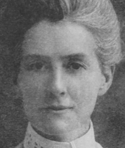
NO WONDER THEY'RE GREAT IF THEIR WOMEN ARE LIKE THAT »
British women nurse the wounded on the battlefields of Europe, and help Allied soldiers escape German capture.
Gandhi in his own words.
For UK orders:
For US orders: