BRITISH HISTORY
THE STORY of
FREEDOM
1st CENTURY BC -
6th CENTURY AD »
17th CENTURY
1600-1644 »
17th CENTURY
1645-1699 »
20th CENTURY
1946-1999 »
21st CENTURY »
Four crucial ideas emerge as Brits fight for freedom.
FREEDOM NETWORK »
Common sense, so often missing-in-action in the modern world, makes a brilliant appearance here.
For UK orders:
For US orders:
McCullough's history, 1776, is a gripping and suspenseful account full of vivid events, including the lightning storm that fell in sheets of fire on Manhattan before the Battle of Long Island.
For UK orders:
For US orders:
Men and women thought Washington was gorgeous and indispensable, but most contemporary paintings and accounts of him are solemn, viz book cover below. In this compact history by Paul Johnson we meet a man who successfully fought for his country and freed his slaves, loved his farm and loved to dance.
For UK orders:
For US orders:
After researching the public and private paers of American revolutionaries, Michael Novak reveals their deeply held religious beliefs, one of two crucial "wings".
For UK orders:
For US orders:
Without John Adams the Revolution might never have succeeded. Without Abigail, John would never have survived. Brilliant, loving, she keeps the farm going and educates the children as John defies the threat of hanging and drowning at sea to win the support of the French and Dutch for the American Revolution. A great fan of the British Constitution, John Adams writes the oldest written constitution still in use in the world today
(Massachusetts) and helps to establish the principles of the U.S. Constitution. McCullough sweeps the reader from 400 mile rides on horseback to the French court in Paris, from mastectomies without anaesthetic to the deepest love between a husband and wife.
For UK orders:
For US orders:
"Proclaim Liberty throughout all the land unto all the inhabitants thereof," says the inscription on the Liberty Bell. Cast in London in 1751, the bell rang for liberty in Independence Hall, Philadelphia, until it cracked.
Photo:[email protected]
WINNING THE REVOLUTION
LINKING LIBERTY
& PROSPERITY
ATTACKING
SLAVERY
American revolutionaries, who began their struggle as Brits, win a long, hard war, and create a new country with a representative government and citizen rights. In this rambunctious century, a Brit also discovers the connection between freedom and prosperity, and five Brits begin the struggle to end the slave trade.
1776 VIRGINIANS PASS BILL OF RIGHTS
On June 12, 1776 Virginians pass a remarkable Bill of Rights. To learn more » This bill contains the spirit of freedom that will animate the Declaration of Independence one month later (and many of the words) and the freedoms enshrined in the Bill of Rights more than ten years later.
The Virginians declare "that all men are by nature equally free and independent, and have certain inherent rights... that all power is vested in, and consequently derived from, the people...that government is, or ought to be, instituted for the common benefit, protection, and security, of the people...that the legislative and executive powers of the state should be separate and distinct from the judicative..."
1776 DECLARING INDEPENDENCE
Brits in America dissolve their ties with Britain on July 4, 1776. In their momentous Declaration of Independence they affirm that:
...all Men are created equal, that they are endowed by their Creator with certain unalienable Rights, that among these are Life, Liberty, and the Pursuit of Happiness. That to secure these Rights, Governments are instituted among Men, deriving their just Powers from the Consent of the Governed, that whenever any Form of Government becomes destructive to these Ends, it is the Right of the People to alter or to abolish it, and to institute a new Government, laying its Foundation on such Principles, and organizing its Powers in such Form, as to them shall seem most likely to effect their Safety and Happiness.
Of the 56 signers of the Declaration, 55 had been born in Britain or were descended from Brits. Many others from Europe and Africa will fight beside them to defend the Declaration of Independence.
1776 - 1783 FIGHTING FOR A REPUBLIC
An East Anglia man, Thomas Paine is unexcited about life as a shopkeeper. With the help of Ben Franklin he sails to America, where he becomes a journalist and a vociferous supporter of the American Revolution.
In 1776 he publishes a bestseller called Common Sense. George Washington believes that Paine’s pamphlet does more to create support for a republic than any other contribution. “We have it in our power,” Paine writes, “to begin the world anew. . .America shall make a stand, not for herself alone, but for the world.”
As the bitter defeats of 1776 corrode hope, and Washington retreats west across New Jersey, Paine makes notes by the light of campfires. These are, as he will write in The American Crisis, “the times that try men’s souls.”
In Peekskill, so many men are without shoes “the blood left on the frozen ground, in many places, marked the route they had taken.” Yet, as they retreat across New Jersey from multiple defeats in New York, the Brits who have come to think of themselves as Americans are “battered, weary, ragged as beggars, but not beaten.”
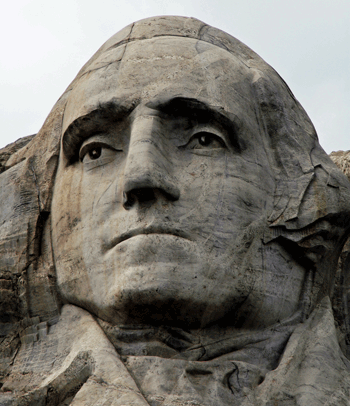
Sounding like the 1st Century Brit Calgacus, Washington tells Americans, “Remember…that you are free men, fighting for the blessings of liberty… slavery will be your portion, and that of your posterity, if you do not acquit yourselves like men.”
Carving of George Washington at Mount Rushmore
Photo: [email protected]
1776 ADAM SMITH SHOWS WHY PROSPERITY DEPENDS ON FREEDOM
In Britain Adam Smith peers into the human character and sees how freedom works for the benefits of people. He recognises that most of us are egoists who want the best for ourselves and that this is a character trait that is unlikely to change. His brilliant insight is that when we have the freedom to create a living for ourselves within a system of just laws, we will cooperate with others to help ourselves, and our cooperation will be good for both ourselves and others.
Adam Smith understands economics mathematically, statistically, psychologically, and morally. He envisions the natural forces of self-interest and freedom combining to create a tide that will lift all boats. For Adam Smith freedom means not only freedom of speech and freedom of religion, but freedom to earn a living, freedom from burdensome taxes and trade restrictions, freedom from excessive government regulations, the freedom to keep your property and to spend your money as you wish.
Adam Smith sees how freedom helps Brits succeed. Their freedoms unleash individual effort and creativity because free individuals protected by just laws create prosperous economies. Free individuals and free markets create the wealth of individuals and nations, while simultaneously raising the standard of living of poor citizens. (Nations that observe Smith’s philosophy of free economies attract immigrants. Very few people are migrating to countries that are not free.)
A significant modern tendency is to see making money as capitalism and capitalism as evil. Adam Smith writes before the words capitalism and capitalists have been coined. He is interested in how men and women can freely earn a living in what might rather be called "people first" economies. He fights the trade monopolies that protect the few at the expense of the many. He denounces the destruction of property rights and free trade in Ireland, which impoverishes the Irish, and makes them vulnerable to famine. He opposes taxes on labour, preferring taxes on luxury consumption because they hurt an economy and most of the people least.
Smith believes government should be limited, but would probably see the reason for government regulation in a case such as the Plimsoll line » He has the endearing habit of giving most of his own money to those in need. He believes that creating wealth must be governed by Christian principles to "do unto others as you would have others do unto you" (Matthew 7:12).
Some blame the world’s ills on capitalism. Wanting the best for others, they like to think they can create ‘utopias’ that control economies and lives. They remain unaware that history repeatedly shows that centrally run economies (by nature not free) are stupid and corrupt. They allow a few people to enrich themselves while rendering everyone else unfree, unhappy, and poor. The poor desperately need property rights, rights for women, freedom of religion, and just laws. They need economies based on the wisdom and energy of millions of free people.
Photo: [email protected]
1776 RICHARD PRICE SUPPORTS AMERICAN REVOLUTION AND REVOLUTIONISES MORALITY, INSURANCE, PENSIONS, AND THE NATIONAL DEBT
In Britain, Richard Price is a dissenting minister with a formidable mind who can explain why he believes reason is the foundation of morality, why the national debt is a bad idea, and how to establish pensions and insurance based on life expectancy. Now almost forgotten, he ardently supports the American Revolution, and publishes two broadsides, Observations on Civil Liberty and Justice and Policy of the War with America, which become bestsellers on both sides of the Atlantic. (Today they are out of print.)
1776 TAKE YOUR CHOICE!
In Britain John Cartwright is inspired by the American argument that taxation should only occur with representation. He applies it to the electoral system in Britain, and finds that system wanting.
In Take Your Choice! Cartwright calls for eliminating property qualifications and giving the vote to all men. He supports a secret ballot that protects every voter’s privacy, and equal electoral districts. In 1793 he will advocate the vote for women. The excesses of the French Revolution will make Brits suspicious of radical change, but Major Cartwright, plagued by bad health and poor finances, will soldier on.
1778-1782 REPEAL OF UNFAIR IRISH & SCOTTISH PENAL LAWS GETS UNDERWAY
Since 1760 some members of Parliament have been trying to repeal the Penal Laws that discriminate so harshly against Catholics in Ireland and Scotland. Finally in 1778 Parliament passes the First Catholic Relief Act, which allows Catholics to inherit and purchase land. Despite rioters who oppose the reforms, Parliament gives the Irish Parliament independence in 1782. Still missing from reform is the vote for Irish Catholics.
1780 BRITS DESTROY OLD NEWGATE PRISON
Two men, John Glover and Benjamin Bowsey, described in newspaper records as 'Black' or 'Mulatto' lead a "riotous and tumultuous assembly" to Newgate Prison "to liberate their honest comrades". They assault the gates, set loose the prisoners, and setting fire to set fire to jail. The destruction of Newgate is against the law, but it is long overdue. It is a horrible, unhealthy place. Glover and Bowsey are pardoned when they agree to serve in the Corps of Footmen.
1782 PARLIAMENT FORCES RESIGNATION OF PRIME MINISTER
Lord North is Prime Minister when the American colonies gain their independence. In a first for Parliament, MPs force him to resign. Until this date the King had dismissed ministers. Now Parliament is claiming this right.
1783 BEGINNING THE WORLD ANEW
It has taken Revolutionary Americans eight years (1775-1783) to win their freedom and to assert the original, radical idea that people can be trusted to govern themselves. The war is won because of their courage and ideas; because they had many British supporters; because the French and the Dutch provide money and the French supply weapons, a naval blockade, and troops; because of the bravery and integrity of George Washington, who despite countless defeats refuses to give up; and because, according to Washington, ‘Divine Providence’ lends a helping hand.
Undoubtedly there are other reasons. One British officer remarked that even if they had conquered all the men in North America they would never be able to conquer the women. To 1787 »
When you contribute to this website,
you support the Best of the Brits.
In his book 1776, McCullough describes a meeting when the war looks grims for Americans, and British Admiral Lord Richard Howe has invited them to parlay. Adams, Benjamin Franklin, and Edward Rutledge are the three selected to go. They are met at Perth Amboy with a British officer who has been sent as a hostage to guarantee their safety, but Adams insists the officer return with them. When Howe realizes the Americans trust his word of honour, he exclaims, "Gentlemen, you make me a very high compliment," and swears their safety will be sacred.
It is not Washington's military skill but his character that leads Americans out of defeat to victory. Fischer shows how in a book with insights on civilian command of the military, Washington's care for his men and prisoners, and his intrepid military action at Trenton.
For UK orders:
For US orders:
Reading Adam Smith, Brits recognise that economic freedom is indispensable to all the other freedoms. Historically the free market has nurtured both political freedom and prosperity.
For UK orders:
For US orders:
Thomas Sowell believes that Adam Smith's theory of free-market economics is one of the most revolutionary concepts to emerge in the history of ideas, and explains why.
For UK orders:
For US orders:
Benson Bobrick's brief account of the American Revolution, which spans 7 years, is vividly illustrated. This is one of many interesting books on the American Revolution.
For UK orders:
For US orders: