BRITISH HISTORY
THE STORY of
FREEDOM
1st CENTURY BC -
6th CENTURY AD »
17th CENTURY
1600-1644 »
17th CENTURY
1645-1699 »
20th CENTURY
1939-1945 »
20th CENTURY
1946-1999 »
21st CENTURY »
Four crucial ideas emerge as Brits fight for freedom.
FREEDOM NETWORK »
The story of the sinking of the City of Benares, a liner carrying children being evacuated from the Blitz to Canada and the United States in 1940 recounts the extraordinary heroism of women and children.
For UK orders:
For US orders:
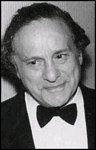
Leo Marks, one of many Jewish people who fought against the Nazis, joined the British SOE. He gave this poem to a fellow agent to use as code behind enemy lines:
The life that I have
Is all that I have
And the life that I have is yours.
The love that I have
Of the life that I have
Is yours and yours and yours.
A sleep I shall have,
A rest I shall have,
Yet death will be but a pause. For the peace of my years in the long green grass
Will be yours and yours and yours.
Viktor Frankl survives the concentration camps, and finds that our deepest desire is for a life of meaning and purpose.
For UK orders:
For US orders:
At the end of World War II, thousands of Londoners were homeless in the worst winter in 50 years, huddling in the Underground, queuing for horsemeat, experiencing devastation and joy.
For UK orders:
For US orders:
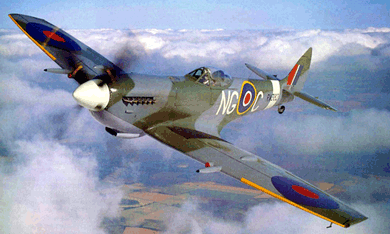
In the summer of 1940, the Battle of Britain rages over the south of England and the Channel. Outnumbered Royal Air Force pilots out fly and outfight the Luftwaffe to prevent the invasion of Britain. Supported by maintenance crews and newly invented radar, they are "the Few" – "Never in the field of human contact was so much owed by so many to so few," says Churchill. Below them in the Channel, the destroyers and battleships of the Royal Navy form another line of defence, protected by the RAF. On the ground I Canadian Corps stands between the German Army and London.
Photo: world-war-2-planes.com »
BRITS FIGHT FOR FREEDOM
IN WORLD WAR II
Brits defeat an evil empire, fighting first alone and then side by side with their Allies.
1939-1945 BRITS FIGHT FOR FREEDOM AND JUSTICE IN WORLD WAR II
For years Winston Churchill has warned of the Nazi menace, and has been ignored:
"If you will not fight for the right when you can easily win without bloodshed; if you will not fight when your victory will be sure and not too costly; you may come to the moment when you will have to fight with all the odds against you and only a small chance of survival. There may even be a worse case: you may have to fight when there is no hope of victory, because it is better to perish than to live as slaves."
Nazi Germany invades Czechoslovakia, Poland, Belgium, the Netherlands, and France. A dark tyranny spreads across Europe. The Brits fight on alone. Winston Churchill, their extraordinary Prime Minister, leads them. See Going Through Hell, Part 3 »

London is bombed. In a row of terraced houses, one is a hole; another is a pile of bricks, the third shows a hand poking out of rubble – small fingers – a child’s hand.
Photo Credit: U.S. National Archives 306-NT-3163V
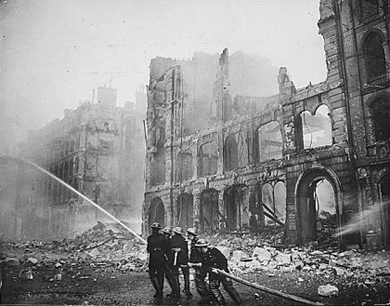
London burns. The House of Commons is bombed into ruins.
Photo Credit: U.S. National Archives 306-NT-901-19
Churchill declares, "We shall fight on the beaches, we shall fight on the landing grounds, we shall fight in the fields and in the streets, we shall fight in the hills; we shall never surrender." Standing with Britain are the people of Canada, Australia, and New Zealand.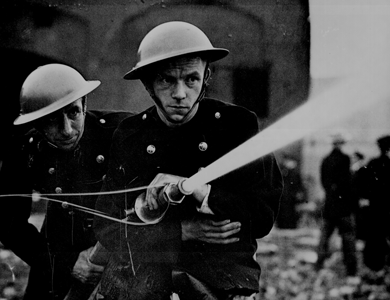
Old and young respond, joining the armed forces or serving at home. According to W.F. Deedes,
writing in the TELEGRAPH, "Thousands of men and boys without weapons rushed forward to fight the prospective German invaders" in the Home Guard ( Dad’s Army)
".
. .Pikes and pitchforks, old shotguns and carving knives lashed on to poles were pressed into service. The Home Guard shares many of the soldier’s hazards and all the risks of civilian life from bombing."
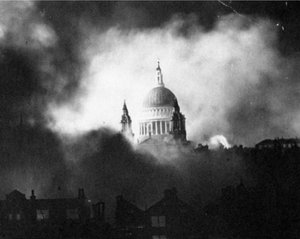
Germany bombs London, Manchester, Liverpool, Belfast, and Glasgow. St. Paul, symbol of British spirit, survives the German Blitz, and the Brits rise to the tremendous challenge of defeating the Nazis.
Photo Credit: U.S. National Archives, 306-NT-3173V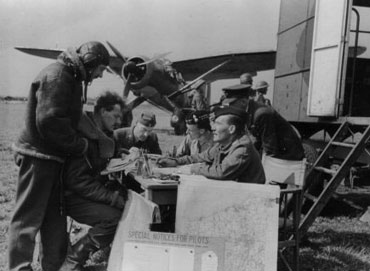
British reconnaissance pilots, just returned from a mission over France, report on German troops to an Air Intelligence Liaison Officer .
Photo: Celia Dibblee Packe »
Her father, Edward Packe, the AILO, is on the right.
Packe served in both world wars.
1941 BRITS AND AMERICANS DECLARE THEIR ALLEGIANCE TO THE PRINCIPLES OF THE ATLANTIC CHARTER
On board ship in the Atlantic in August, 1941, U.S. President Franklin Delano Roosevelt and Churchill make known the principles guiding Britain and America:-
First, their countries seek no aggrandizement, territorial or other;
-
Second, they desire to see no territorial changes that do not accord with the freely expressed wishes of the peoples concerned;
-
Third, they respect the right of all peoples to choose the form of government under which they will live; and they wish to see sovereign rights and self government restored to those who have been forcibly deprived of them;
-
Fourth, they will endeavour, with due respect for their existing obligations, to further the enjoyment by all States, great or small, victor or vanquished, of access, on equal terms, to the trade and to the raw materials of the world which are needed for their economic prosperity;
-
Fifth, they desire to bring about the fullest collaboration between all nations in the economic field with the object of securing, for all, improved labour standards, economic advancement and social security;
-
Sixth, after the final destruction of the Nazi tyranny, they hope to see established a peace which will afford to all nations the means of dwelling in safety within their own boundaries, and which will afford assurance that all the men in all lands may live out their lives in freedom from fear and want;
-
Seventh, such a peace should enable all men to traverse the high seas and oceans without hindrance;
-
Eighth, they believe that all of the nations of the world, for realistic as well as spiritual reasons must come to the abandonment of the use of force. Since no future peace can be maintained if land, sea or air armaments continue to be employed by nations which threaten, or may threaten, aggression outside of their frontiers, they believe, pending the establishment of a wider and permanent system of general security, that the disarmament of such nations is essential. They will likewise aid and encourage all other practicable measures which will lighten for peace loving peoples the crushing burden of armaments.
The Atlantic Charter will lead to the founding of the United Nations, which seemed like a good idea at the time.
BLETCHLEY PARK CRYPTOGRAPHERS DEVELOP BREAKTHROUGHS ESSENTIAL TO WINNING THE WAR AND BUILDING MODERN COMPUTERS
Alan Turing and his Cambridge and Oxford mathematicians and Classical scholars are essential to war efforts as they crack the codes of the Nazi Enigma machine, which set all the Nazis' secret war codes.
Early in the war, Polish heroes brought an Enigma machine they had captured to England, which allowed Turing and his associates to crack the machine, and decode up to 8,500 messages a day in a desperate effort to save Allied shipping from U-Boats in the Battle of the Atlantic.
In 1942 Germans add a fourth code-setting wheel to the Enigma machine and an electric current to swap pairs of letters. When the Royal Navy captures a German submarine with its vital codebooks, Bletchley Park exposes the secrets of this new Enigma machine as well. The ideas developed by these brainy Brits while cracking codes will prove crucial to the development of the modern computer.

In 1943 the Germans destroy the Warsaw Ghetto as part of their Final Solution to kill every Jewish man, woman, and child.
U.S. National Archives, 238-NT-282Brits oppose the Axis Powers that include Nazi Germany, Italy, and Japan in Europe, the jungles of the Far East, the icy waters of the Arctic and North Atlantic, and the deserts of Africa. They fight side by side with American and Dominion Allies – Canadians, Australians, New Zealanders, Indians, and South Africans. As the war goes global, the Allies will include Russians, Free French, Poles, Yugoslavs, Greeks, Chinese, and the remarkable Nepalese Gurkhas, whom Brits call "the bravest of the brave".
The Allies launch D-Day to liberate Europe. They battle to restore freedom, and to end the murderous horrors of the Fascist regimes. Four hundred thousand British men and women die in action. Three hundred thousand are wounded. Sixty thousand British civilians perish. All told, the Allies lose an estimated 12 million people. Civilian casualties around the world reach 50 million.
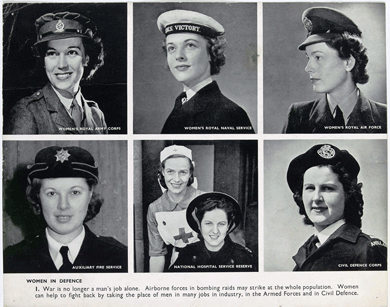
World War II is won with the help of British women who pitch in at farms and factories, and serve in the fire brigades, the WACs (Women's Army Corps), WAAFs (Women's Auxiliary Air Force), ATA (Air Transport Auxiliary), ATS (Auxiliary Territorial Service – the future Queen Elizabeth II serves in the ATS), and the WRENs (Women's Royal Naval Service). No job is too difficult, dangerous, or dirty.
Photo: National Maritime Museum »
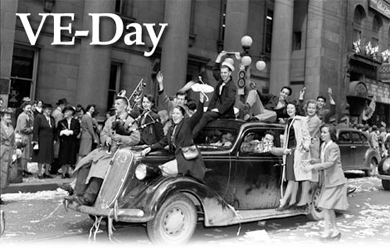
On May 8, 1945, people all around the world – this photo was taken in Canada – celebrate the end of World War II.
Photo Credit: Canadian Broadcasting Corporation »
PLEASE NOTE: If anyone has a photo of the British Army or Navy during World War II that is copyright free, and available for use, we would be very gled to put it up in this section, and to credit the owner.
When you contribute to this website,
you support the Best of the Brits.
Wing Commander
Christopher Frederick
"Bunny" Currant, one of the RAF's best and wittiest fighter pilots.
Called the best war movie ever made in Britain, The First of the Few includes Wing Commander Currant playing himself.
For UK orders:
For US orders:
Beginning with The Gathering Storm , Churchill's history of The Second World War transports the reader from the desperate rescue of the British Army at Dunkirk to the dark and icy struggle to keep supply boats afloat on the Atlantic so Britain did not starve, from the extraordinary and often unseen sacrifice of RAF pilots in the air to the deserts of North Africa and the landing beaches of Europe. Along the way the inner workings of a democracy fighting for its life are laid bare. The six volumes can also be purchased individually.
For UK orders:
For US orders:
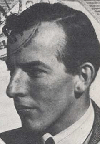
ARMED WITH
AN UMBRELLA »
Digby Tatham-Warter and fellow Brits hold off a SS Panzer Division at the Arnhem Bridge.
William Shirer's harrowing account of World War II makes the justice of the Allied cause blazingly clear.
For UK orders:
For US orders:
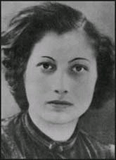
Princess Noor Khan was a Muslim who volunteered to fight the Nazis as a British SOE agent in France. She sent radio reports to London until she was captured, placed in chains and beaten bloody for months. She refused to betray other SOE agents, and was killed with a shot at close range. She died with the word "Liberté!" on her lips.
U.S. veteran pays tribute to his Captain, who died during the Normandy Invasion.
Photo: jplank1807
@istockphoto.com
The TELEGRAPH'S Heroes portrays men and women of uncommon courage, daring and wit. Many of them fought in World War II.
For UK orders
For US orders